

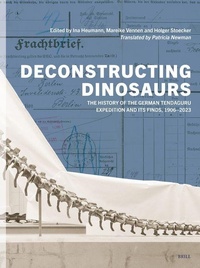
Deconstructing Dinosaurs
The History of the German Tendaguru Expedition and Its Finds, 1906-2023
Published on 12. December 2024
Book
Paperback/Softback
304 pages
978-90-04-69105-6 (ISBN)
Description
Deconstructing Dinosaurs takes a fresh look at the history of the German Tendaguru Expedition (1909-1913), using recently uncovered sources to reveal how Berlin's Natural History Museum appropriated and extracted 225 tonnes of dinosaur fossils from land belonging to modern-day Tanzania. It examines the colonial conditions under which the area's inhabitants located, excavated, and prepared the finds and carried them out of the country's interior to the coast. Once in Berlin, the fossils were transformed into valuable scientific assets and prize exhibits, foremost among them Giraffatitan brancai. This specimen, a prominent subject of provenance and restitution debates, is used to explore the colonial legacy of natural history collections and the social and political responsibilities of the museums that hold them.
More details
Language
English
Place of publication
Leiden
Netherlands
Target group
Professional and scholarly
Product notice
With flaps
Dimensions
Height: 290 mm
Width: 215 mm
Weight
1339 gr
ISBN-13
978-90-04-69105-6 (9789004691056)
Copyright in bibliographic data and cover images is held by Nielsen Book Services Limited or by the publishers or by their respective licensors: all rights reserved.
Schweitzer Classification
Persons
Ina Heumann is a historian of science and co-leads the Humanities of Nature Department at the Museum fuer Naturkunde Berlin. She studies the politics of natural history and is particularly interested in issues of natural history and empire, economies of collections, and the social and political responsibilities of natural history museums.
Bertram Mapunda is a professor of anthropology and history at Jordan University College, Tanzania, where he also serves as college principal. He has edited three books, authored two books, and published over 40 book chapters and journal articles in the fields of archaeometallurgy, public archaeology, heritage management, cultural tourism, and social history.
Michael Ohl is an entomologist and historian of science with the Museum fuer Naturkunde Berlin and a professor at Humboldt University. His main research interests lie in the systematics and phylogeny of insects and in the history of biological classification.
Musa Sadock is a history lecturer and former department chair at the University of Dar es Salaam, Tanzania. His most recent research has focused on the history of smallpox, good governance (in particular, the issue of corruption), and peoples' memories of the German colonial expedition to Tendaguru in southern Tanzania.
Holger Stoecker is a historian who specialises in African-German colonial history and history of science, currently at University of Goettingen. He conducts research into the provenance of human remains and natural history objects from colonial contexts.
Marco Tamborini teaches history and philosophy of science and technology at the Technical University of Darmstadt. His research focuses on the history and philosophy of biology, technoscience, and architecture from the nineteenth century to the present.
Mareike Vennen is a cultural scientist with the Landesarchiv Berlin. After receiving her PhD from Bauhaus-Universitaet Weimar in 2016 and doing postdoctoral research in Berlin at Humboldt-Universitaet and Technische Universitaet, she currently writes on the cultures of natural history collecting and collection ecologies.
Bertram Mapunda is a professor of anthropology and history at Jordan University College, Tanzania, where he also serves as college principal. He has edited three books, authored two books, and published over 40 book chapters and journal articles in the fields of archaeometallurgy, public archaeology, heritage management, cultural tourism, and social history.
Michael Ohl is an entomologist and historian of science with the Museum fuer Naturkunde Berlin and a professor at Humboldt University. His main research interests lie in the systematics and phylogeny of insects and in the history of biological classification.
Musa Sadock is a history lecturer and former department chair at the University of Dar es Salaam, Tanzania. His most recent research has focused on the history of smallpox, good governance (in particular, the issue of corruption), and peoples' memories of the German colonial expedition to Tendaguru in southern Tanzania.
Holger Stoecker is a historian who specialises in African-German colonial history and history of science, currently at University of Goettingen. He conducts research into the provenance of human remains and natural history objects from colonial contexts.
Marco Tamborini teaches history and philosophy of science and technology at the Technical University of Darmstadt. His research focuses on the history and philosophy of biology, technoscience, and architecture from the nineteenth century to the present.
Mareike Vennen is a cultural scientist with the Landesarchiv Berlin. After receiving her PhD from Bauhaus-Universitaet Weimar in 2016 and doing postdoctoral research in Berlin at Humboldt-Universitaet and Technische Universitaet, she currently writes on the cultures of natural history collecting and collection ecologies.