

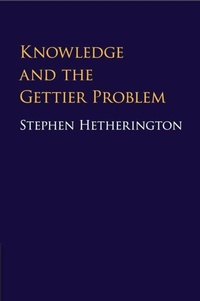
Knowledge and the Gettier Problem
Published on 3. January 2019
Book
Paperback/Softback
253 pages
978-1-316-60397-0 (ISBN)
Description
Edmund Gettier's 1963 verdict about what knowledge is not has become an item of philosophical orthodoxy, accepted by philosophers as a genuine epistemological result. It assures us that - contrary to what Plato and later philosophers have thought - knowledge is not merely a true belief well supported by epistemic justification. But that orthodoxy has generated the Gettier problem - epistemology's continuing struggle to understand how to accommodate Gettier's apparent result within an improved conception of knowledge. In this book, Stephen Hetherington argues that none of epistemology's standard attempts to solve that problem have succeeded: he shows how subtle yet fundamental mistakes - regarding explication, methodology, properties, modality, and fallibility - have permeated those responses to Gettier's challenge. His fresh and original book outlines a new way of solving the problem, and an improved grasp of Gettier's challenge and its significance is the result. In a sense, Plato can now embrace Gettier.
More details
Language
English
Place of publication
Cambridge
United Kingdom
Target group
Professional and scholarly
Product notice
Paperback (trade)
Dimensions
Height: 229 mm
Width: 152 mm
Thickness: 14 mm
Weight
374 gr
ISBN-13
978-1-316-60397-0 (9781316603970)
Copyright in bibliographic data and cover images is held by Nielsen Book Services Limited or by the publishers or by their respective licensors: all rights reserved.
Schweitzer Classification
Other editions
Additional editions
Stephen Hetherington
Knowledge and the Gettier Problem
Book
09/2016
Cambridge University Press
€122.70
Shipment within 15-20 days
Person
Stephen Hetherington is Professor of Philosophy at the University of New South Wales, Sydney. His publications include Epistemology's Paradox (1992), Good Knowledge, Bad Knowledge (2001) and How To Know (2011).
Content
Part I. Introducing Gettierism: 1.1. The year of Gettier; 1.2. Gettierism introduced; 1.3. Gettier cases introduced; 1.4. Gettierism refined; 1.5. Gettierism finalised: individual-Gettierism versus property-Gettierism; 1.6. Gettieristic responses to Gettier cases; 1.7. Supporting Gettierism; Part II. Explicating Gettierism: A General Challenge: 2.1. Introduction; 2.2. The fallibilism underlying Gettierism; 2.3. A general anti-Gettierism argument; 2.3.1. The strategy; 2.3.2. The argument; 2.3.3. Objection: merely definitional?; Part III. Explicating Gettierism: A Case Study: 3.1. Introduction; 3.2 Veritic luck; 3.3. The argument; 3.4. The argument, more metaphysically; 3.5. An alternative Gettieristic interpretation of safety?; 3.6. Belief-forming methods; 3.7. The backward clock; 3.8. The anti-luck intuition supplanted; Part IV. Explicating Gettierism: Modality and Properties: 4.1. Introduction; 4.2. Objection: modal fallacy?; 4.2.1. The objection; 4.2.2. The property of being Gettiered; 4.2.3. Property preclusion; 4.2.4. Predicates for the property of being Gettiered; 4.2.5. Property analysis; 4.3. Objection: another modal fallacy?; 4.3.1. The objection; 4.3.2. The objection's failure; 4.3.3. Individual-Gettierism versus property-Gettierism, again; Part V. Explicating Gettierism: Infallibility Presuppositions: 5.1. A question; 5.2. Some Gettieristic reasoning; 5.3. Realistic possibilities?; 5.4. A case study: virtue-theoretic manifestation; 5.4.1. Sosa/Turri's Gettieristic proposal; 5.4.2. Fallibilism within Gettier's challenge; 5.4.3. Turri's unwitting infallibilism; 5.4.4. A methodological moral; 5.4.5. Manifestation clarified; 5.5. Conclusion; Part VI. Gettierism and its Intuitions: 6.1. Intuitive support?; 6.2. Gettier's fallibilism, again; 6.3. A methodological moral, again; 6.4. A methodological question about Gettieristic assessments; 6.5. A methodological problem for Gettieristic assessments; 6.6. An objection and two replies; 6.7. Conclusion; Part VII. Gettierism Improved: 7.1. A compatibilist aim; 7.2. An old-fashioned account of not being Gettiered; 7.2.1. An internalist condition; 7.2.2. A fallibilist condition; 7.2.3. A non-reductive condition; 7.3. A non-reductive justified-true-belief conception of knowledge.