

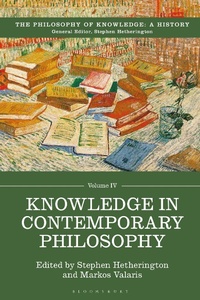
Knowledge in Contemporary Philosophy
Published on 18. April 2024
Book
Paperback/Softback
304 pages
978-1-350-44663-2 (ISBN)
Description
To know epistemology's history is to know better what contemporary epistemology could be and perhaps should be - and what it need not be and perhaps ought not to be.
Knowledge in Contemporary Philosophy introduces many of the more developed ideas, issues, and theories from this past century of epistemological reflection. By doing so, it captures the current concerns of one of Western philosophy's greatest challenges: understanding the nature of knowledge.
Covering recent discussions about scientific, social, and self-knowledge, and more, along with attempts to understand knowledge naturalistically, contextually, and modally, this volume follows conceptions of knowledge that have been proposed, defended, replaced, and proposed anew by contemporary philosophers. Knowledge in Contemporary Philosophy reveals much of what is currently vital and now evolving within epistemology.
Knowledge in Contemporary Philosophy introduces many of the more developed ideas, issues, and theories from this past century of epistemological reflection. By doing so, it captures the current concerns of one of Western philosophy's greatest challenges: understanding the nature of knowledge.
Covering recent discussions about scientific, social, and self-knowledge, and more, along with attempts to understand knowledge naturalistically, contextually, and modally, this volume follows conceptions of knowledge that have been proposed, defended, replaced, and proposed anew by contemporary philosophers. Knowledge in Contemporary Philosophy reveals much of what is currently vital and now evolving within epistemology.
More details
Language
English
Place of publication
London
United Kingdom
Publishing group
Bloomsbury Publishing PLC
Target group
College/higher education
Product notice
Paperback (trade)
Unsewn / adhesive bound
Dimensions
Height: 234 mm
Width: 156 mm
Thickness: 26 mm
Weight
476 gr
ISBN-13
978-1-350-44663-2 (9781350446632)
Copyright in bibliographic data and cover images is held by Nielsen Book Services Limited or by the publishers or by their respective licensors: all rights reserved.
Schweitzer Classification
Persons
Stephen Hetherington is Professor Emeritus of Philosophy at the University of New South Wales, Australia.
Markos Valaris is Associate Professor of Philosophy at the University of New South Wales, Australia.
Markos Valaris is Associate Professor of Philosophy at the University of New South Wales, Australia.
Content
Introduction: Theorizing about Theorizing about Knowledge (Stephen Hetherington and Markos Valaris)
1. Pragmatism and Epistemology (Scott Aikin)
2. On Our Epistemological Debt to Moore and Russell (Claudio de Almeida)
3. What Knowledge Is Not: Reflections on Some Uses of the Verb 'To Know' (Julia Tanney)
4. Naturalistic Descriptions of Knowledge (Kourken Michaelian)
5. Knowing the Unobservable: Confirmation and Theoretical Virtue (Stathis Psillos)
6. Social Knowledge and Social Norms (Peter J. Graham)
7. Knowledge-How and Perceptual Learning (Berit Brogaard)
8. Self-Knowledge (Markos Valaris)
9. Knowledge as Contextual (Michael Blome-Tillmann)
10. Knowledge and Probability (Weng Hong Tang)
11. Analysing the Concept of Knowledge (Duncan Pritchard)
12. Conceiving of Knowledge in Modal Terms? (Stephen Hetherington)
13. Knowledge and Normativity (Clayton Littlejohn)
14. Intellectual Virtue and Knowledge (Heather Battaly)
1. Pragmatism and Epistemology (Scott Aikin)
2. On Our Epistemological Debt to Moore and Russell (Claudio de Almeida)
3. What Knowledge Is Not: Reflections on Some Uses of the Verb 'To Know' (Julia Tanney)
4. Naturalistic Descriptions of Knowledge (Kourken Michaelian)
5. Knowing the Unobservable: Confirmation and Theoretical Virtue (Stathis Psillos)
6. Social Knowledge and Social Norms (Peter J. Graham)
7. Knowledge-How and Perceptual Learning (Berit Brogaard)
8. Self-Knowledge (Markos Valaris)
9. Knowledge as Contextual (Michael Blome-Tillmann)
10. Knowledge and Probability (Weng Hong Tang)
11. Analysing the Concept of Knowledge (Duncan Pritchard)
12. Conceiving of Knowledge in Modal Terms? (Stephen Hetherington)
13. Knowledge and Normativity (Clayton Littlejohn)
14. Intellectual Virtue and Knowledge (Heather Battaly)