

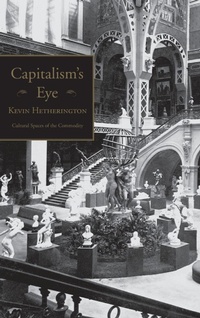
Capitalism's Eye
Cultural Spaces of the Commodity
1st Edition
Published on 20. August 2007
Book
Hardback
232 pages
978-0-415-93340-7 (ISBN)
Description
Capitalism's Eye is an extremely ambitious cultural history of how people experienced commodities in the era of industrial expansion. Writing against the dominant argument that the 'society of the spectacle' emerged fully formed in the mid-nineteenth century, Kevin Hetherington explains that the emergence of a culture of mass consumption dominated by visual experience was a much slower process, not truly ascendant until after the First World War. Looking at the department stores, home life, and the great exhibitions around the turn of the last century, Capitalism's Eye promises to transform how we understand both the cultural history of capitalism in America and Europe and the historical roots of the mediated spectacle that dominates our world today.
More details
Series
Language
English
Place of publication
London
United Kingdom
Publishing group
Taylor & Francis Ltd
Target group
College/higher education
Dimensions
Height: 235 mm
Width: 157 mm
Thickness: 17 mm
Weight
493 gr
ISBN-13
978-0-415-93340-7 (9780415933407)
Copyright in bibliographic data and cover images is held by Nielsen Book Services Limited or by the publishers or by their respective licensors: all rights reserved.
Schweitzer Classification
Other editions
Additional editions
E-Book
02/2011
1st Edition
Routledge
€64.49
Available for download
E-Book
02/2011
1st Edition
Routledge
€64.49
Available for download
Book
08/2007
1st Edition
Routledge
€71.30
Shipment within 15-20 days
Person
Content
1. The Kohinoor Diamond 2. The Civil Inattention of the Object: The Making of the Late-Nineteenth Century Surrounding 3. The Society of Surroundings: Museum, Exhibition, and Shop 4. Kitsch and Clutter: Inhabiting Dream Interiors 5. Borderlands: Scent, Color, and the Middle Class Garden 6. Conservation Surroundings: Spaces of Suspended Time 7. The Japonisation of the Commodity: Lacquer, Surface, and Spectacle 8. Revealed Construction and Aesthetic Subjectivity 9. Conclusion