

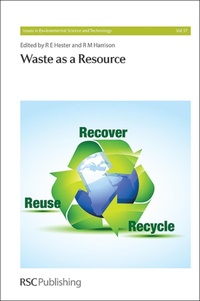
Waste as a Resource
Published on 11. July 2013
Book
Hardback
252 pages
978-1-84973-668-8 (ISBN)
Description
The volume of waste produced by human activity continues to grow, but steps are being taken to mitigate this problem by viewing waste as a resource. Recovering a proportion of waste for re-use immediately reduces the volume of landfill. Furthermore, the scarcity of some elements (such as phosphorous and the rare-earth metals) increases the need for their recovery from waste streams.
This volume of Issues in Environmental Science and Technology examines the potential resource available from several waste streams, both domestic and industrial. Opportunities for exploiting waste are discussed, along with their environmental and economic considerations. Landfill remains an unavoidable solution in some circumstances, and the current situation regarding this is also presented. Other chapters focus on mine waste, the recovery of fertilisers, and the growing potential for compost.
In keeping with the Issues series, this volume is written with a broad audience in mind. University students and active researches in the field will appreciate the latest research and discussion, while policy makers and members of NGOs will benefit from the wealth of information presented.
This volume of Issues in Environmental Science and Technology examines the potential resource available from several waste streams, both domestic and industrial. Opportunities for exploiting waste are discussed, along with their environmental and economic considerations. Landfill remains an unavoidable solution in some circumstances, and the current situation regarding this is also presented. Other chapters focus on mine waste, the recovery of fertilisers, and the growing potential for compost.
In keeping with the Issues series, this volume is written with a broad audience in mind. University students and active researches in the field will appreciate the latest research and discussion, while policy makers and members of NGOs will benefit from the wealth of information presented.
Reviews / Votes
Evezy year, massive and ever-increasing amounts of waste are generated worldwide. This is giving rise to the dualproblem of diminishing resources and overflowing landfills. However, waste can be used as a resource to make new
products, while simultaneously saving landfill space. This book addresses an array of different waste streams (e.g.,
plastic packaging, food wastes, mine wastes, and wastewater) as well as numerous issues associated with converting
waste materials into useful resources. Chapter contributors discuss the use of these diverse waste steams in a
practical manner and from a commercial perspective, rather than in a lab-based research context. They address
chemical and engineering issues in a multidisciplinary approach, but at a level that makes the book more suited to a
teclmical readership than a general audience. Besides describing the chemical, technical, and engineering issues
associated with collection and use of waste streams, a noteworthy feature of this book is that in several chapters, the
authors specifically examine economic and policy issues associated with waste as a resource. Therefore, while the
readership for this book is likely to be multidisciplinary, it is also likely to be a higher-level readership. Summing
Up: Recommended. Graduate students, researchers/faculty, and professionals/practitioners.-- P. G. Heiden,
Michigan Technological University -- P. G. Heiden * CHOICE - Vol. 51 No. 10 *
More details
Series
Language
English
Place of publication
Cambridge
United Kingdom
Target group
College/higher education
Professional and scholarly
Product notice
Unsewn / adhesive bound
Dimensions
Height: 241 mm
Width: 163 mm
Thickness: 21 mm
Weight
576 gr
ISBN-13
978-1-84973-668-8 (9781849736688)
DOI
10.1039/9781849737883
Copyright in bibliographic data and cover images is held by Nielsen Book Services Limited or by the publishers or by their respective licensors: all rights reserved.
Schweitzer Classification
Other editions
Additional editions
R. E. Hester | R. M. Harrison
Waste as a Resource
E-Book
07/2013
1st Edition
Royal Society of Chemistry
€92.99
Available for download
Complete work / Part of the work
Other
10/2013
Royal Society of Chemistry
€212.50
Article not available at the moment
Persons
The series has been edited by Professors Hester and Harrison since it began in 1994.
Professor Roy Harrison OBE is listed by ISI Thomson Scientific (on ISI Web of Knowledge) as a Highly Cited Researcher in the Environmental Science/Ecology category. He has an h-index of 54 (i.e. 54 of his papers have received 54 or more citations in the literature). In 2004 he was appointed OBE for services to environmental science in the New Year Honours List. He was profiled by the Journal of Environmental Monitoring (Vol 5, pp 39N-41N, 2003). Professor Harrison's research interests lie in the field of environment and human health. His main specialism is in air pollution, from emissions through atmospheric chemical and physical transformations to exposure and effects on human health. Much of this work is designed to inform the development of policy.
Now an emeritus professor, Professor Ron Hester's current activities in chemistry are mainly as an editor and as an external examiner and assessor. He also retains appointments as external examiner and assessor / adviser on courses, individual promotions, and departmental / subject area evaluations both in the UK and abroad.
Professor Roy Harrison OBE is listed by ISI Thomson Scientific (on ISI Web of Knowledge) as a Highly Cited Researcher in the Environmental Science/Ecology category. He has an h-index of 54 (i.e. 54 of his papers have received 54 or more citations in the literature). In 2004 he was appointed OBE for services to environmental science in the New Year Honours List. He was profiled by the Journal of Environmental Monitoring (Vol 5, pp 39N-41N, 2003). Professor Harrison's research interests lie in the field of environment and human health. His main specialism is in air pollution, from emissions through atmospheric chemical and physical transformations to exposure and effects on human health. Much of this work is designed to inform the development of policy.
Now an emeritus professor, Professor Ron Hester's current activities in chemistry are mainly as an editor and as an external examiner and assessor. He also retains appointments as external examiner and assessor / adviser on courses, individual promotions, and departmental / subject area evaluations both in the UK and abroad.
Content
1. Advanced Thermal Treatment of Wastes for Fuels, Chemicals and Materials Recovery;
2. Resource Recovery from Mine Waste;
3. Waste to Wealth using Green Chemistry;
4. Recycling of Plastics and Packaging;
5. Phosphorus Recovery from Wastewater;
6. Recent Developments in the Area of Waste as a Resource, with Particular Reference to the Circular Economy as a Guiding Principle;
7. Recycling Policy: The Sound Material Cycle Society and 3R Concepts from Japan to Developing Asia;
8. Composting and Compost;
9. Landfill as a Resource
2. Resource Recovery from Mine Waste;
3. Waste to Wealth using Green Chemistry;
4. Recycling of Plastics and Packaging;
5. Phosphorus Recovery from Wastewater;
6. Recent Developments in the Area of Waste as a Resource, with Particular Reference to the Circular Economy as a Guiding Principle;
7. Recycling Policy: The Sound Material Cycle Society and 3R Concepts from Japan to Developing Asia;
8. Composting and Compost;
9. Landfill as a Resource