

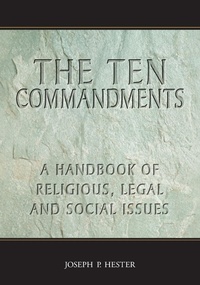
The Ten Commandments
A Handbook of Religious, Legal and Social Issues
2nd Edition
Published on 6. February 2006
Book
Paperback/Softback
291 pages
978-0-7864-2658-4 (ISBN)
Description
The founders of the United States were well aware of religious differences in the new nation. Oppression had forced varied European religious groups to seek homes elsewhere, some in the new world of America. Governmental pressures toward conformity in religion had in the past led to corruption and civil strife. Thus, Congress made a dual assertion in its First Amendment to the Constitution: "Congress shall make no law respecting an establishment of religion, or prohibiting the free exercise thereof." However, the ethical foundations of American society--and therefore its laws--intermingle with the moral codes of religions, including the Judeo-Christian Ten Commandments.
This handbook helps bring understanding and meaning to the controversies that have arisen in present day society over the application of the Ten Commandments to public law and moral problems. Applications can be logical and legal, or can violate the separation of church and state called for in the First Amendment. Part One provides background on the Ten Commandments. It gives the various versions found in the Old Testament, and explains the non-Israelite influences on those versions (the Hammurabi Code, for example). The moral thinking of the ancient Mesopotamian, Egyptian and Hebrew cultures is examined. The modern Jewish tradition is detailed, as well as the different interpretations placed on the Ten Commandments by Roman Catholics, Anglicans, Lutherans and other Protestants. Part Two focuses on the modern controversies, assessing the differing sides of each. Among the many controversies covered are government funding of faith-based charities, posting the Ten Commandments in public buildings, science versus religion in schools, prayer in public places, blue laws, stem cell research, cloning, euthanasia, capital punishment, abortion and war, racial profiling and covenant marriages.
This handbook helps bring understanding and meaning to the controversies that have arisen in present day society over the application of the Ten Commandments to public law and moral problems. Applications can be logical and legal, or can violate the separation of church and state called for in the First Amendment. Part One provides background on the Ten Commandments. It gives the various versions found in the Old Testament, and explains the non-Israelite influences on those versions (the Hammurabi Code, for example). The moral thinking of the ancient Mesopotamian, Egyptian and Hebrew cultures is examined. The modern Jewish tradition is detailed, as well as the different interpretations placed on the Ten Commandments by Roman Catholics, Anglicans, Lutherans and other Protestants. Part Two focuses on the modern controversies, assessing the differing sides of each. Among the many controversies covered are government funding of faith-based charities, posting the Ten Commandments in public buildings, science versus religion in schools, prayer in public places, blue laws, stem cell research, cloning, euthanasia, capital punishment, abortion and war, racial profiling and covenant marriages.
Reviews / Votes
"thorough notes are included...useful...recommended"-Choice; "commentary is balanced and well-researched"-C&RL News; "interesting information"-The Society for Old Testament Study; "useful"-ARBA; "discussion throughtout is comprehensive, lucid and serves in many ways as an introduction to general ethical theory. This is enhanced by extensive references to North American legal cases, bibliographies, references and a glossary"-Theological Book Review.More details
Edition
Second Edition
Language
English
Place of publication
Jefferson, NC
United States
Target group
College/higher education
Professional and scholarly
Interest Age: From 18 years
Product notice
Paperback (trade)
Illustrations
glossary, notes, bibliography, index
Dimensions
Height: 254 mm
Width: 178 mm
Thickness: 15 mm
Weight
512 gr
ISBN-13
978-0-7864-2658-4 (9780786426584)
Copyright in bibliographic data and cover images is held by Nielsen Book Services Limited or by the publishers or by their respective licensors: all rights reserved.
Schweitzer Classification
Other editions
Previous edition

Book
08/2002
McFarland & Co Inc
€72.62
Article exhausted; check for reprint
Person
Now retired, Joseph P. Hester taught at the university level for ten years, at the public school level for ten years, and served as a public school administrator for seventeen years. He holds the Master in Theology from Southeastern Seminary, Wake Forest, and the Ph.D. in Philosophy from the University of Georgia, Athens. He has written extensively on ethics, philosophy and education and is also the author of Ethical Leadership for School Administrators and Teachers and Public School Safety: A Handbook, with a Resource Guide (both in 2003). He lives in Claremont, North Carolina.
Content
Table of Contents
Preface
Introduction
PART I: THE HISTORY AND MEANING
1. Biblical Content
Versions of the Ten Commandments
Analysis of the Ten Commandments
Interpretation of the Ten Commandments
2. Ethical Inquiry and the Development of Morality
Approaches to Ethical Inquiry
The Development of Moral Thinking in Ancient Cultures
Three Types of Religious Ethics
3. Reflective Morality
The Role of Reason in Ethics
Religion as a Type of Ethic
PART II: ISSUES AND CONTROVERSIES
4. Separation of Church and State
Controversy: Funding the Faithful-Faith-Based Initiatives
Controversy: Posting the Ten Commandments in Public Buildings
Controversy: Character Education-What Values Do We Teach?
5. "Thou Shalt Have No Other Gods Before Me"
Controversy: One Nation Under God?
Controversy: Religion, Science, and the Schools-Evolution or Creationism?
Controversy: Prayer in Public Schools
Controversy: Keeping the Sabbath Holy
6. "Thou Shalt Not Kill"
Controversy: Federal Funding of Stem Cell Research-Extending the Cloning Controversy
Controversy: Is Euthanasia Ever Morally Correct?
Controversy: Capital Punishment
Controversy: The Morality (or Immorality) of War
Controversy: Is Abortion Murder?
7. "Thou Shalt Not Bear False Witness"
Controversy: Racial or Religious Profiling
8. "Thou Shalt Not Commit Adultery"
Controversy: Covenant Marriage
Glossary
Notes
Bibliography
Index
Preface
Introduction
PART I: THE HISTORY AND MEANING
1. Biblical Content
Versions of the Ten Commandments
Analysis of the Ten Commandments
Interpretation of the Ten Commandments
2. Ethical Inquiry and the Development of Morality
Approaches to Ethical Inquiry
The Development of Moral Thinking in Ancient Cultures
Three Types of Religious Ethics
3. Reflective Morality
The Role of Reason in Ethics
Religion as a Type of Ethic
PART II: ISSUES AND CONTROVERSIES
4. Separation of Church and State
Controversy: Funding the Faithful-Faith-Based Initiatives
Controversy: Posting the Ten Commandments in Public Buildings
Controversy: Character Education-What Values Do We Teach?
5. "Thou Shalt Have No Other Gods Before Me"
Controversy: One Nation Under God?
Controversy: Religion, Science, and the Schools-Evolution or Creationism?
Controversy: Prayer in Public Schools
Controversy: Keeping the Sabbath Holy
6. "Thou Shalt Not Kill"
Controversy: Federal Funding of Stem Cell Research-Extending the Cloning Controversy
Controversy: Is Euthanasia Ever Morally Correct?
Controversy: Capital Punishment
Controversy: The Morality (or Immorality) of War
Controversy: Is Abortion Murder?
7. "Thou Shalt Not Bear False Witness"
Controversy: Racial or Religious Profiling
8. "Thou Shalt Not Commit Adultery"
Controversy: Covenant Marriage
Glossary
Notes
Bibliography
Index