

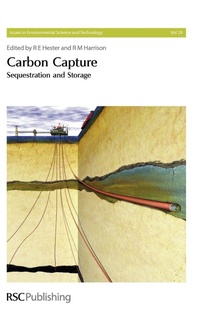
Carbon Capture
Sequestration and Storage
Published on 22. December 2009
Book
Hardback
324 pages
978-1-84755-917-3 (ISBN)
Description
It is widely recognised that global warming is occurring due to increasing levels of carbon dioxide and other greenhouse gases in the atmosphere. Methods of capturing and then storing CO2 from major sources such as fossil-fuel-burning power plants are being developed to reduce the levels emitted to the atmosphere by human activities. The book reports on progress in this field and provides a context within the range of natural absorption processes in the oceans and forests and in soil. Comparisons with alternative energy sources such as solar and nuclear are made and policy issues are also reviewed. This topical book is multi-authored by experts ensuring expertise across the full range of this highly technical but mainstream subject. It is cutting edge science and technology presented in a highly readable form along with an extensive bibliography.
More details
Series
Language
English
Place of publication
Cambridge
United Kingdom
Target group
College/higher education
Professional and scholarly
Product notice
Unsewn / adhesive bound
Dimensions
Height: 236 mm
Width: 157 mm
Thickness: 25 mm
Weight
635 gr
ISBN-13
978-1-84755-917-3 (9781847559173)
DOI
10.1039/9781847559715
Copyright in bibliographic data and cover images is held by Nielsen Book Services Limited or by the publishers or by their respective licensors: all rights reserved.
Schweitzer Classification
Other editions
Additional editions
E-Book
12/2009
1st Edition
Royal Society of Chemistry
€82.49
Available for download
Complete work / Part of the work

Other
05/2013
Royal Society of Chemistry
€255.50
Article not available at the moment
Persons
Ronald E Hester is at the University of York, UK Roy M Harrison OBE is at the University of Birmingham, UK
Content
1. Comparative impacts of fossil fuels and alternative energy sources;
2. Fossil power generation with CCS: policy development for technology deployment;
3. Carbon capture and storage (CCS) in Australia;
4. Underground coal gasification with CCS;
5. Towards zero emission production: potential of carbon capture in an energy intensive industry;
6. Geological storage of CO2;
7. Carbon sequestration in soils;
8. Carbon capture and storage in forests;
9. Carbon uptake, transport and storage by oceans and the consequences of change;
10. Methane biogeochemistry in the Arctic Ocean: hydrates and permafrost
2. Fossil power generation with CCS: policy development for technology deployment;
3. Carbon capture and storage (CCS) in Australia;
4. Underground coal gasification with CCS;
5. Towards zero emission production: potential of carbon capture in an energy intensive industry;
6. Geological storage of CO2;
7. Carbon sequestration in soils;
8. Carbon capture and storage in forests;
9. Carbon uptake, transport and storage by oceans and the consequences of change;
10. Methane biogeochemistry in the Arctic Ocean: hydrates and permafrost