

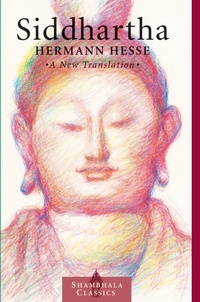
Siddhartha
A New Translation
Published on 19. September 2000
Book
Paperback/Softback
144 pages
978-1-57062-721-7 (ISBN)
Description
This classic of twentieth-century literature chronicles the spiritual evolution of a man living in India at the time of the Buddha-a spiritual journey that has inspired generations of readers. Here is a fresh translation from Sherab Chödzin Kohn, a gifted translator and longtime student of Buddhism and Eastern philosophy. Kohn's flowing, poetic translation conveys the philosophical and spiritual nuances of Hesse's text, paying special attention to the qualities of meditation experience. This edition also includes an introduction exploring Hesse's own spiritual journey as evidenced in his journals and personal letters.
More details
Series
Edition
Revised edition
Language
English
Place of publication
Boston
United States
Product notice
Paperback (trade)
Dimensions
Height: 228 mm
Width: 152 mm
Thickness: 24 mm
Weight
235 gr
ISBN-13
978-1-57062-721-7 (9781570627217)
Copyright in bibliographic data and cover images is held by Nielsen Book Services Limited or by the publishers or by their respective licensors: all rights reserved.
Schweitzer Classification
Other editions
Additional editions
Book
01/2005
Shambhala Publications Inc
€10.00
Available immediately
Persons
Hermann Hesse was born in 1877 in Calw, Germany. He was the son and grandson of Protestant missionaries and was educated in religious schools until the age of thirteen, when he dropped out of school. At age eighteen he moved to Basel, Switzerland, to work as a bookseller and lived in Switzerland for most of his life. His early novels include Peter Camenzind (1904), Beneath the Wheel (1906), Gertrud (1910), and Rosshalde (1914). During this period Hesse married and had three sons.
During World War I Hesse worked to supply German prisoners of war with reading materials and expressed his pacifist leanings in antiwar tracts and novels. Hesse's lifelong battles with depression drew him to study Freud during this period and, later, to undergo analysis with Jung. His first major literary success was the novel Demian (1919).
When Hesse's first marriage ended, he moved to Montagnola, Switzerland, where he created his best-known works: Siddhartha (1922), Steppenwolf (1927), Narcissus and Goldmund (1930), Journey to the East (1932), and The Glass Bead Game (1943). Hesse won the Nobel Prize for Literature in 1946. He died in 1962 at the age of eighty-five.
During World War I Hesse worked to supply German prisoners of war with reading materials and expressed his pacifist leanings in antiwar tracts and novels. Hesse's lifelong battles with depression drew him to study Freud during this period and, later, to undergo analysis with Jung. His first major literary success was the novel Demian (1919).
When Hesse's first marriage ended, he moved to Montagnola, Switzerland, where he created his best-known works: Siddhartha (1922), Steppenwolf (1927), Narcissus and Goldmund (1930), Journey to the East (1932), and The Glass Bead Game (1943). Hesse won the Nobel Prize for Literature in 1946. He died in 1962 at the age of eighty-five.