

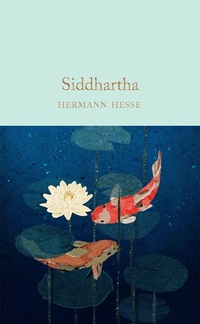
Siddhartha
Published on 1. October 2020
Book
Hardback
208 pages
978-1-5290-2404-3 (ISBN)
Description
Told in a simple mythical style, the story of Siddhartha is an inspirational classic by Hermann Hesse, winner of the Nobel Prize for Literature.
Part of the Macmillan Collector's Library, a series of stunning, clothbound, pocket-sized classics with gold-foiled edges and ribbon markers. These beautiful books make perfect gifts or a treat for any book lover. This edition is translated from German by Hilda Rosner with an introduction by John Peacock.
Siddhartha, the son of a wealthy Brahmin, is unable to find peace within his own religion and community so sets off on his travels through India in search of enlightenment. First he spends time with a group of ascetics called Samanas. For a while he embraces their doctrine and rejects all worldly goods. When he hears about a man called Gotama the Buddha he leaves the Samanas. However Buddhist teaching disappoints him and he realizes that self-discovery must come from his own experiences. He rejects the spiritual life, takes a lover and becomes a rich merchant. But after some years, dissatisfied with materialism, he takes off again in search of the spiritual peace he longs for.
Part of the Macmillan Collector's Library, a series of stunning, clothbound, pocket-sized classics with gold-foiled edges and ribbon markers. These beautiful books make perfect gifts or a treat for any book lover. This edition is translated from German by Hilda Rosner with an introduction by John Peacock.
Siddhartha, the son of a wealthy Brahmin, is unable to find peace within his own religion and community so sets off on his travels through India in search of enlightenment. First he spends time with a group of ascetics called Samanas. For a while he embraces their doctrine and rejects all worldly goods. When he hears about a man called Gotama the Buddha he leaves the Samanas. However Buddhist teaching disappoints him and he realizes that self-discovery must come from his own experiences. He rejects the spiritual life, takes a lover and becomes a rich merchant. But after some years, dissatisfied with materialism, he takes off again in search of the spiritual peace he longs for.
Reviews / Votes
He was an interesting figure who, through his refusal to acknowledge his limitations or the times he lived in, brought something entirely new to the novel -- Philip Hensher * Spectator * A trusted guide for a generation of readers whose faith in institutions was destroyed by the First World War -- Adam Kirsch * New Yorker * A subtle distillation of wisdom, stylistic grace and symmetry of form * The Sunday Times *More details
Series
Language
English
Place of publication
London
United Kingdom
Publishing group
Pan Macmillan
Target group
Interest Age: From 18 years
Dimensions
Height: 152 mm
Width: 97 mm
Thickness: 16 mm
Weight
148 gr
ISBN-13
978-1-5290-2404-3 (9781529024043)
Copyright in bibliographic data and cover images is held by Nielsen Book Services Limited or by the publishers or by their respective licensors: all rights reserved.
Schweitzer Classification
Persons
Hermann Hesse was born in Calw in 1877, a town in the north of the Black Forest. As a child he was constantly at odds with his religious upbringing and education.
His experiences of childhood, adolescence and the desire to break into the world as an artist would form the matter of his first three novels, Peter Camenzind, The Prodigy and Gertrude. Following an ever-present spiritual thirst, Hesse read widely on theosophy, Buddhism and the burgeoning field of psychoanalysis, even becoming a patient of Carl Jung.
This seeking is evident in some of his greatest novels, such as Demian, Steppenwolf, and Siddhartha. Little known outside of Germany at the time of his death in 1962 the arrival of the first English translation of Siddhartha in 1954 struck a chord with the counterculture movement of the 1960s. Soon after, Hesse became one of the most widely read and translated European authors of the 20th century. He was awarded the Nobel Prize for Literature in 1946.
His experiences of childhood, adolescence and the desire to break into the world as an artist would form the matter of his first three novels, Peter Camenzind, The Prodigy and Gertrude. Following an ever-present spiritual thirst, Hesse read widely on theosophy, Buddhism and the burgeoning field of psychoanalysis, even becoming a patient of Carl Jung.
This seeking is evident in some of his greatest novels, such as Demian, Steppenwolf, and Siddhartha. Little known outside of Germany at the time of his death in 1962 the arrival of the first English translation of Siddhartha in 1954 struck a chord with the counterculture movement of the 1960s. Soon after, Hesse became one of the most widely read and translated European authors of the 20th century. He was awarded the Nobel Prize for Literature in 1946.