

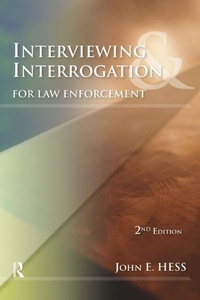
Interviewing and Interrogation for Law Enforcement
2nd Edition
Published on 24. November 2015
Book
Hardback
122 pages
978-1-138-13450-8 (ISBN)
Description
Easy-to-read and practical, this text uses a survey approach and numerous examples to illustrate interviewing skills and techniques. Using his years of experience as an instructor at the FBI Academy, the author dispels some of the mystery surrounding the interview process by sharing techniques and ideas that have been used successfully. The author has years of experience as an FBI academy instructor.
More details
Edition
2nd edition
Language
English
Place of publication
London
United Kingdom
Publishing group
Taylor & Francis Ltd
Target group
College/higher education
Undergraduate Core
Product notice
sewn/stitched
Cloth over boards
Dimensions
Height: 254 mm
Width: 178 mm
Thickness: 8 mm
Weight
435 gr
ISBN-13
978-1-138-13450-8 (9781138134508)
Copyright in bibliographic data and cover images is held by Nielsen Book Services Limited or by the publishers or by their respective licensors: all rights reserved.
Schweitzer Classification
Other editions
Additional editions
E-Book
04/2010
2nd Edition
Routledge
€55.49
Available for download
E-Book
04/2010
2nd Edition
Routledge
€55.49
Available for download
Book
04/2010
2nd Edition
Anderson Publishing
€52.50
Shipment within 10-20 days
Person
John E. Hess has years of experience as an instructor at the FBI Academy.
Content
Part I: Interviewing
1. Structure of an Interview (The steps of an interview from preparation to completion)
2. Demeanor (How actions contribute to success)
3. Essentials (Listening, note-taking, advice of rights)
Part II: Detecting Deception
4. Verbal Clues (Hearing and recognizing lies)
5. Nonverbal Clues (A simplified method of reading body language for deception)
6. Statement Analysis (How language usage can reveal lies)
Part III: Interrogation
7. Structure of an Interrogation (A systematic approach to the basic phases of interrogation)
8. Keys to Success (Persuasion, setting, flexibility, props)
9. Case Study (Example and analysis of an interrogation)
Final Thoughts
1. Structure of an Interview (The steps of an interview from preparation to completion)
2. Demeanor (How actions contribute to success)
3. Essentials (Listening, note-taking, advice of rights)
Part II: Detecting Deception
4. Verbal Clues (Hearing and recognizing lies)
5. Nonverbal Clues (A simplified method of reading body language for deception)
6. Statement Analysis (How language usage can reveal lies)
Part III: Interrogation
7. Structure of an Interrogation (A systematic approach to the basic phases of interrogation)
8. Keys to Success (Persuasion, setting, flexibility, props)
9. Case Study (Example and analysis of an interrogation)
Final Thoughts