

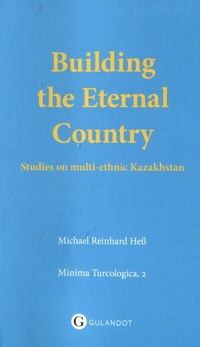
Building the Eternal Country
Studies on muti-ethnical Kazakhstan
1st Edition
Published on 10. April 2021
Book
Paperback/Softback
248 pages
978-3-947057-04-7 (ISBN)
Description
This volume assembles three scholarly contributions on Kazakhstan´s multiethnic composition.
"The state of the Steppe" discusses Kazakhstan´s 2015 celebrations of the 550th anniversary of its statehood. The contribution focusses on the spectacular stage gala given in the Kazakh capital Astana on September 11, 2015. It presents an in-depth analysis of a publicly accessible video recording of the show. The historical elements presented in the show as well as the geopolitical and political context, linguistic and terminological aspects, symbolic and mythological elements, as well as dramaturgical features are investigated with the aim to understand how Kazakhstan used the celebration as an answer to Russian threats both to its existence and its national identity.
"Russians and Kazakhs - a conflict-ridden history seen through Abay´s eyes" analyses the representation of the relationship between the Kazakh and Russian peoples according to selected chapters from Abay´s "Dark Words" (Qara Sözder). The scrutiny is based on the original Kazakh text and discusses Abay´s attitude towards Russians, Kazakhs, and some other ethnic groups. It is demonstrated that Abay applies mitigating literary and argumentative techniques which allow him to combine sharp criticism with a constructive attitude. The importance of these findings for Kazakhstan´s present-day multi-ethnical society is considered as well.
"On Russian and Kazakh influence on Modern Uyghur in Kazakhstan" analyses the linguistic influence of the Russian and Kazakh languages on spoken Modern Uyghur in Kazakhstan. The contribution is based on field research material from Almaty, which is analyzed both with statistical and common linguistic methods. The investigation shows that Russian influence on spoken Modern Uyghur is much more important than Kazakh influence. In a further methodological step, the results of the contribution are projected on theoretical discussions about code-switching, code-mixing, and borrowing/ loans. It is argued that twofold oppositions of these categories are less useful than a more differentiated approach, which takes the intermediary and ambivalent stages into consideration.
"The state of the Steppe" discusses Kazakhstan´s 2015 celebrations of the 550th anniversary of its statehood. The contribution focusses on the spectacular stage gala given in the Kazakh capital Astana on September 11, 2015. It presents an in-depth analysis of a publicly accessible video recording of the show. The historical elements presented in the show as well as the geopolitical and political context, linguistic and terminological aspects, symbolic and mythological elements, as well as dramaturgical features are investigated with the aim to understand how Kazakhstan used the celebration as an answer to Russian threats both to its existence and its national identity.
"Russians and Kazakhs - a conflict-ridden history seen through Abay´s eyes" analyses the representation of the relationship between the Kazakh and Russian peoples according to selected chapters from Abay´s "Dark Words" (Qara Sözder). The scrutiny is based on the original Kazakh text and discusses Abay´s attitude towards Russians, Kazakhs, and some other ethnic groups. It is demonstrated that Abay applies mitigating literary and argumentative techniques which allow him to combine sharp criticism with a constructive attitude. The importance of these findings for Kazakhstan´s present-day multi-ethnical society is considered as well.
"On Russian and Kazakh influence on Modern Uyghur in Kazakhstan" analyses the linguistic influence of the Russian and Kazakh languages on spoken Modern Uyghur in Kazakhstan. The contribution is based on field research material from Almaty, which is analyzed both with statistical and common linguistic methods. The investigation shows that Russian influence on spoken Modern Uyghur is much more important than Kazakh influence. In a further methodological step, the results of the contribution are projected on theoretical discussions about code-switching, code-mixing, and borrowing/ loans. It is argued that twofold oppositions of these categories are less useful than a more differentiated approach, which takes the intermediary and ambivalent stages into consideration.
More details
Person
Author
Turkologe
Michael Reinhard Heß (*1967, PhD Mainz 1997, habilitation 2005), is a Turkologist, lecturer at Justus-Liebig-University Giessen (Germany), and also works as a translator. His research interests include Ottoman and Azerbaijani history, Classical Ottoman and Azerbaijani poetry, modern Turkish literature, Turkish, Bashkir, and Ottoman syntax theory, Uyghur and Kazakh bilingualism, and martyrdom in the Turkic world. He is the author of more than 200 scholarly contributions. Among his recent publications are "Profitable Dying. Turkic Interpretations of Martyrdom" (Aachen: Shaker 2021), "Karabakh from the 13th century to 1920" (Berlin: Gulandot 2020), "In schweren Tagen. Texte und Quellen zu den Uiguren Kasachstans" (Wiesbaden: Harrassowitz, 2019), Two worlds can fit into me, I can not fit into this world". Azerbaijan´s immortal poet Imad?ddin N?simi. Berlin 2019. Gulandot."Blätter aus dem Rosengarten. Beiträge zum deutsch-türkischen Kulturaustausch." (ed., together with Thomas Weiberg. Berlin: Edition orient-al, 2018), "Panzer im Paradies: der Berg-Karabach-Konflikt zwischen Armenien und Aserbaidschan" (Berlin: Dr. Köster, 2016.).
Michael Reinhard Heß (*1967, PhD Mainz 1997, habilitation 2005), is a Turkologist, lecturer at Justus-Liebig-University Giessen (Germany), and also works as a translator. His research interests include Ottoman and Azerbaijani history, Classical Ottoman and Azerbaijani poetry, modern Turkish literature, Turkish, Bashkir, and Ottoman syntax theory, Uyghur and Kazakh bilingualism, and martyrdom in the Turkic world. He is the author of more than 200 scholarly contributions. Among his recent publications are "Profitable Dying. Turkic Interpretations of Martyrdom" (Aachen: Shaker 2021), "Karabakh from the 13th century to 1920" (Berlin: Gulandot 2020), "In schweren Tagen. Texte und Quellen zu den Uiguren Kasachstans" (Wiesbaden: Harrassowitz, 2019), Two worlds can fit into me, I can not fit into this world". Azerbaijan´s immortal poet Imad?ddin N?simi. Berlin 2019. Gulandot."Blätter aus dem Rosengarten. Beiträge zum deutsch-türkischen Kulturaustausch." (ed., together with Thomas Weiberg. Berlin: Edition orient-al, 2018), "Panzer im Paradies: der Berg-Karabach-Konflikt zwischen Armenien und Aserbaidschan" (Berlin: Dr. Köster, 2016.).