

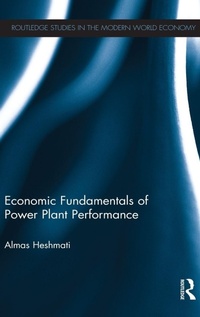
Economic Fundamentals of Power Plant Performance
1st Edition
Published on 20. October 2011
Book
Hardback
348 pages
978-0-415-61004-9 (ISBN)
Description
Stability of the electricity industry is crucial for economic growth of all nations. Sustainable economic growth cannot be accomplished without secured energy supply. The book underlines how management of the electricity industry should be conducted and the efficient form of electricity market structure. The book also studies the electricity industry in Korea which has been a strongly supportive and vital factor in the economic development of Korea for the last few decades.
The book focuses on the three market players of the electricity market and they are the suppliers, consumers and the government-related organizations. It includes detailed information on generation and finances at the generator level and analyzes the efficiency differences among generators, plants and business units by using different performance measurement methods. It identifies and analyzes different production factors' effectiveness and relationships in generation. The comprehensive analysis helps to provide explanations in the differences in the performance of the studied units. The book also discusses the implications of the findings for future resource allocation and how we can further enhance the efficiency of the industry.
The book will appeal to those interested in energy and energy policies, as well as researchers and practitioners in the economic development and electricity and utilities industry.
The book focuses on the three market players of the electricity market and they are the suppliers, consumers and the government-related organizations. It includes detailed information on generation and finances at the generator level and analyzes the efficiency differences among generators, plants and business units by using different performance measurement methods. It identifies and analyzes different production factors' effectiveness and relationships in generation. The comprehensive analysis helps to provide explanations in the differences in the performance of the studied units. The book also discusses the implications of the findings for future resource allocation and how we can further enhance the efficiency of the industry.
The book will appeal to those interested in energy and energy policies, as well as researchers and practitioners in the economic development and electricity and utilities industry.
More details
Language
English
Place of publication
London
United Kingdom
Publishing group
Taylor & Francis Ltd
Target group
College/higher education
Illustrations
141 s/w Abbildungen, 141 s/w Zeichnungen, 99 s/w Tabellen
99 Tables, black and white; 141 Line drawings, black and white; 141 Illustrations, black and white
Dimensions
Height: 240 mm
Width: 161 mm
Thickness: 23 mm
Weight
693 gr
ISBN-13
978-0-415-61004-9 (9780415610049)
Copyright in bibliographic data and cover images is held by Nielsen Book Services Limited or by the publishers or by their respective licensors: all rights reserved.
Schweitzer Classification
Other editions
Additional editions
Almas Heshmati
Economic Fundamentals of Power Plant Performance
Book
09/2013
1st Edition
Routledge
€76.94
Shipment within 15-20 days
Almas Heshmati
Economic Fundamentals of Power Plant Performance
E-Book
06/2013
1st Edition
Routledge
€64.49
Available for download
Almas Heshmati
Economic Fundamentals of Power Plant Performance
E-Book
06/2013
1st Edition
Routledge
€64.49
Available for download
Person
Almas Heshmati is Professor of Economics at Sogang University, South Korea and at Joenkoeping International Business School, Joenkoeping University.
Content
1. Introduction 2. The Korean Electricity Industry 3. Market Structure of the Electricity Industry 4. Global Trends in Electricity Industry and Energy Consumption 5. Overview of Performance Methodologies 6.Previous Efficiency Analysis of Electricity Generation 7. The General Level Data 8. Analysis of Performance at the Generator Level and Policy Implications 9. Summary and Conclusions