

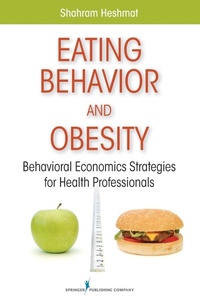
Eating Behavior and Obesity
Behavioral Economics Strategies for Health Professionals
Published on 10. June 2011
Book
Paperback/Softback
356 pages
978-0-8261-0621-6 (ISBN)
Description
Obesity is one of the most pressing health issues affecting our country. This unique volume is the first to apply behavioral economics??the integration of psychological and economic knowledge??to the study of eating behavior. The text demonstrates how this discipline can be used to understand why it so difficult for individuals to control their eating habits, and helps readers use this knowledge to create and improve public health nutrition programs and policies.
The text examines dietary choices and obesity through a multidisciplinary lens of biological, psychological, and social factors, and draws from the disciplines of behavioral economics, nutrition, public health, and health promotion. Based on the premise that humans are hardwired to make judgment errors and need a "nudge" to make decisions in their best interests, the book argues that increasing consumer well-being requires changing an individual's personal environment. It describes the power of irrational forces that compete with sensible judgment in regard to food choices, and provides strategies for improving decisions and health habits. Highly accessible, the text will be of interest to students, professors, and practitioners in nutrition-related health programs, as well as to public health policy makers.
Key Features:
Assesses the social determinants that affect nutrition choices, including food availability, nutrition education, income, culture, and other key factors
Demonstrates how flawed decisions and self-control difficulties can affect eating behavior
Provides a valuable framework for improving public health through understanding and changing the way individuals make food decisions
Explains the link between obesity rates and economics of food choice (fast food, food marketing, and social factors)
Provides strategies and tools to help people improve their decision-making and health habits
The text examines dietary choices and obesity through a multidisciplinary lens of biological, psychological, and social factors, and draws from the disciplines of behavioral economics, nutrition, public health, and health promotion. Based on the premise that humans are hardwired to make judgment errors and need a "nudge" to make decisions in their best interests, the book argues that increasing consumer well-being requires changing an individual's personal environment. It describes the power of irrational forces that compete with sensible judgment in regard to food choices, and provides strategies for improving decisions and health habits. Highly accessible, the text will be of interest to students, professors, and practitioners in nutrition-related health programs, as well as to public health policy makers.
Key Features:
Assesses the social determinants that affect nutrition choices, including food availability, nutrition education, income, culture, and other key factors
Demonstrates how flawed decisions and self-control difficulties can affect eating behavior
Provides a valuable framework for improving public health through understanding and changing the way individuals make food decisions
Explains the link between obesity rates and economics of food choice (fast food, food marketing, and social factors)
Provides strategies and tools to help people improve their decision-making and health habits
More details
Language
English
Place of publication
New York
United States
Target group
Professional and scholarly
Dimensions
Height: 229 mm
Width: 152 mm
Thickness: 14 mm
Weight
379 gr
ISBN-13
978-0-8261-0621-6 (9780826106216)
Copyright in bibliographic data and cover images is held by Nielsen Book Services Limited or by the publishers or by their respective licensors: all rights reserved.
Schweitzer Classification
Person
Shahram Heshmat, PhD, is an Associate Professor of Public Health & Economics at the University of Illinois at Springfield and an Adjunct Associate Professor of Medical Humanities at Southern Illinois University. His research is aimed at understanding the role of emotions in consumer behavior and well-being; applications of the principles of behavioral economics to appetitive behavior, changing health behavior, and designing prevention policies.
Content
1. Overview
2. Eating Behavior and Obesity
3. Basic Economic Concepts
4. An Economic Perspective on Obesity
5. Social Determinants of Health and Obesity
6. Impulsive and Self-Controlled Decisions
7. Choice Over Time
8. Food Addiction
9. Overeating as a Decision Disorder
10. Why Dieters Fail
11. Self-Control Strategies
12. Conclusion
2. Eating Behavior and Obesity
3. Basic Economic Concepts
4. An Economic Perspective on Obesity
5. Social Determinants of Health and Obesity
6. Impulsive and Self-Controlled Decisions
7. Choice Over Time
8. Food Addiction
9. Overeating as a Decision Disorder
10. Why Dieters Fail
11. Self-Control Strategies
12. Conclusion