

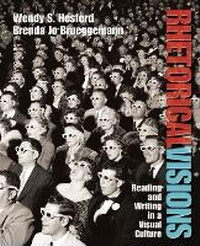
Rhetorical Visions
Reading and Writing in a Visual Culture
Published on 28. December 2006
Book
Paperback/Softback
656 pages
978-0-13-177345-5 (ISBN)
Description
A thematic, visual reader for courses in composition and cultural studies.
Rhetorical Visions is the visual reader with the most support for analytical writing.
This thematic, visual reader uses rhetoric as the frame for investigating the verbal and visual texts of our culture. Rhetorical Visions is designed to help tap into the considerable rhetorical awareness that students already possess, in order to to help them put their insights into words in well-crafted academic papers and projects.
In order to exercise their analytical reading and writing skills, Rhetorical Visions provides occasions for students to explore and apply key rhetorical concepts such as narrative, description, interpretation, genre, context, rhetorical appeals (ethos, logos, pathos), and memory to the analysis of print and non-print texts.
Rhetorical Visions is the visual reader with the most support for analytical writing.
This thematic, visual reader uses rhetoric as the frame for investigating the verbal and visual texts of our culture. Rhetorical Visions is designed to help tap into the considerable rhetorical awareness that students already possess, in order to to help them put their insights into words in well-crafted academic papers and projects.
In order to exercise their analytical reading and writing skills, Rhetorical Visions provides occasions for students to explore and apply key rhetorical concepts such as narrative, description, interpretation, genre, context, rhetorical appeals (ethos, logos, pathos), and memory to the analysis of print and non-print texts.
Reviews / Votes
Rhetorical Visions uses the visual world that college freshmen live in and turns it into a rhetorical learning place."Beverly Neiderman, Kent State University
"From silence and passive immersion, students are brought into articulate and critical engagement
with the world of images and texts, and thereby, with the world itself."
Adrielle Mitchell, Nazareth College of Rochester
"...[U]nlike many texts I have used to teach composition, the connections between key rhetorical elements and the thematic readings are
clear and coherent, challenging students to make connections between the two as they read..."
Justin Bain, Westminster College
More details
Language
English
Place of publication
United States
Publishing group
Pearson Education (US)
Target group
Professional and scholarly
Dimensions
Height: 235 mm
Width: 191 mm
ISBN-13
978-0-13-177345-5 (9780131773455)
Copyright in bibliographic data and cover images is held by Nielsen Book Services Limited or by the publishers or by their respective licensors: all rights reserved.
Schweitzer Classification
Content
Table of Contents
Preface: About This Book
CHAPTER I
INTRODUCTION: RHETORICAL VISIONS
Rhetoric: All the Available Means of Persuasion
Understanding Rhetorical Context
Rhetor
Audience
Text
Rhetorical Analysis: A Summation
The Political Power of Rhetoric
The Rhetorical Gaze
Identification and Difference
CHAPTER II
READINGAND WRITING RHETORICALLY
Analysis and Genesis: Twin Rhetorical Acts
Form and Content: The "How" and "What" of Rhetorical Analysis
KRC's: Tools of Rhetorical Analysis
Writing Rhetorical Texts
Invention
Arrangement
Style
Memory
Delivery
Explication and Analysis
Sample Student Text
READINGS
CHAPTER III
FAMILIAL GAZES: REWORKING THE FAMILY ALBUM
Key Rhetorical Concepts: memory, description, interpretation, narrative
Critical Frame
Archives and Familial Gazes
Reading Family Photographs: Moving from Description to Interpretation
What is Seen
What is Not Seen
Reading Contexts
Linking Family Stories
Popular Images of the American Family
Memory and Interpretation
Readings
Maxine Hong Kingston, "Photograph of My Parents" Memoir
bell hooks, "In Our Glory: Photography and Black Life" Essay
Mark Jeffreys, "The Visible Cripple (Scars and Other Disfiguring
Displays Included)" Essay/Memoir
Annette Kuhn, "Remembrance" Essay/Memoir
Connie May Fowler, "No Snapshots in the Attic: A Grandmother's
Search for a Cherokee Past" Memoir
Dorothy and Thomas Hoobler, "La Familia" Interview/Memoir
Tomas Rivera, "The Portrait" Short Story
Jeffrey Wolin, Images from Written in Memory: Portraits of the Holocaust Portraits
Marianne Hirsch, "Reframing the Human Family Romance" Essay
Sharon Olds, "I Go Back to May 1937" Poem
- "Looking at Them Asleep" Poem
CHAPTER IV
NATIONAL GAZES: WITNESSING NATIONS
Key Rhetorical Concepts: context, metonymy, metaphor
Critical Frame
Intersections: Familial and National Gazes
The Rhetorical Work of Memorials
Reading Contexts through Metaphor and Metonymy
Remembrance: Rituals and Collective Identification
Readings
Dinitia Smith, "Slave Site as Memorial for Freedom" Newspaper Article
Marita Sturken, "The Image as Memorial" Essay
Roadside memorials Photographs
Diana Taylor,"Lost in the Field of Vision: Witnessing September 11" Essay
Four Images from the Franklin Delano Roosevelt Archives Portraits
Wendy Kozol, "The Kind of People Who Make Good Americans" Essay
The U.S. Flag as Cultural Icon Photographs
Aurora Morales, "Child of the Americas" Poem
Robert Kaplan, "The Rusted Iron Curtain" Essay
Maya Angelou, "Champion of the World" Memoir
Orlando Patterson and Jason Kaufman, "Bowling for Democracy" Op-Ed
CHAPTER V
TRAVELING GAZES: SHAPING MOBILE IDENTITIES
Key Rhetorical Concepts: identification and difference
Critical Frame
Identifying Tourists and Tourism
Troubling Binaries
The Economics of Tourism
Far and Away Places
Touring Differently
Readings
Elizabeth Bishop, "Questions of Travel" Poem
Adrienne Rich, "Atlas of the World" Poem
Catherine Lutz and Collins, "The Photograph as an Intersection of Gazes" Essay
Travel to India Recruitment poster/
Web page
James Clifford, "White Ethnicity" Essay
John Hockenberry, "Walking with the Kurds" Memoir
Jamaica Kincaid, "A Small Place" Essay
Haunani-Kay Trask, "Tourists, Stay Home" Essay
Evelyn Alsultany, "Los Intersticos: Recasting Moving Selves" Essay
Audre Lorde, "The Fourth of July" Memoir
Lilo and Stitch Movie poster
Lisa Nakamura, "Where Do You Want to Go Today? Cybernetic Tourism,
the Internet, and Transnationality" Essay
Jane Kuenz, "It's a Small World" Essay
CHAPTER VI
CONSUMER GAZES: MADE IN THE USA?
Key Rhetorical Concepts: the appeals: logos, pathos, ethos
Critical Frame
Consumer Appeal
Logic, Ethics, and Emotion in Ads
Consuming College
Readings
Cynthia Enloe, "The Globetrotting Sneaker" Essay
Adbusters Advertisements
Charles Kernaghan, "An Appeal to Walt Disney" Letter
Martin Espada, "Coca Cola and Coco Frio" Poem
Espada/ the Nike Corporation Letters
Liza Featherstone, "Student Activists versus the Corporate University" Essay
Child labor Photographs
Sweatshop Poems
Denise Duhamel, "Manifest Destiny" Poem
Robert Pinsky, "Shirt" Poem
Naomi Shihab Nye, "Catalogue Army" Poem
Barbara Ehrenreich, "Maid to Order" Essay
Pam Spaulding, "New York City 1989" Portrait
Barbie/Doll Suite
Heid E. Erdrich, "Butter Maiden and Maize Girl Survive Death Leap" Poem
Susan Deer Cloud "Her Pocahontas" Poem
Denise Duhamel, "Oriental Barbie" Poem
--, "Buddha Barbie" Poem
Rabbi Susan Schnur, "Barbie Does Yom Kipper" Essay
Sarala Nagala, "'Om' Hinduism in American Popular Culture:
Global Strategy or Sacrilegious Mistake?" Essay
CHAPTER VII
DOCUMENTARY GAZES: REPRESENTING HISTORY
Key Rhetorical Concepts: documentary, genre, kairos
Critical Frame
Understanding (the) Genre
Documentary Images at War
Interventionist and Humane Gazes
Documentary as Advocacy
Documentary Outlaws: Challening Audience Expectations
Readings
Michael Ignatieff, "The Stories We Tell: Television and Humanitarian Aid" Essay
Susan Sontag, "Regarding the Pain of Others" Essay
Barbie Zelizer, "Conveying Atrocity in Image" Essay
Robert Coles, "The Tradition: Fact and Fiction" Essay
Paul Fischer, "Moore's Lore Re-evaluates U.S. Gun Culture" Interview
Georgina Kleege, "Dream Museum: Blindness, Language, and Visual Art" Essay
Rosemarie Garland-Thomson, "The Politics of Staring: Visual Rhetorics
of Disability in Popular Photography" Essay
Catherine Filloux "Photographs from S-21" Play
Photography, Art, Blindness Photographs/
Catalog cover
CHAPTER VIII
DOING RESEARCH
Selection and Analysis of Primary Texts
Collect a set of primary sources and begin taking notes.
Select analytical tools to guide your analysis.
Analyze your primary sources.
Identify a representational trend.
Develop a preliminary argument.
Research and Annotation
Search library databases and websites.
Evaluate the quality and relevance of sources.
Genre
Subheadings and text features
Read and take notes on sources.
Drafting and Revision
The Annotated Bibliography
Bibliographic entry
Annotation: Summary
Evaluation
The Research Prospectus
Situating your topic: background and content
Situating the problem: kairos, or exigency
Situating your audience: significance
Situating your authority: ethos
Writing the (Draft) Research Paper
Describe and analyze primary sources.
Introduce secondary sources.
Refine and complicate your initial thesis.
Arrange the research paper draft.
Organize analytical claims and support.
Generate and place revised thesis.
Consider introductions.
Consider conclusions.
Finishing the Paper
APPENDIX
CONVERSATIONS ACROSS SECTIONS: ASSIGNMENT SEQUENCES
Sequence 1: Reworking the Family Album [Familial and National]
Sequence 2: Racing the Nation/Erasing Discrimination [National/Documentary Gazes]
Sequence 3: Under Western Eyes [Consumer/Traveling Gazes]
Sequence 4: Normalizing Gazes [multiple sections]
Preface: About This Book
CHAPTER I
INTRODUCTION: RHETORICAL VISIONS
Rhetoric: All the Available Means of Persuasion
Understanding Rhetorical Context
Rhetor
Audience
Text
Rhetorical Analysis: A Summation
The Political Power of Rhetoric
The Rhetorical Gaze
Identification and Difference
CHAPTER II
READINGAND WRITING RHETORICALLY
Analysis and Genesis: Twin Rhetorical Acts
Form and Content: The "How" and "What" of Rhetorical Analysis
KRC's: Tools of Rhetorical Analysis
Writing Rhetorical Texts
Invention
Arrangement
Style
Memory
Delivery
Explication and Analysis
Sample Student Text
READINGS
CHAPTER III
FAMILIAL GAZES: REWORKING THE FAMILY ALBUM
Key Rhetorical Concepts: memory, description, interpretation, narrative
Critical Frame
Archives and Familial Gazes
Reading Family Photographs: Moving from Description to Interpretation
What is Seen
What is Not Seen
Reading Contexts
Linking Family Stories
Popular Images of the American Family
Memory and Interpretation
Readings
Maxine Hong Kingston, "Photograph of My Parents" Memoir
bell hooks, "In Our Glory: Photography and Black Life" Essay
Mark Jeffreys, "The Visible Cripple (Scars and Other Disfiguring
Displays Included)" Essay/Memoir
Annette Kuhn, "Remembrance" Essay/Memoir
Connie May Fowler, "No Snapshots in the Attic: A Grandmother's
Search for a Cherokee Past" Memoir
Dorothy and Thomas Hoobler, "La Familia" Interview/Memoir
Tomas Rivera, "The Portrait" Short Story
Jeffrey Wolin, Images from Written in Memory: Portraits of the Holocaust Portraits
Marianne Hirsch, "Reframing the Human Family Romance" Essay
Sharon Olds, "I Go Back to May 1937" Poem
- "Looking at Them Asleep" Poem
CHAPTER IV
NATIONAL GAZES: WITNESSING NATIONS
Key Rhetorical Concepts: context, metonymy, metaphor
Critical Frame
Intersections: Familial and National Gazes
The Rhetorical Work of Memorials
Reading Contexts through Metaphor and Metonymy
Remembrance: Rituals and Collective Identification
Readings
Dinitia Smith, "Slave Site as Memorial for Freedom" Newspaper Article
Marita Sturken, "The Image as Memorial" Essay
Roadside memorials Photographs
Diana Taylor,"Lost in the Field of Vision: Witnessing September 11" Essay
Four Images from the Franklin Delano Roosevelt Archives Portraits
Wendy Kozol, "The Kind of People Who Make Good Americans" Essay
The U.S. Flag as Cultural Icon Photographs
Aurora Morales, "Child of the Americas" Poem
Robert Kaplan, "The Rusted Iron Curtain" Essay
Maya Angelou, "Champion of the World" Memoir
Orlando Patterson and Jason Kaufman, "Bowling for Democracy" Op-Ed
CHAPTER V
TRAVELING GAZES: SHAPING MOBILE IDENTITIES
Key Rhetorical Concepts: identification and difference
Critical Frame
Identifying Tourists and Tourism
Troubling Binaries
The Economics of Tourism
Far and Away Places
Touring Differently
Readings
Elizabeth Bishop, "Questions of Travel" Poem
Adrienne Rich, "Atlas of the World" Poem
Catherine Lutz and Collins, "The Photograph as an Intersection of Gazes" Essay
Travel to India Recruitment poster/
Web page
James Clifford, "White Ethnicity" Essay
John Hockenberry, "Walking with the Kurds" Memoir
Jamaica Kincaid, "A Small Place" Essay
Haunani-Kay Trask, "Tourists, Stay Home" Essay
Evelyn Alsultany, "Los Intersticos: Recasting Moving Selves" Essay
Audre Lorde, "The Fourth of July" Memoir
Lilo and Stitch Movie poster
Lisa Nakamura, "Where Do You Want to Go Today? Cybernetic Tourism,
the Internet, and Transnationality" Essay
Jane Kuenz, "It's a Small World" Essay
CHAPTER VI
CONSUMER GAZES: MADE IN THE USA?
Key Rhetorical Concepts: the appeals: logos, pathos, ethos
Critical Frame
Consumer Appeal
Logic, Ethics, and Emotion in Ads
Consuming College
Readings
Cynthia Enloe, "The Globetrotting Sneaker" Essay
Adbusters Advertisements
Charles Kernaghan, "An Appeal to Walt Disney" Letter
Martin Espada, "Coca Cola and Coco Frio" Poem
Espada/ the Nike Corporation Letters
Liza Featherstone, "Student Activists versus the Corporate University" Essay
Child labor Photographs
Sweatshop Poems
Denise Duhamel, "Manifest Destiny" Poem
Robert Pinsky, "Shirt" Poem
Naomi Shihab Nye, "Catalogue Army" Poem
Barbara Ehrenreich, "Maid to Order" Essay
Pam Spaulding, "New York City 1989" Portrait
Barbie/Doll Suite
Heid E. Erdrich, "Butter Maiden and Maize Girl Survive Death Leap" Poem
Susan Deer Cloud "Her Pocahontas" Poem
Denise Duhamel, "Oriental Barbie" Poem
--, "Buddha Barbie" Poem
Rabbi Susan Schnur, "Barbie Does Yom Kipper" Essay
Sarala Nagala, "'Om' Hinduism in American Popular Culture:
Global Strategy or Sacrilegious Mistake?" Essay
CHAPTER VII
DOCUMENTARY GAZES: REPRESENTING HISTORY
Key Rhetorical Concepts: documentary, genre, kairos
Critical Frame
Understanding (the) Genre
Documentary Images at War
Interventionist and Humane Gazes
Documentary as Advocacy
Documentary Outlaws: Challening Audience Expectations
Readings
Michael Ignatieff, "The Stories We Tell: Television and Humanitarian Aid" Essay
Susan Sontag, "Regarding the Pain of Others" Essay
Barbie Zelizer, "Conveying Atrocity in Image" Essay
Robert Coles, "The Tradition: Fact and Fiction" Essay
Paul Fischer, "Moore's Lore Re-evaluates U.S. Gun Culture" Interview
Georgina Kleege, "Dream Museum: Blindness, Language, and Visual Art" Essay
Rosemarie Garland-Thomson, "The Politics of Staring: Visual Rhetorics
of Disability in Popular Photography" Essay
Catherine Filloux "Photographs from S-21" Play
Photography, Art, Blindness Photographs/
Catalog cover
CHAPTER VIII
DOING RESEARCH
Selection and Analysis of Primary Texts
Collect a set of primary sources and begin taking notes.
Select analytical tools to guide your analysis.
Analyze your primary sources.
Identify a representational trend.
Develop a preliminary argument.
Research and Annotation
Search library databases and websites.
Evaluate the quality and relevance of sources.
Genre
Subheadings and text features
Read and take notes on sources.
Drafting and Revision
The Annotated Bibliography
Bibliographic entry
Annotation: Summary
Evaluation
The Research Prospectus
Situating your topic: background and content
Situating the problem: kairos, or exigency
Situating your audience: significance
Situating your authority: ethos
Writing the (Draft) Research Paper
Describe and analyze primary sources.
Introduce secondary sources.
Refine and complicate your initial thesis.
Arrange the research paper draft.
Organize analytical claims and support.
Generate and place revised thesis.
Consider introductions.
Consider conclusions.
Finishing the Paper
APPENDIX
CONVERSATIONS ACROSS SECTIONS: ASSIGNMENT SEQUENCES
Sequence 1: Reworking the Family Album [Familial and National]
Sequence 2: Racing the Nation/Erasing Discrimination [National/Documentary Gazes]
Sequence 3: Under Western Eyes [Consumer/Traveling Gazes]
Sequence 4: Normalizing Gazes [multiple sections]