

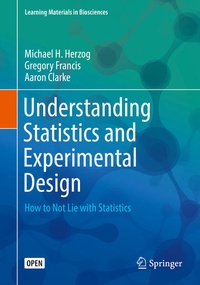
Understanding Statistics and Experimental Design
How to Not Lie with Statistics
Published on 22. August 2019
Book
Paperback/Softback
XI, 142 pages
978-3-030-03498-6 (ISBN)
Description
This open access textbook provides the background needed to correctly use, interpret and understand statistics and statistical data in diverse settings. Part I makes key concepts in statistics readily clear. Parts I and II give an overview of the most common tests (t-test, ANOVA, correlations) and work out their statistical principles. Part III provides insight into meta-statistics (statistics of statistics) and demonstrates why experiments often do not replicate. Finally, the textbook shows how complex statistics can be avoided by using clever experimental design. Both non-scientists and students in Biology, Biomedicine and Engineering will benefit from the book by learning the statistical basis of scientific claims and by discovering ways to evaluate the quality of scientific reports in academic journals and news outlets.
Reviews / Votes
"Readers with little or no background in statistics will appreciate how these fundamental concepts are so well illustrated in this book to establish the solid foundation of probability and statistics." (David Han, Mathematical Reviews, April, 2020)"Readers with little or no background in statistics will appreciate how these fundamental concepts are so well illustrated in this book to establish the solid foundation of probability and statistics." (David Han, Mathematical Reviews, April, 2020)
More details
Product info
Book
Series
Edition
1st ed. 2019
Language
English
Place of publication
Cham
Switzerland
Publishing group
Springer International Publishing
Target group
Professional and scholarly
College/higher education
Illustrations
29 farbige Abbildungen, 6 s/w Abbildungen
XI, 142 p. 35 illus., 29 illus. in color.
Dimensions
Height: 240 mm
Width: 168 mm
Thickness: 9 mm
Weight
306 gr
ISBN-13
978-3-030-03498-6 (9783030034986)
DOI
10.1007/978-3-030-03499-3
Schweitzer Classification
Persons
Michael Herzog is a professor at the EPFL in Switzerland. He studied Mathematics, Biology, and Philosophy at the Universities of Erlangen, Tübingen, and MIT. His primary area of research is the field of vision using all sorts of experimental designs including psychophysical methods, TMS, EEG, and mathematical modeling.
Greg Francis is a professor of Psychological Sciences at Purdue University. His primary area of research develops and tests computational neural network models of human visual perception. A secondary area of interest explores how to identify faulty uses of statistics, such as publication bias and questionable research practices. He also applies cognitive models to topics in human factors and develops on-line teaching tools.
Aaron Clarke is a professor at Bilkent University. He is a psychologist by training with a special emphasis on computational neuroscience and statistics.
Greg Francis is a professor of Psychological Sciences at Purdue University. His primary area of research develops and tests computational neural network models of human visual perception. A secondary area of interest explores how to identify faulty uses of statistics, such as publication bias and questionable research practices. He also applies cognitive models to topics in human factors and develops on-line teaching tools.
Aaron Clarke is a professor at Bilkent University. He is a psychologist by training with a special emphasis on computational neuroscience and statistics.
Content
Part I.- Basic Probability Theory.- Experimental Design and the Basics of Statistics: Signal detection Theory (SDT).- The Core Concept of Statistics.- Variations on the t-test.- PART II.- The Multiple Testing Problem.- ANOVA.- Experimental design: Model Fits, Power, and Complex Designs.- Correlation.- PART III.- Meta-analysis.- Understanding replication.- Magnitude of excess success.- Suggested improvements and challenges