

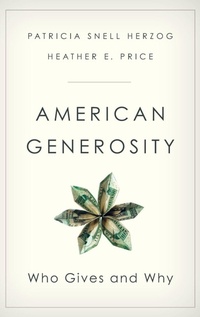
American Generosity
Who Gives and Why
Published on 17. March 2016
Book
Hardback
376 pages
978-0-19-045649-8 (ISBN)
Description
This accessibly written book presents a picture of generosity that is unique in its breadth. American Generosity is distinguished by its comprehensive approach to answering the what, how much, who, where, and why of giving. The authors consider multiple forms of generosity. They focus on three especially important forms of giving: donating money, volunteering time, and taking political action. But they also look at activities like giving blood and bodily organs, material possessions, relational attention, and participation in environmental activism.
Their striking and sometimes counterintuitive findings are based on data from the Science of Generosity initiative, which combines a nationally representative survey of adult Americans with in-depth interviews and ethnographies. From the interviews, case studies are selected to illustrate core themes. The analyses examine multiple dimensions of resources, social status, regional cultural norms, different approaches to giving, social-psychological orientation, and the relational contexts of generosity.
The authors conclude that giving is supported by "circles of generosity," which ripple outward in their reach to giving targets. The practical implications include tips for readers who want to increase their own giving, and for parents modeling giving to their children, spouses desiring alignment in their giving, and friends and community members seeking to support other people's giving. Also on offer are explicit fundraising ideas for nonprofits, foundations, and religious leaders.
In American Generosity we find a broad yet nuanced explanation of giving that transcends the usual categories of sociological study to address the simple but confounding question about charity-who gives and why?
Their striking and sometimes counterintuitive findings are based on data from the Science of Generosity initiative, which combines a nationally representative survey of adult Americans with in-depth interviews and ethnographies. From the interviews, case studies are selected to illustrate core themes. The analyses examine multiple dimensions of resources, social status, regional cultural norms, different approaches to giving, social-psychological orientation, and the relational contexts of generosity.
The authors conclude that giving is supported by "circles of generosity," which ripple outward in their reach to giving targets. The practical implications include tips for readers who want to increase their own giving, and for parents modeling giving to their children, spouses desiring alignment in their giving, and friends and community members seeking to support other people's giving. Also on offer are explicit fundraising ideas for nonprofits, foundations, and religious leaders.
In American Generosity we find a broad yet nuanced explanation of giving that transcends the usual categories of sociological study to address the simple but confounding question about charity-who gives and why?
Reviews / Votes
American Generosity is an academically sound and highly accessible book. Practitioners, general readers, as well as scholars will find it rewarding. * Young-Il Kim, Sociology of Religion *More details
Language
English
Place of publication
New York
United States
Target group
College/higher education
Professional and scholarly
Illustrations
64
Dimensions
Height: 240 mm
Width: 161 mm
Thickness: 25 mm
Weight
731 gr
ISBN-13
978-0-19-045649-8 (9780190456498)
Copyright in bibliographic data and cover images is held by Nielsen Book Services Limited or by the publishers or by their respective licensors: all rights reserved.
Schweitzer Classification
Other editions
Additional editions
E-Book
02/2016
1st Edition
OUP eBook
€20.99
Available for download
E-Book
02/2016
1st Edition
OUP eBook
€20.99
Available for download
Persons
Patricia Snell Herzog is a co-investigator on the Science of Generosity Initiative and an Assistant Professor in the Department of Sociology & Criminal Justice at the University of Arkansas. Previously Herzog was the Assistant Director of the Center for the Study of Religion at the University of Notre Dame. Her areas of interest are charitable giving & voluntary participation, religion, youth and emerging adults, community, spatial inequality, and social theory.
Heather Price is a co-investigator on the Science of Generosity Phase II. Previously Price was the Assistant Director of the Center for the Study of Religion at the University of Notre Dame. Price is a sociologist who studies education, networks, organizations, and community. Her work informs education policy locally, nationally, and internationally.
Heather Price is a co-investigator on the Science of Generosity Phase II. Previously Price was the Assistant Director of the Center for the Study of Religion at the University of Notre Dame. Price is a sociologist who studies education, networks, organizations, and community. Her work informs education policy locally, nationally, and internationally.
Content
Acknowledgments
Foreword
Introduction - Who Gives & Why? American Generosity in Perspective
Case Study Introductions - An In-Depth Look at Twelve Americans & Their Giving
Chapter 1 - Picture of American Generosity: Participation in Giving Behaviors
Chapter 2 - Landscape of American Generosity: Social Status & Regional Patterns
Chapter 3 - Types of American Givers: Variations in Approaches to Giving
Chapter 4 - Personal & Social Orientations to Giving: A Social Psychological Approach
Chapter 5 - Giving Web of Affiliations: A Socio-Relational Approach
Conclusion - Generosity, Philanthropy, and Civil Society in Social Context
Methodological Appendixes
Notes
Index
Foreword
Introduction - Who Gives & Why? American Generosity in Perspective
Case Study Introductions - An In-Depth Look at Twelve Americans & Their Giving
Chapter 1 - Picture of American Generosity: Participation in Giving Behaviors
Chapter 2 - Landscape of American Generosity: Social Status & Regional Patterns
Chapter 3 - Types of American Givers: Variations in Approaches to Giving
Chapter 4 - Personal & Social Orientations to Giving: A Social Psychological Approach
Chapter 5 - Giving Web of Affiliations: A Socio-Relational Approach
Conclusion - Generosity, Philanthropy, and Civil Society in Social Context
Methodological Appendixes
Notes
Index