

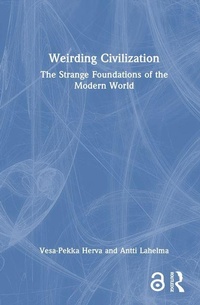
Weirding Civilization
The Strange Foundations of the Modern World
1st Edition
Published on 28. May 2025
Book
Hardback
290 pages
978-1-032-94118-9 (ISBN)
Description
Weirding Civilization examines the irrational foundations of civilization, from the Bronze Age to the Anthropocene. Inspired by Twin Peaks and Lovecraftian horror, it reveals how weirdness - disorienting, monstrous, and ambivalent - has shaped human society since the rise of the first complex civilizations.
Taking 'weirding' as its conceptual lens, the book examines hallmarks of civilization such as urbanism, money, and writing, uncovering their layered and often non-rational nature. While the concept of weirding has gained traction across disciplines, from literature studies to climate science, this book applies it systematically to early civilizations for the first time. Weirdness emerges as ruptures in experienced reality, arising from the complex interplay between humans and non-humans. The book explores how civilization has unfolded in relation to hidden, invisible, and unknown dimensions of reality. Accessible and thought-provoking, it broadens conceptual horizons, offering fresh insights into the past and present while inviting readers to embrace that which resists categorization. With a primary focus on Europe and the Near East, it also addresses global questions of modernity, technology, and cultural imagination.
This book is essential for archaeologists, anthropologists, and historians studying complex societies as well as for readers fascinated by unconventional approaches to history and civilization. It appeals to anyone seeking to disrupt conventional understandings of humanity's development.
The Open Access version of this book, available at http://www.taylorfrancis.com, has been made available under a Creative Commons Attribution-Non Commercial-No Derivatives (CC BY-NC-ND) 4.0 license.
Taking 'weirding' as its conceptual lens, the book examines hallmarks of civilization such as urbanism, money, and writing, uncovering their layered and often non-rational nature. While the concept of weirding has gained traction across disciplines, from literature studies to climate science, this book applies it systematically to early civilizations for the first time. Weirdness emerges as ruptures in experienced reality, arising from the complex interplay between humans and non-humans. The book explores how civilization has unfolded in relation to hidden, invisible, and unknown dimensions of reality. Accessible and thought-provoking, it broadens conceptual horizons, offering fresh insights into the past and present while inviting readers to embrace that which resists categorization. With a primary focus on Europe and the Near East, it also addresses global questions of modernity, technology, and cultural imagination.
This book is essential for archaeologists, anthropologists, and historians studying complex societies as well as for readers fascinated by unconventional approaches to history and civilization. It appeals to anyone seeking to disrupt conventional understandings of humanity's development.
The Open Access version of this book, available at http://www.taylorfrancis.com, has been made available under a Creative Commons Attribution-Non Commercial-No Derivatives (CC BY-NC-ND) 4.0 license.
More details
Language
English
Place of publication
London
United Kingdom
Publishing group
Taylor & Francis Ltd
Target group
College/higher education
Professional and scholarly
Academic, Postgraduate, and Undergraduate Advanced
Product notice
sewn/stitched
Cloth over boards
Illustrations
67 s/w Abbildungen, 67 s/w Photographien bzw. Rasterbilder
67 Halftones, black and white; 67 Illustrations, black and white
Dimensions
Height: 234 mm
Width: 156 mm
Weight
700 gr
ISBN-13
978-1-032-94118-9 (9781032941189)
Copyright in bibliographic data and cover images is held by Nielsen Book Services Limited or by the publishers or by their respective licensors: all rights reserved.
Schweitzer Classification
Other editions
Additional editions
E-Book
05/2025
1st Edition
Routledge
€0.00
Available for download
Book
05/2025
1st Edition
Routledge
€52.50
Shipment within 10-20 days
E-Book
05/2025
1st Edition
Routledge
€0.00
Available for download
Persons
Vesa-Pekka Herva is a professor of archaeology at the University of Oulu, Finland. He has studied the Aegean Bronze Age and European northern worlds from the Neolithic to the present. His research interests encompass cosmologies, human-environment relations, cultural heritage, and classical Graeco-Roman traditions.
Antti Lahelma is a university lecturer of archaeology at the University of Helsinki, Finland. His research focuses on prehistoric rock art, identity, and worldview, particularly in the northern circumpolar region, and he has also worked extensively on the archaeology of the Ancient Near East. He has previously authored together with Vesa-Pekka Herva a book titled Northern Archaeology and Cosmology: A Relational View (Routledge, 2020).
Antti Lahelma is a university lecturer of archaeology at the University of Helsinki, Finland. His research focuses on prehistoric rock art, identity, and worldview, particularly in the northern circumpolar region, and he has also worked extensively on the archaeology of the Ancient Near East. He has previously authored together with Vesa-Pekka Herva a book titled Northern Archaeology and Cosmology: A Relational View (Routledge, 2020).
Content
List of Figures; Preface; Acknowledgements; Chapter 1: Introduction; Chapter 2: Origins and Origin Narratives; Chapter 3: Cities beneath the Surface; Chapter 4: Money, Metals and Treasures; Chapter 5: Otherworldly Writing and Communication;Chapter 6: Civilization and Its Monsters; Chapter 7: Concluding reflections; Bibliography; Index.