

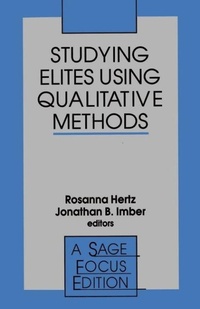
Studying Elites Using Qualitative Methods
1st Edition
Published on 21. September 1995
Book
Paperback/Softback
210 pages
978-0-8039-7037-3 (ISBN)
Description
Few social researchers study elites because elites, by their nature, are very difficult to access. The contributors to this volume provide valuable insights on how researchers can successfully penetrate elite settings. As the authors reflect on their experiences, they provide constructive advice as well as cautionary tales about how they learned to maneuver and become accepted in a world that is often closed to them. This book's coverage includes three broad research domains: business elites, professional elites, and community and political elites. Although the studies focus on qualitative methodology, even researchers who emphasize more quantitative methods will benefit from this volume's thoughtful observations on how researchers gather data, construct interview strategies, write about their subjects, and experience the research process. A wide range of researchers in organizational studies, sociology, political science, and many other fields will find this volume to be an important guide to the many subtle and elusive features of conducting successful research with these groups.
More details
Series
Language
English
Place of publication
Thousand Oaks
United States
Target group
Professional and scholarly
Dimensions
Height: 216 mm
Width: 140 mm
Thickness: 13 mm
Weight
322 gr
ISBN-13
978-0-8039-7037-3 (9780803970373)
Copyright in bibliographic data and cover images is held by Nielsen Book Services Limited or by the publishers or by their respective licensors: all rights reserved.
Schweitzer Classification
Other editions
Additional editions
Rosanna Hertz | Jonathan Imber
Studying Elites Using Qualitative Methods
Book
09/1995
1st Edition
SAGE Publications Inc
€218.30
Shipment within 15-20 days
Persons
Rosanna Hertz is the 1919 Reunion Professor of Sociology and Women's and Gender Studies at Wellesley College. She is the author of Single By Chance, Mothers By Choice: How Women are Choosing Parenthood Without Marriage and Creating the New American Family (Oxford Press, 2008). She is also the author or co-author of five edited collections which focus on the use of qualitative methods including Open to Disruption: Time and Craft in the Practice of Slow Sociology (Vanderbilt University, 2015) with Anita Ilta Garey and Margaret K. Nelson.
Content
Introduction - Rosanna Hertz and Jonathan B Imber
PART ONE: BUSINESS ELITES
Interviewing Important People in Big Companies - Robert J Thomas
Reaching Corporate Executives - Michael Useem
Fielding Hot Topics in Cool Settings - Peter Cleary Yeager and Kathy E Kram
The Study of Corporate Ethics
Using Electronic Media to Support Fieldwork in a Corporate Setting - John P Workman Jr
Tales from the Field - Paul M Hirsch
Learning from Researchers' Accounts
PART TWO: PROFESSIONAL ELITES
Stopping the Spin and Becoming a Prop - Joshua Gamson
Fieldwork on Hollywood Elites
Reflections on Fieldwork in a Complex Organization - Jennifer L Pierce
Lawyers, Ethnographic Authority, and Lethal Weapons
Negotiating Status - Alan Aldridge
Social Scientists and Anglican Clergy
How I Learned What a Crock Was - Howard S Becker
PART THREE: COMMUNITY AND POLITICAL ELITES
`Surely You're Not in This Just to Be Helpful' - Susan A Ostrander
Access, Rapport, and Interviews in Three Studies of Elites
Local Knowledge and Local Power - Albert Hunter
Notes on the Ethnography of Local Community Elites
Research as a Communication Act - Hanna Herzog
A Study on Israeli Women in Local Politics
Exploding Anthropology's Canon in the World of the Bomb - Hugh Gusterson
Ethnographic Writing on Militarism
PART ONE: BUSINESS ELITES
Interviewing Important People in Big Companies - Robert J Thomas
Reaching Corporate Executives - Michael Useem
Fielding Hot Topics in Cool Settings - Peter Cleary Yeager and Kathy E Kram
The Study of Corporate Ethics
Using Electronic Media to Support Fieldwork in a Corporate Setting - John P Workman Jr
Tales from the Field - Paul M Hirsch
Learning from Researchers' Accounts
PART TWO: PROFESSIONAL ELITES
Stopping the Spin and Becoming a Prop - Joshua Gamson
Fieldwork on Hollywood Elites
Reflections on Fieldwork in a Complex Organization - Jennifer L Pierce
Lawyers, Ethnographic Authority, and Lethal Weapons
Negotiating Status - Alan Aldridge
Social Scientists and Anglican Clergy
How I Learned What a Crock Was - Howard S Becker
PART THREE: COMMUNITY AND POLITICAL ELITES
`Surely You're Not in This Just to Be Helpful' - Susan A Ostrander
Access, Rapport, and Interviews in Three Studies of Elites
Local Knowledge and Local Power - Albert Hunter
Notes on the Ethnography of Local Community Elites
Research as a Communication Act - Hanna Herzog
A Study on Israeli Women in Local Politics
Exploding Anthropology's Canon in the World of the Bomb - Hugh Gusterson
Ethnographic Writing on Militarism