

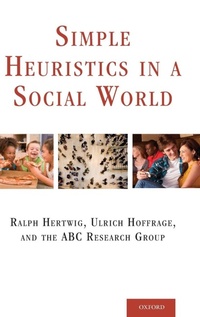
Simple Heuristics in a Social World
1st Edition
Published on 6. December 2012
Book
Hardback
672 pages
978-0-19-538843-5 (ISBN)
Description
Simple Heuristics in a Social World invites readers to discover the simple heuristics that people use to navigate the complexities and surprises of environments populated with others. The social world is a terrain where humans and other animals compete with conspecifics for myriad resources, including food, mates, and status, and where rivals grant the decision maker little time for deep thought, protracted information search, or complex calculations. Yet, the social world also encompasses domains where social animals such as humans can learn from one another and can forge alliances with one another to boost their chances of success.
According to the book's thesis, the undeniable complexity of the social world does not dictate cognitive complexity as many scholars of rationality argue. Rather, it entails circumstances that render optimization impossible or computationally arduous: intractability, the existence of incommensurable considerations, and competing goals. With optimization beyond reach, less can be more. That is, heuristics--simple strategies for making decisions when time is pressing and careful deliberation an unaffordable luxury--become indispensible mental tools. As accurate as or even more accurate than complex methods when used in the appropriate social environments, these heuristics are good descriptive models of how people make many decisions and inferences, but their impressive performance also poses a normative challenge for optimization models. In short, the Homo socialis may prove to be a Homo heuristicus whose intelligence reflects ecological rather than logical rationality.
According to the book's thesis, the undeniable complexity of the social world does not dictate cognitive complexity as many scholars of rationality argue. Rather, it entails circumstances that render optimization impossible or computationally arduous: intractability, the existence of incommensurable considerations, and competing goals. With optimization beyond reach, less can be more. That is, heuristics--simple strategies for making decisions when time is pressing and careful deliberation an unaffordable luxury--become indispensible mental tools. As accurate as or even more accurate than complex methods when used in the appropriate social environments, these heuristics are good descriptive models of how people make many decisions and inferences, but their impressive performance also poses a normative challenge for optimization models. In short, the Homo socialis may prove to be a Homo heuristicus whose intelligence reflects ecological rather than logical rationality.
Reviews / Votes
Simple Heuristics in a Social World is both informative and inspiring. It will inform you of what is in the adaptive toolbox of social learning, stimulate your thinking about how best to model cognition and rationality, and inspire you with the sophisticated methodology of the social/ecological approach to cognition. * PsycCRITIQUES, August 2013 *More details
Series
Language
English
Place of publication
New York
United States
Target group
College/higher education
Professional and scholarly
Interdisciplinary academic audience (e.g., psychologists, philosophers, economists, political scientists) interested in human rationality and decision making. In addition: General readers interested in how people make decisions (in particular in the social world) Students interested in how people make decisions
Dimensions
Height: 240 mm
Width: 161 mm
Thickness: 40 mm
Weight
1148 gr
ISBN-13
978-0-19-538843-5 (9780195388435)
Copyright in bibliographic data and cover images is held by Nielsen Book Services Limited or by the publishers or by their respective licensors: all rights reserved.
Schweitzer Classification
Other editions
Additional editions
Ralph Hertwig | Ulrich Hoffrage | Abc Research Group
Simple Heuristics in a Social World
E-Book
11/2012
1st Edition
OUP eBook
€101.99
Available for download
Ralph Hertwig | Ulrich Hoffrage | Abc Research Group
Simple Heuristics in a Social World
E-Book
09/1999
1st Edition
OUP eBook
€48.99
Available for download
Persons
Ralph Hertwig is Professor of Cognitive and Decision Sciences, Department of Psychology, University of Basel. He studies bounded and social rationality, experienced-based decision making, and the methodology of the social sciences. He was a recipient of the Heinz Heckhausen Young Scientist Prize and the Charlotte-und-Karl-Buehler Young Career Award.
Ulrich Hoffrage is Professor of Decision Theory and Risk, Graduate Business School of Economics (Ecole des Hautes Etudes Commerciales; HEC), University of Lausanne, Switzerland
Ulrich Hoffrage is Professor of Decision Theory and Risk, Graduate Business School of Economics (Ecole des Hautes Etudes Commerciales; HEC), University of Lausanne, Switzerland
Content
Contents ; Part I The Research Agenda ; 1. Simple Heuristics: The Foundations of Adaptive Social Behavior ; Ralph Hertwig and Ulrich Hoffrage ; Part II Heuristics in Social Games ; 2. Simple Heuristics in a Social Game ; Ralph Hertwig, Urs Fischbacher, and Adrian Bruhin ; 3. Trust-Your-Doctor: A Simple Heuristic in Need of a Proper Social Environment ; Odette Wegwarth and Gerd Gigerenzer ; 4. Probabilistic Persuasion: A Brunswikian Theory of Argumentation ; Torsten Reimer, Ralph Hertwig, amd Sanja Sipek ; 5. Cooperate with Equals: A Simple Heuristic for Social Exchange ; Tim Johnson and Oleg Smirnov ; 6. The Is and Ought of Sharing: The Equality Heuristic Across the Lifespan ; Monika Keller, Michaela Gummerum, Thomas Canz, Gerd Gigerenzer, and Masanori Takezawa ; Part III Structures of Social Worlds ; 7. When Will We Meet Again? Regularities of Social Connectivity and Their Reflections in Memory and Decision Making ; Thorsten Pachur, Lael J. Schooler, and Jeffrey R. Stevens ; 8. Fast Acceptance by Common Experience: Augmenting Schelling's Neighborhood Segregation Model with FACE-Recognition ; Nathan Berg, Katarzyna Abramczuk, and Ulrich Hoffrage ; Part IV Social Information, Collective Decision Making, and Social Learning ; 9. The Mind as an Intuitive Pollster: Frugal Search in Social Spaces ; Thorsten Pachur, Ralph Hertwig, and Jorg Rieskamp ; 10. The <"Less-is-More>" Effect in Group Decision Making ; Shengua Luan, Konstantinos V. Katsikopoulos, and Torsten Reimer ; 11. Simple Heuristics and Information Sharing in Groups ; Torsten Reimer and Ulrich Hoffrage ; 12. How to Find Good Cue Orderings: When Social Learning Benefits Simple Heuristics ; Rocio Garcia-Retamero, Masanori Takezawa, Jan K. Woike, and Gerd Gigerenzer ; 13. The Advice of Others: When and How We Benefit From It ; Guido Biele and Jorg Rieskamp ; Part V Simple Heuristics and Social Rationality ; 14. The Evolutionary Rationality of Social Learning ; Richard McElreath, Annika Wallin, and Barbara Fasolo ; 15. The Lives of Others: Social Rationality in Animals ; Jeffrey R. Stevens and Andrew J. King ; 16. The Heart Has Its Reasons: Social Rationality in Mate Choice ; Alison P. Lenton, Lars Penke, Peter Todd, and Barbara Fasolo ; 17. Can Simple Heuristics Explain Moral Inconsistencies? ; Nadine Fleischhut and Gerd Gigerenzer ; 18. Why Simple Heuristics Make Life Both Easier and Harder: A Social-Psychological Perspective ; Klaus Fiedler and Michaela Wanke ; References ; Name Index ; Subject Index