

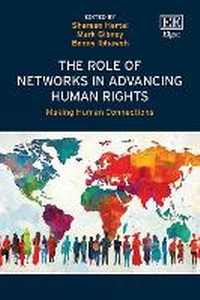
The Role of Networks in Advancing Human Rights
Making Human Connections
Published on 24. October 2025
Book
Hardback
200 pages
978-1-0353-3610-4 (ISBN)
Description
Networks play a central role in the human rights field. Expert contributors in this book explain how different types of networks form and shape outcomes globally. Together, they demonstrate how connections among scholars, practitioners and activists drive knowledge sharing and collaboration across disciplines, spurring innovation to address global challenges such as inequality and injustice.
Each chapter offers insights from personal experiences of building and sustaining diverse networks across traditional academic boundaries. Contributors examine the role of technology (including digital platforms, social media and podcasts) in expanding a network. They offer practical advice for overcoming systemic challenges such as resource constraints and gender bias. Chapters highlight case studies of successful human rights networking projects, emphasising how academic research can influence real-world advocacy. Reflecting on the dynamism and resilience of the human rights field, the book ultimately sheds light on the transformative power and joy of community building among people working in this space.
The Role of Networks in Advancing Human Rights is an essential read for academics and practitioners across human rights, international relations and law seeking effective strategies for collaboration, advocacy and innovation in their work.
Each chapter offers insights from personal experiences of building and sustaining diverse networks across traditional academic boundaries. Contributors examine the role of technology (including digital platforms, social media and podcasts) in expanding a network. They offer practical advice for overcoming systemic challenges such as resource constraints and gender bias. Chapters highlight case studies of successful human rights networking projects, emphasising how academic research can influence real-world advocacy. Reflecting on the dynamism and resilience of the human rights field, the book ultimately sheds light on the transformative power and joy of community building among people working in this space.
The Role of Networks in Advancing Human Rights is an essential read for academics and practitioners across human rights, international relations and law seeking effective strategies for collaboration, advocacy and innovation in their work.
Reviews / Votes
'At a time when human rights are under threat, this book offers accessible, first-hand insights from the worlds of practice and academia on the vital importance of forging relationships. It reminds us that "Networking is essential to sustaining human life", and central to effective collaboration for a more equitable world.' -- Peter Taylor, Institute of Development Studies, UK 'This book reveals the often-invisible labour of weaving networks that anchor human rights in lived reality. It shows how scholars, practitioners, and activists collectively confront urgent problems, balancing joy and anxiety, energy and fatigue. The book is a powerful reminder that networks are not mere links but transformative engines safeguarding what protects our humanity from dehumanising systems.' -- Nicole Curato, University of Birmingham, UKMore details
Language
English
Place of publication
Cheltenham
United Kingdom
Target group
Professional and scholarly
Dimensions
Height: 234 mm
Width: 156 mm
ISBN-13
978-1-0353-3610-4 (9781035336104)
Copyright in bibliographic data and cover images is held by Nielsen Book Services Limited or by the publishers or by their respective licensors: all rights reserved.
Schweitzer Classification
Persons
Edited by Shareen Hertel, University of Connecticut, USA, Mark Gibney, University of North Carolina, Asheville, USA and Bonny Ibhawoh, McMaster University, Canada
Content
Contents
1 Introduction: networking for human rights 1
Bonny Ibhawoh, Shareen Hertel and Mark Gibney
PART I NETWORKING WITHIN ACADEMIA
2 Networking for academic freedom: issues and challenges 9
George Andreopoulos
3 Academic networking for human rights: research chairs as
social capital 24
Alison Brysk
4 On (not) networking while female 37
Rhoda E. Howard-Hassmann
5 An interview with Bert Lockwood 45
Bert Lockwood with Mark Gibney
6 Academic networks as research and learning communities 53
Francesca Parente and Kelebogile Zvobgo
PART II BRIDGING THE ACADEMIC AND PRACTICE DIVIDES
7 Thinking about academic networks through social network
analysis 63
Thomas Gammeltoft-Hansen
8 Moving economic and social rights from the margins to the
center through networking 73
Shareen Hertel
9 The Extraterritorial Obligations (ETO) Consortium 84
Mark Gibney
10 Participedia: networking for democratic innovations 95
Bonny Ibhawoh
11 Partnerships, networks, and eco-systems: the case of human
rights cities 105
Morten Kjaerum
12 Human rights networks: from analogue to digital 115
Todd Landman
13 Paradigm shifts and the evolution of quantitative human
rights cooperation 125
Skip Mark and Daniel Arnon
14 The Human Rights Measurement Initiative (HRMI):
transforming accountability through collaboration 138
Pratibha Singh and K. Anne Watson
PART III STUDYING THE PRACTICE WORLD
15 The complex of issue networks in transitional justice 151
Bo Won Kim and Sumin Lee
16 A Geneva perspective on human rights networking at the
U.N.: schmoozing for human rights 167
1 Introduction: networking for human rights 1
Bonny Ibhawoh, Shareen Hertel and Mark Gibney
PART I NETWORKING WITHIN ACADEMIA
2 Networking for academic freedom: issues and challenges 9
George Andreopoulos
3 Academic networking for human rights: research chairs as
social capital 24
Alison Brysk
4 On (not) networking while female 37
Rhoda E. Howard-Hassmann
5 An interview with Bert Lockwood 45
Bert Lockwood with Mark Gibney
6 Academic networks as research and learning communities 53
Francesca Parente and Kelebogile Zvobgo
PART II BRIDGING THE ACADEMIC AND PRACTICE DIVIDES
7 Thinking about academic networks through social network
analysis 63
Thomas Gammeltoft-Hansen
8 Moving economic and social rights from the margins to the
center through networking 73
Shareen Hertel
9 The Extraterritorial Obligations (ETO) Consortium 84
Mark Gibney
10 Participedia: networking for democratic innovations 95
Bonny Ibhawoh
11 Partnerships, networks, and eco-systems: the case of human
rights cities 105
Morten Kjaerum
12 Human rights networks: from analogue to digital 115
Todd Landman
13 Paradigm shifts and the evolution of quantitative human
rights cooperation 125
Skip Mark and Daniel Arnon
14 The Human Rights Measurement Initiative (HRMI):
transforming accountability through collaboration 138
Pratibha Singh and K. Anne Watson
PART III STUDYING THE PRACTICE WORLD
15 The complex of issue networks in transitional justice 151
Bo Won Kim and Sumin Lee
16 A Geneva perspective on human rights networking at the
U.N.: schmoozing for human rights 167