

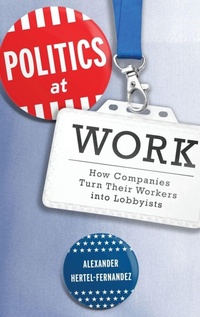
Politics at Work
How Companies Turn Their Workers into Lobbyists
Published on 26. April 2018
Book
Hardback
360 pages
978-0-19-062989-2 (ISBN)
Description
Employers are increasingly recruiting their workers into politics to change elections and public policy - sometimes in coercive ways. Using a diverse array of evidence, including national surveys of workers and employers, as well as in-depth interviews with top corporate managers, Politics at Work explains why mobilization of workers has become an appealing corporate political strategy in recent decades. The book also assesses the effect of employer mobilization on the political process more broadly, including its consequences for electoral contests, policy debates, and political representation.
In Politics at Work, Alexander Hertel-Fernandez shows that while employer political recruitment has some benefits for American democracy - for instance, getting more workers to the polls - it also has troubling implications for other aspects of political participation. Workers face considerable pressure to respond to their managers' political requests because of the economic power employers possess over workers. In spite of these worrisome patterns, corporate managers report that mobilization of workers is an important strategy for influencing politics. Politics at Work documents how companies consider mobilization of their workers to be even more effective at changing public policy than making campaign contributions or buying electoral ads.
Hertel-Fernandez concludes by discussing when and why employer recruitment efforts represent problematic violations of workers' political rights. He then reviews policy proposals that could protect workers from employer political coercion and could also win the support of majorities of Americans. By carefully examining a growing yet underappreciated political practice, Politics at Work contributes to our understanding of the changing workplace, as well as the ways that businesses influence politics in the United States. The book offers fresh perspectives on debates over money in politics and will be valuable to anyone interested in the connections between inequality, public policy, and American democracy.
In Politics at Work, Alexander Hertel-Fernandez shows that while employer political recruitment has some benefits for American democracy - for instance, getting more workers to the polls - it also has troubling implications for other aspects of political participation. Workers face considerable pressure to respond to their managers' political requests because of the economic power employers possess over workers. In spite of these worrisome patterns, corporate managers report that mobilization of workers is an important strategy for influencing politics. Politics at Work documents how companies consider mobilization of their workers to be even more effective at changing public policy than making campaign contributions or buying electoral ads.
Hertel-Fernandez concludes by discussing when and why employer recruitment efforts represent problematic violations of workers' political rights. He then reviews policy proposals that could protect workers from employer political coercion and could also win the support of majorities of Americans. By carefully examining a growing yet underappreciated political practice, Politics at Work contributes to our understanding of the changing workplace, as well as the ways that businesses influence politics in the United States. The book offers fresh perspectives on debates over money in politics and will be valuable to anyone interested in the connections between inequality, public policy, and American democracy.
Reviews / Votes
[Politics at Work's] chief attribute is to unearth and investigate a major workplace dynamic that has received little scholarly or popular attention * Jake Rosenfeld, Washington University-St. Louis, ILR Review * Hertel-Fernandez, a Columbia professor of international and public affairs, provides an eye-opening and timely look at the increased role of private-sector employers in American politics. He instantly demands attention with examples of employer behavior that is currently legalfor instance, requiring subordinates to volunteer for political campaigns as a condition of employment.He offers cogent legislative reforms to protect workers from political coercion by their bosses, in the hope that these reforms can remedy one important and growing symptom of the troubled relationship between democracy and corporate capitalism. Hertel-Fernandez has performed a great public service with this accessible and rigorously documented study. * Publishers Weekly * Hertel-Fernandez (Columbia) has written an excellent new book that adds to the growing canon on business influence in American politics. * A. J. Nownes, CHOICE *More details
Series
Language
English
Place of publication
New York
United States
Target group
Professional and scholarly
Dimensions
Height: 240 mm
Width: 161 mm
Thickness: 24 mm
Weight
699 gr
ISBN-13
978-0-19-062989-2 (9780190629892)
Copyright in bibliographic data and cover images is held by Nielsen Book Services Limited or by the publishers or by their respective licensors: all rights reserved.
Schweitzer Classification
Other editions
Additional editions
E-Book
02/2018
1st Edition
OUP eBook
€13.99
Available for download
E-Book
02/2018
1st Edition
OUP eBook
€16.49
Available for download
Person
Alexander Hertel-Fernandez is an Assistant Professor in Columbia University's School of International and Public Affairs. A scholar of lobbying, business-government relations, and public policy, Hertel-Fernandez received his PhD in Government and Social Policy from Harvard University in 2016. His research has appeared in the American Prospect, Democracy Journal, the New York Times, the New Yorker, and the Washington Post, as well as numerous scholarly journals.
Content
Chapter 1: The New Office Politics
Chapter 2: The Landscape of Employer Mobilization in the American Economy
Chapter 3: The Changing Economic, Legal, and Technological Context for Employer Mobilization
Chapter 4: When Do Firms Decide to Mobilize Their Workers?
Chapter 5: Who Are the Champions? Worker Responses to Employer Mobilization
Chapter 6: The Political Consequences of Employer Mobilization
Chapter 7: Employer Mobilization and American Democracy
Chapter 2: The Landscape of Employer Mobilization in the American Economy
Chapter 3: The Changing Economic, Legal, and Technological Context for Employer Mobilization
Chapter 4: When Do Firms Decide to Mobilize Their Workers?
Chapter 5: Who Are the Champions? Worker Responses to Employer Mobilization
Chapter 6: The Political Consequences of Employer Mobilization
Chapter 7: Employer Mobilization and American Democracy