

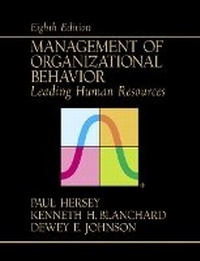
Management of Organizational Behavior
Leading Human Resources
8th Edition
Published on 11. October 2000
Book
Paperback/Softback
516 pages
978-0-13-017598-4 (ISBN)
Description
For undergraduate and graduate-level courses in Organizational Behavior, Leadership, and Organizational Development.
Used by more than a million people throughout the world, this highly readable text provides a comprehensive examination of the applied behavioral sciences, and focuses on fundamental ideas which have stood the test of years of application in academic, business, not-for-profit and administrative environments.
Used by more than a million people throughout the world, this highly readable text provides a comprehensive examination of the applied behavioral sciences, and focuses on fundamental ideas which have stood the test of years of application in academic, business, not-for-profit and administrative environments.
More details
Edition
8th edition
Language
English
Place of publication
United States
Publishing group
Pearson Education (US)
Target group
Professional and scholarly
Dimensions
Height: 230 mm
Width: 179 mm
Thickness: 28 mm
Weight
832 gr
ISBN-13
978-0-13-017598-4 (9780130175984)
Copyright in bibliographic data and cover images is held by Nielsen Book Services Limited or by the publishers or by their respective licensors: all rights reserved.
Schweitzer Classification
Other editions
New editions
Paul Hersey | Kenneth H. Blanchard | Dewey E. Johnson
Management of Organizational Behavior
United States Edition
Book
10/2007
9th Edition
Pearson
€91.75
Article exhausted; check for reprint
Previous edition

Paul Hersey | Kenneth H. Blanchard | Dewey E. Johnson
Management of Organizational Behavior
Utilizing Human Resources
Book
05/1996
7th Edition
Prentice Hall
€52.07
Article exhausted; check for reprint
Content
1. Management: An Applied Behavioral Sciences Approach.
2. Motivation and Behavior.
3. Motivating.
4. Leadership: An Initial Perspective.
5. Leadership: Situational Approaches.
6. Determining Effectiveness.
7. Diagnosing the Environment.
8. Situational Leadership.
9. Situational Leadership, Perception, and the Impact of Power.
10. Situational Leadership: Training and Development.
11. The Situational Leader and Constructive Discipline.
12. Building Effective Relationships.
13. Effective Communication.
14. Leading Effective Teams.
15. Implementing Situational Leadership: Managing People to Perform.
16. Implementing Situational Leadership: Building Commitments.
17. Planning and Implementing Change.
18. Leadership to Achieve Quality.
19. Leadership Strategies for Organizational Transformation.
20. The Organizational Cone.
21. Synthesizing Management Theory: Integrating Situational Leadership with the Classics.
Appendix: Life Cycle Theory of Leadership Revisited.
Recommended Supplementary Reading.
Index.
2. Motivation and Behavior.
3. Motivating.
4. Leadership: An Initial Perspective.
5. Leadership: Situational Approaches.
6. Determining Effectiveness.
7. Diagnosing the Environment.
8. Situational Leadership.
9. Situational Leadership, Perception, and the Impact of Power.
10. Situational Leadership: Training and Development.
11. The Situational Leader and Constructive Discipline.
12. Building Effective Relationships.
13. Effective Communication.
14. Leading Effective Teams.
15. Implementing Situational Leadership: Managing People to Perform.
16. Implementing Situational Leadership: Building Commitments.
17. Planning and Implementing Change.
18. Leadership to Achieve Quality.
19. Leadership Strategies for Organizational Transformation.
20. The Organizational Cone.
21. Synthesizing Management Theory: Integrating Situational Leadership with the Classics.
Appendix: Life Cycle Theory of Leadership Revisited.
Recommended Supplementary Reading.
Index.