

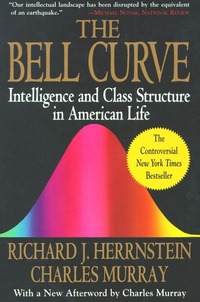
The Bell Curve
Intelligence and Class Structure in American Life
Published on 7. February 1996
Book
Paperback/Softback
912 pages
978-0-684-82429-1 (ISBN)
Description
The controversial book linking intelligence to class and race in modern society, and what public policy can do to mitigate socioeconomic differences in IQ, birth rate, crime, fertility, welfare, and poverty.
Reviews / Votes
Michael Novak National Review Our intellectual landscape has been disrupted by the equivalent of an earthquake. David Brooks The Wall Street Journal Has already kicked up more reaction than any social?science book this decade. Peter Brimelow Forbes Long-awaited...massive, meticulous, minutely detailed, clear. Like Darwin's Origin of Species -- the intellectual event with which it is being seriously compared -- The Bell Curve offers a new synthesis of research...and a hypothesis of far-reaching explanatory power. Milton Friedman This brilliant, original, objective, and lucidly written book will force you to rethink your biases and prejudices about the role that individual difference in intelligence plays in our economy, our policy, and our society. Chester E. Finn, Jr. Commentary The Bell Curve's implications will be as profound for the beginning of the new century as Michael Harrington's discovery of "the other America" was for the final part of the old. Richard Herrnstein's bequest to us is a work of great value. Charles Murray's contribution goes on. Prof. Thomas J. Bouchard Contemporary Psychology [The authors] have been cast as racists and elitists and The Bell Curve has been dismissed as pseudoscience....The book's message cannot be dismissed so easily. Herrnstein and Murray have written one of the most provocative social science books published in many years....This is a superbly written and exceedingly well documented book. Christopher Caldwell American Spectator The Bell Curve is a comprehensive treatment of its subject,never mean-spirited or gloating. It gives a fair hearing to those who dissent scientifically from its propositions -- in fact, it bends over backward to be fair....Among the dozens of hostile articles that have thus far appeared, none has successfully refuted any of its science. Malcolme W. Browne The New York Times Book Review Mr. Murray and Mr. Herrnstein write that "for the last 30 years, the concept of intelligence has been a pariah in the world of ideas," and that the time has come to rehabilitate rational discourse on the subject. It is hard to imagine a democratic society doing otherwise. Prof. Eugene D. Genovese National Review Richard Herrnstein and Charles Murray might not feel at home with Daniel Patrick Moynihan and Lani Guinier, but they should....They have all [made] brave attempts to force a national debate on urgent matters that will not go away. And they have met the same fate. Once again, academia and the mass media are straining every muscle to suppress debate. Prof. Earl Hunt American Scientist The first reactions to The Bell Curve were expressions of public outrage. In the second round of reaction, some commentators suggested that Herrnstein and Murray were merely bringing up facts that were well known in the scientific community, but perhaps best not discussed in public. A Papua New Guinea language has a term for this, Mokita. It means "truth that we all know, but agree not to talk about." ...There are fascinating questions here for those interested in the interactions between sociology, economics, anthropology and cognitive science. We do not have the answers yet. We may need them soon, for policy makers who rely on Mokita are flying blind.More details
Language
English
Place of publication
New York
United States
Publishing group
Simon & Schuster
Product notice
Paperback (trade)
Dimensions
Height: 233 mm
Width: 156 mm
Thickness: 45 mm
Weight
928 gr
ISBN-13
978-0-684-82429-1 (9780684824291)
Copyright in bibliographic data and cover images is held by Nielsen Book Services Limited or by the publishers or by their respective licensors: all rights reserved.
Schweitzer Classification
Other editions
Additional editions
Richard J. Herrnstein | Charles Murray
The Bell Curve
Intelligence and Class Structure in American Life
E-Book
05/2010
1st Edition
Free Press
€18.78
Available for download
Persons
Richard J. Herrnstein held the Edger Pierce Chair in Psychology at Harvard University until his death in 1994.
Content
Contents
List of Illustrations
List of Tables
A Note to the Reader
Preface
Acknowledgments
Introduction
PART I.
THE EMERGENCE OF A COGNITIVE ELITE
1 Cognitive Class and Education, 1900-1990
2 Cognitive Partitioning by Occupation
3 The Economic Pressure to Partition
4 Steeper Ladders, Narrower Gates
PART II.
COGNITIVE CLASSES AND SOCIAL BEHAVIOR
5 Poverty
6 Schooling
7 Unemployment, Idleness, and Injury
8 Family Matters
9 Welfare Dependency
10 Parenting
11 Crime
12 Civility and Citizenship
PART III.
THE NATIONAL CONTEXT
13 Ethnic Differences in Cognitive Ability
14 Ethnic Inequalities in Relation to IQ
15 The Demography of Intelligence
16 Social Behavior and the Prevalence of Low Cognitive Ability
PART IV.
LIVING TOGETHER
17 Raising Cognitive Ability
18 The Leveling of American Education
19 Affirmative Action in Higher Education
20 Affirmative Action in the Workplace
21 The Way We Are Headed
22 A Place for Everyone
Afterworld
APPENDIXES
1 Statistics for People Who Are Sure They Can't Learn Statistics
2 Technical Issues Regarding the National Longitudinal Survey of Youth
3 Technical Issues Regarding the Armed Forces Qualification Test as a Measure of IQ
4 Regression Analyses (rom Part II
5 Supplemental Material for Chapter 13
6 Regression Analyses from Chapter 14
7 The Evolution of Affirmative Action in the Workplace
Notes
Bibliography
Index
List of Illustrations
List of Tables
A Note to the Reader
Preface
Acknowledgments
Introduction
PART I.
THE EMERGENCE OF A COGNITIVE ELITE
1 Cognitive Class and Education, 1900-1990
2 Cognitive Partitioning by Occupation
3 The Economic Pressure to Partition
4 Steeper Ladders, Narrower Gates
PART II.
COGNITIVE CLASSES AND SOCIAL BEHAVIOR
5 Poverty
6 Schooling
7 Unemployment, Idleness, and Injury
8 Family Matters
9 Welfare Dependency
10 Parenting
11 Crime
12 Civility and Citizenship
PART III.
THE NATIONAL CONTEXT
13 Ethnic Differences in Cognitive Ability
14 Ethnic Inequalities in Relation to IQ
15 The Demography of Intelligence
16 Social Behavior and the Prevalence of Low Cognitive Ability
PART IV.
LIVING TOGETHER
17 Raising Cognitive Ability
18 The Leveling of American Education
19 Affirmative Action in Higher Education
20 Affirmative Action in the Workplace
21 The Way We Are Headed
22 A Place for Everyone
Afterworld
APPENDIXES
1 Statistics for People Who Are Sure They Can't Learn Statistics
2 Technical Issues Regarding the National Longitudinal Survey of Youth
3 Technical Issues Regarding the Armed Forces Qualification Test as a Measure of IQ
4 Regression Analyses (rom Part II
5 Supplemental Material for Chapter 13
6 Regression Analyses from Chapter 14
7 The Evolution of Affirmative Action in the Workplace
Notes
Bibliography
Index