

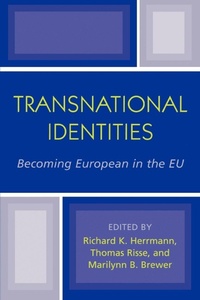
Transnational Identities
Becoming European in the EU
Published on 17. May 2004
Book
Paperback/Softback
320 pages
978-0-7425-3007-2 (ISBN)
Description
This original work explores the increasingly important phenomenon of the formation of transnational identity. Considering the ongoing relevance of the European Union, the contributors ask a series of intriguing questions: Is a European identity possible? How are the various types of European identity formed and maintained? How are these identities linked to the process of European integration? Examining the psychological, institutional, and political mechanisms that encourage or impede identification with transnational groups, the book considers these theoretical questions in light of new evidence drawn from a rich body of primary research, including field experiments, in-depth interviews with elites, and public opinion surveys. Brought together for the first time, social psychologists, sociologists, political scientists, and ethnographers share their theoretical and methodological perspectives in tackling the common issues surrounding the emergence of 'European' as a political identity. Paying special attention to the role of the institutions of the EU, the authors investigate the impact of neo-functionalist strategies and find that the processes of identity formation are far more complicated than can be explained by material and institutional factors alone. The authors engage in a fruitful dialogue about how much a European identity exists and how much it matters as they delve into the sources of disagreement and their implications.
Reviews / Votes
A welcome-and timely-contribution. Theoretically innovative and empirically rich case studies document the complex, uneven, and often surprising ways in which European identities are-or are not-changing. Transnational Identities will find a wide and appreciative audience among students of identity, Europeanists, and social scientists of various methodological orientations. -- Jeffrey T. Checkel, University of Oslo Works like Transnational Identities go along way toward developing a pool of evidence which social scientist can examine and consider now, while future historians of late-twentieth century Europe will be able to explore for many years to come. This is an important and useful work for any scholars in the social sciences studying identity formation. -- Andrew D. Devenney, Central Michigan University * H-Net: Humanities and Social Science Reviews Online * The book proves to be an insightful reading and makes a remarkable contribution to the academic debates on European political identity and European democratic governance. * Global and European Law Books Review Program * This imaginative, multidisciplinary volume probes Europe's transnational identities by bringing together the work of political scientists, social psychologists, ethnographers, historians, and linguists. Differences in approach and findings convey a complex and nuanced understanding of central issues in European politics. Teachers and students interested in the evolving European polity will want to read this impressive collection. -- Peter J. Katzenstein, Cornell UniversityMore details
Series
Language
English
Place of publication
United States
Publishing group
Bloomsbury Publishing Plc
Dimensions
Height: 234 mm
Width: 156 mm
Thickness: 17 mm
Weight
480 gr
ISBN-13
978-0-7425-3007-2 (9780742530072)
Copyright in bibliographic data and cover images is held by Nielsen Book Services Limited or by the publishers or by their respective licensors: all rights reserved.
Schweitzer Classification
Other editions
Additional editions

Transnational Identities
Becoming European in the Eu
E-Book
05/2004
1st Edition
Rowman & Littlefield Publishers
€55.99
Available for download
Persons
Richard K. Herrmann is professor in the Department of Political Science and director of the Mershon Center, Ohio State University. Thomas Risse is professor in the Department of Political and Social Sciences and director of the Center for Transatlantic Foreign and Security Policy, Freie UniversitSt Berlin. Marilynn B. Brewer is professor in the Department of Psychology, Ohio State University.
Content
Chapter 1 Identity and Institutions: Becoming European in the EU
Part 2 Part I: The Social Psychology of Identity Change
Chapter 3 Identity Change in the Context of the Growing Influence of European Union Institutions
Chapter 4 European Identity: A Social-psychological Perspective
Chapter 5 National Differences and European Plurality: Discrimination or Tolerance between European Countries
Part 6 Part II: Identity within the EU Institutions at the Elite Level
Chapter 7 The European Union and Its Institutions as "Identity Builders"
Chapter 8 National and Transnational Identities: European and Other Identities Constructed in Interviews with EU Officials
Chapter 9 EU Correspondents in Brussels: Between Europe and the Nation-State
Part 10 European Identity among Non-elites
Chapter 11 More than Nationals: How Identity Choice Matters in the New Europe
Chapter 12 Civic and Cultural Components of a European Identity: A Pilot Model of Measurement of Citizens' Levels of European Identity
Chapter 13 Europe Viewed from Below: Agents, Victims, and the Threat of the Other
Part 14 Part IV: Comparisons and Lessons
Chapter 15 European Institutions and Identity Change: What Have We Learned?
Part 2 Part I: The Social Psychology of Identity Change
Chapter 3 Identity Change in the Context of the Growing Influence of European Union Institutions
Chapter 4 European Identity: A Social-psychological Perspective
Chapter 5 National Differences and European Plurality: Discrimination or Tolerance between European Countries
Part 6 Part II: Identity within the EU Institutions at the Elite Level
Chapter 7 The European Union and Its Institutions as "Identity Builders"
Chapter 8 National and Transnational Identities: European and Other Identities Constructed in Interviews with EU Officials
Chapter 9 EU Correspondents in Brussels: Between Europe and the Nation-State
Part 10 European Identity among Non-elites
Chapter 11 More than Nationals: How Identity Choice Matters in the New Europe
Chapter 12 Civic and Cultural Components of a European Identity: A Pilot Model of Measurement of Citizens' Levels of European Identity
Chapter 13 Europe Viewed from Below: Agents, Victims, and the Threat of the Other
Part 14 Part IV: Comparisons and Lessons
Chapter 15 European Institutions and Identity Change: What Have We Learned?