

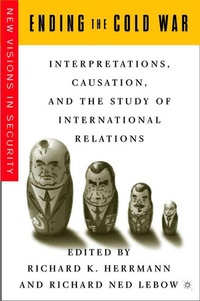
Ending the Cold War
Interpretations, Causation and the Study of International Relations
Published on 15. April 2004
Book
Hardback
VIII, 248 pages
978-1-4039-6383-3 (ISBN)
Description
Although in hindsight the end of the Cold War seems almost inevitable, almost no one saw it coming and there is little consensus over why it ended. A popular interpretation is that the Soviet Union was unable to compete in terms of power, especially in the area of high technology. Another interpretation gives primacy to the new ideas Gorbachev brought to the Kremlin and to the importance of leaders and domestic considerations. In this volume, prominent experts on Soviet affairs and the Cold War interrogate these competing interpretations in the context of five 'turning points' in the end of the Cold War process. Relying on new information gathered in oral history interviews and archival research, the authors draw into doubt triumphal interpretations that rely on a single variable like the superior power of the United States and call attention to the importance of how multiple factors combined and were sequenced historically. The volume closes with chapters drawing lessons from the end of the Cold War for both policy making and theory building.
Reviews / Votes
'Ending the Cold War is the product of a 'Who's Who' of scholars writing on one of the most important periods in recent history. Making good use of new knowledge available from documents and from interviews with key participants, this book will be valuable for scholars and accesible to students.' - James M. Godgeier, George Washington University, USA
'By far the best and most stimulating book to date on the subject, Ending the Cold War will be profitably read by scholars, pollcy makers and sudents of international relations.' - Robert D. English, University of Southern California, USA and author of Russia and the Idea of the West
More details
Series
Edition
2004 edition
Language
English
Place of publication
New York
United States
Publishing group
Palgrave USA
Target group
Professional and scholarly
Product notice
sewn/stitched
Cloth over boards
With dust jacket
Illustrations
VIII, 248 p.
Dimensions
Height: 240 mm
Width: 164 mm
Thickness: 19 mm
Weight
463 gr
ISBN-13
978-1-4039-6383-3 (9781403963833)
DOI
10.1057/9781403982810
Schweitzer Classification
Other editions
Additional editions
R. Herrmann | R. Lebow
Ending the Cold War
Interpretations, Causation and the Study of International Relations
Book
04/2004
Palgrave MacMillan
€106.99
Shipment within 10-20 days
R. Herrmann | R. Lebow
Ending the Cold War
Interpretations, Causation and the Study of International Relations
E-Book
04/2004
Palgrave MacMillan
€96.29
Available for download
Persons
GEORGE W. BRESLAUER University of California, Berkeley, USA
ARCIE BROWN St. Antony's College, Oxford, UK
JAMES A. DAVIS, University of Munich, Bavaria, Germany
MATTHEW EVANGELISTA Cornell University, New York, USA
RAYMOND L. GARTHOFF The Brookings Institution, Washington DC, USA
JACQUES LÉVESQUE Université du Québec à Montréal, Canada
JANICE GROSS STEIN University of Toronto, Canada
WILLIAM H. WOHLFORTH Georgetown University, Washington DC, USA
Content
What was the Cold War-and When and Why Did It End?; R.K.Herrmann & R.N.Lebow PART I: TURNING POINTS AND CAUSES Gorbachev and the End of the Cold War; A.Brown Regional Conflicts as Turning Points: The Soviet and American Withdrawals from Afghanistan, Angola, and Nicaragua; R.K.Herrman Turning Points in Arms Control; M.Evangelista The Emancipation of Eastern Europe; J.Lévesque German Unification; J.A.Davis & W.H.Wohlforth PART II: COMPARING TURNING POINTS AND CAUSES Process and Outcome; R.L.Garthoff Leadership and the End of the Cold War: A Counterfactual Thought Experiment; G.W.Breslauer & R.N.Lebow Why Did the Cold War End?; R.N.Lebow & J.Gross Stein Learning From the End of the Cold War; R.K.Herrmann