

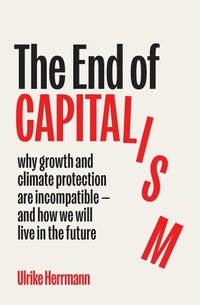
The End of Capitalism
Why Growth and Climate Protection Are Incompatible - and How We Will Live in the Future
Published on 13. March 2025
Book
Hardback
336 pages
978-1-915590-93-0 (ISBN)
Description
How do we manage to transition to a more sustainable world without the collapse of the economy?
Capitalism has brought about many positive things. At the same time, however, it is ruining the climate and the environment, so that humanity's very existence is now at risk. 'Green growth' is supposed to be the saviour, but economics expert and bestselling author Ulrike Herrmann disagrees. In this book, she explains in a clear and razor-sharp manner why we need 'green shrinkage' instead.
Greenhouse gases are increasing dramatically and unchecked. This failure is no coincidence, because the climate crisis goes to the heart of capitalism. Prosperity and growth are only possible if technology is used and energy is utilised. Unfortunately, however, green energy from the sun and wind will never be enough to fuel global growth. The industrialised countries must therefore bid farewell to capitalism and strive for a circular economy in which only what can be recycled is consumed.
Herrmann makes a convincing argument that we won't get anywhere without personal restrictions and government planning. Her example for a solution is the British war economy of the 1940s. This is not a utopian scenario, but a comprehensive example of the restrictions and government-led plans needed now and in the future.
The translation of this book was supported by a grant from the Goethe-Institut.
Capitalism has brought about many positive things. At the same time, however, it is ruining the climate and the environment, so that humanity's very existence is now at risk. 'Green growth' is supposed to be the saviour, but economics expert and bestselling author Ulrike Herrmann disagrees. In this book, she explains in a clear and razor-sharp manner why we need 'green shrinkage' instead.
Greenhouse gases are increasing dramatically and unchecked. This failure is no coincidence, because the climate crisis goes to the heart of capitalism. Prosperity and growth are only possible if technology is used and energy is utilised. Unfortunately, however, green energy from the sun and wind will never be enough to fuel global growth. The industrialised countries must therefore bid farewell to capitalism and strive for a circular economy in which only what can be recycled is consumed.
Herrmann makes a convincing argument that we won't get anywhere without personal restrictions and government planning. Her example for a solution is the British war economy of the 1940s. This is not a utopian scenario, but a comprehensive example of the restrictions and government-led plans needed now and in the future.
The translation of this book was supported by a grant from the Goethe-Institut.
Reviews / Votes
'The book attempts a long-overdue green realism. Herrmann, trained as a banker, speaks a language capitalists understand ... The book is a new, green Road to Serfdom. Unlike Friedrich Hayek's 1944 masterpiece, hers is a roadmap rather than a warning.' -- Timothy J. Lynch * Australian Book Review * 'A provocative argument for ending capitalism before capitalism ends us.' -- Jeff Sparrow, author of <em>Crimes Against Nature</em> 'The End of Capitalism abounds with examples of green technology as a false dawn ... Throughout, Herrmann's tone is measured and matter-of-fact, and David Shaw's fine translation maintains the integrity of her ideas as well as the clarity of their expression.' -- Ben Brooker * Overland * 'Herrmann argues that there is no choice other than radical and seemingly unimaginable change if we are to survive in anything like a civilised condition ... she does provide a clear explanation of the rise of capitalism and the social and technological forces that have made it the most transformative force in human history ... There is no doubt that unmitigated climate change and environmental degradation will transform our lives and the political systems that circumscribe them.' -- Mark Besson * The Conversation * 'German journalist Ulrike Herrmann provides a definitive account of the unsustainability of capitalism in our emerging climate crisis ... Combining historical, cultural, scientific and economic analysis with a hopeful yet realistic model, Herrmann paves our way out of the climate crisis, and into a new beginning.' -- Teddy Peak * Readings * 'She addresses what she believes to be the incompatible nature of market-based economies reliant on growth and the survival of humanity ... Ms Herrman said technological advancements to abate the worst excesses of capitalism, such as climate change, will not be enough to prevent complete environmental destruction ... Readers accustomed to creature comforts may find her ideas confronting, but this is an excellent book on our future.' * Red Tape * 'Ulrike Herrmann writes straightforwardly and with a great deal of expertise. This makes it clear once again how great a challenge climate change poses for us.' -- Claas Christophersen * NDR Kultur * 'Herrmann's book is worth reading and sets a counterpoint to all those who may overestimate the technological possibilities of climate protection.' -- Katja Scherer * Deutschlandfunk * 'This clever book ... by Ulrike Herrmann says that we should slowly forget about eternal growth and prepare ourselves for gradual renunciation.' * rbb Inforadio *More details
Language
English
Place of publication
London
United Kingdom
Dimensions
Height: 219 mm
Width: 139 mm
Thickness: 33 mm
Weight
450 gr
ISBN-13
978-1-915590-93-0 (9781915590930)
Copyright in bibliographic data and cover images is held by Nielsen Book Services Limited or by the publishers or by their respective licensors: all rights reserved.
Schweitzer Classification
Persons
Ulrike Herrmann was born in Hamburg in 1964. She trained as a banker and later as a journalist, and majored in philosophy and history. Since 2000 she has been an economics editor at the left-alternative national daily Die Tageszeitung, in Berlin. A member of the Greens, she appears regularly on German TV and radio, and often gives talks on economic topics at companies, foundations, institutes, and universities. She has previously published four books, which all became bestsellers in Germany.
David Shaw works as a journalist for Germany's international broadcaster, Deutsche Welle, as well as translating from several languages, including German, Dutch, Russian, and French. He lives in Berlin.
David Shaw works as a journalist for Germany's international broadcaster, Deutsche Welle, as well as translating from several languages, including German, Dutch, Russian, and French. He lives in Berlin.