

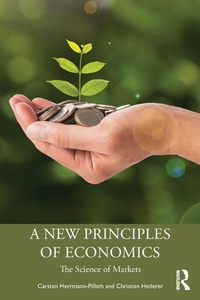
A New Principles of Economics
The Science of Markets
1st Edition
Published on 30. December 2022
Book
Paperback/Softback
506 pages
978-0-367-55719-5 (ISBN)
Description
Despite the dynamic development of the discipline of economics, the ways in which economics is taught and how it defines its basic principles have hardly changed, resulting in economics being criticised for its inability to provide relevant insights on global challenges. In response, this book defines new principles of economics and seeks to establish economics as the science of markets.
A New Principles of Economics provides an alternative conceptual framework for the study of economics, integrating recent developments and research in both economics and neighbouring social sciences. Adopting the structure of a standard principles text, it separates the study of markets as mechanisms and markets in their wider contexts. In doing so, a number of new perspectives are introduced, including approaching the economy as part and parcel of the Earth system; directly connecting the analysis of production with an analysis of technology and thermodynamic principles; explicitly treating markets as forms of social networks mediated by the institution of money; and reinstating the central role of distribution in political economy analysis. The book is accompanied by a series of video lectures prepared by the authors, which can be accessed at www.youtube.com/playlist?list=PLKe-ures4LFR_uTvCekrha4WFY-OcRjHD
Drawing on the latest theories and research on the economy, and including both the natural and social sciences, this text provides a holistic introduction suitable for postgraduates and other advanced students.
A New Principles of Economics provides an alternative conceptual framework for the study of economics, integrating recent developments and research in both economics and neighbouring social sciences. Adopting the structure of a standard principles text, it separates the study of markets as mechanisms and markets in their wider contexts. In doing so, a number of new perspectives are introduced, including approaching the economy as part and parcel of the Earth system; directly connecting the analysis of production with an analysis of technology and thermodynamic principles; explicitly treating markets as forms of social networks mediated by the institution of money; and reinstating the central role of distribution in political economy analysis. The book is accompanied by a series of video lectures prepared by the authors, which can be accessed at www.youtube.com/playlist?list=PLKe-ures4LFR_uTvCekrha4WFY-OcRjHD
Drawing on the latest theories and research on the economy, and including both the natural and social sciences, this text provides a holistic introduction suitable for postgraduates and other advanced students.
Reviews / Votes
"Introductory courses in economics are like gated communities; they rarely admit visitors from other disciplines. The authors' approach here, in contrast, is refreshingly interdisciplinary. The result is a novel approach to teaching -- and thinking about -- economics."Barry Eichengreen, George C. Pardee and Helen N. Pardee Professor of Economics and Political Science, Department of Economics, University of California at Berkeley
"Recommended for all of those readers who want to see economics going beyond values and markets, this book considers evolution, ecology, energy, history and technology as essential parts of a new synthesis."
Vaclav Smil, Distinguished Professor Emeritus at the University of Manitoba, a Fellow of the Royal Society of Canada (Science Academy), and a Member of the Order of Canada
"This book offers a fresh and vivid approach to the teaching and understanding of basic principles in economics. Using recent theoretical and empirical research, it invigorates and extends these principles in an exciting and highly insightful manner. It adopts a dynamic, evolutionary perspective and stresses the centrality of institutions in any economic system. This is a very important book."
Geoffrey Hodgson, Emeritus Professor in Management at Loughborough University London. Editor in Chief of the Journal of Institutional Economics
"Economics needs renovation. Carsten Herrmann-Pillath and Christian Hederer provide creative synthesis out of the combination of domains that are hitherto conceived to be foreign. Now, the time is mature to bring their transdisciplinary investigation to the front of the principles of economics."
Kiichiro Yagi, Emeritus Professor of Economics, Kyoto University
More details
Language
English
Place of publication
London
United Kingdom
Publishing group
Taylor & Francis Ltd
Target group
College/higher education
Postgraduate and Undergraduate
Illustrations
60 s/w Abbildungen, 2 s/w Photographien bzw. Rasterbilder, 58 s/w Zeichnungen, 1 s/w Tabelle
1 Tables, black and white; 58 Line drawings, black and white; 2 Halftones, black and white; 60 Illustrations, black and white
Dimensions
Height: 234 mm
Width: 156 mm
Thickness: 28 mm
Weight
781 gr
ISBN-13
978-0-367-55719-5 (9780367557195)
Copyright in bibliographic data and cover images is held by Nielsen Book Services Limited or by the publishers or by their respective licensors: all rights reserved.
Schweitzer Classification
Other editions
Additional editions
Book
12/2022
1st Edition
Routledge
€161.21
Shipment within 15-20 days

E-Book
12/2022
1st Edition
Routledge
€76.49
Available for download

E-Book
12/2022
1st Edition
Routledge
€76.49
Available for download
Persons
Carsten Herrmann-Pillath is Professor of Economics and Permanent Fellow at the Max Weber Centre for Advanced Cultural and Social Studies, University of Erfurt, Germany.
Christian Hederer is Professor of Economics and International Economic Policy at the Technical University of Applied Sciences Wildau, Germany.
Christian Hederer is Professor of Economics and International Economic Policy at the Technical University of Applied Sciences Wildau, Germany.
Content
Introduction PART I: 1. What Are Markets? 2. Economics as the science of markets 3. Economics and values PART II 4. Evolution, ecology, economy 5. Specialisation and cooperation 6. Production and technological evolution PART III 7. The economic agent 8. Networks and social interaction 9. Institutions 10. Money and value 11. Markets evolving PART IV 12. Money and finance 13. Economic fluctuations and aggregate economic evolution 14. The economics of global markets 15. Markets and inequality 16. Global economic growth in the Earth system PART V 17. Economic policy 18. Epilogue: The economist as adviser