

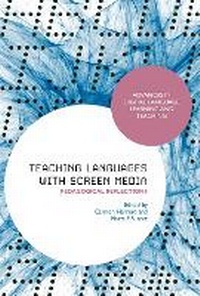
Teaching Languages with Screen Media
Pedagogical Reflections
Published on 23. January 2025
Book
Paperback/Softback
296 pages
978-1-350-21623-5 (ISBN)
Description
In recent years, the expansion of screen media, including film, TV, music videos, and computer games, has inspired new tools for both educators and learners. This book illustrates how screen media can be exploited to support foreign language (L2) teaching and learning.
Drawing on a range of theories and approaches from second language acquisition, audio-visual translation, multimodality, and new media and film studies, this book provides both best practices and in-depth research on this interdisciplinary field. Areas of screen media-enhanced learning and teaching are covered across 4 sections: film and broadcast media, in-depth case studies, translation and screen media, and interactive media. With a focus on pedagogical approaches to teaching and learning Spanish, French, German, and English as a Foreign Language, Teaching Languages with Screen Media presents innovative insights in this new interdisciplinary field.
Drawing on a range of theories and approaches from second language acquisition, audio-visual translation, multimodality, and new media and film studies, this book provides both best practices and in-depth research on this interdisciplinary field. Areas of screen media-enhanced learning and teaching are covered across 4 sections: film and broadcast media, in-depth case studies, translation and screen media, and interactive media. With a focus on pedagogical approaches to teaching and learning Spanish, French, German, and English as a Foreign Language, Teaching Languages with Screen Media presents innovative insights in this new interdisciplinary field.
Reviews / Votes
This book is an updated vision of how screen media can promote foreign language learning. Language students will feel motivated to learn through consuming, analyzing and producing interesting media artifacts that give them extended language learning opportunities beyond the classroom walls. -- M. Carmen Fonseca-Mora, University of Huelva, SpainMore details
Series
Language
English
Place of publication
London
United Kingdom
Publishing group
Bloomsbury Publishing PLC
Target group
College/higher education
Illustrations
11 bw illus.
Dimensions
Height: 232 mm
Width: 154 mm
Thickness: 18 mm
Weight
460 gr
ISBN-13
978-1-350-21623-5 (9781350216235)
Copyright in bibliographic data and cover images is held by Nielsen Book Services Limited or by the publishers or by their respective licensors: all rights reserved.
Schweitzer Classification
Other editions
Additional editions
E-Book
06/2023
1st Edition
Bloomsbury Academic
€31.99
Available for download
E-Book
06/2023
1st Edition
Bloomsbury Academic
€31.99
Available for download
Persons
Carmen Herrero is Principal Lecturer of Spanish at Manchester Metropolitan University, UK.
Marta F. Suarez is a Lecturer in Latin American Studies at Manchester Metropolitan University, UK.
Marta F. Suarez is a Lecturer in Latin American Studies at Manchester Metropolitan University, UK.
Content
List of Figures
List of Tables
Acknowledgments
Notes on Contributors
1. Screen Cultures and Language Education: Current and Future Trends in Teaching, Learning and Research, Carmen Herrero and Marta F. Suarez (Manchester Metropolitan University, UK)
Part I: Entertainment Media: Informed Research and Practice
2. Screen Media in Language Education: Towards a Student-Centred Approach, Carmen Herrero, Marta F. Suarez (Manchester Metropolitan University, UK) and Alicia Sanchez-Requena (Sheffield Hallam University, UK)
3. Integrating Screen Media into the Language Curriculum, Carmen Herrero (Manchester Metropolitan University, UK)
4. Bridging the Gaps Left by Boredom and Socio-Cultural Misperceptions: Does Foreign Film Pedagogy Hold the Answer? Mark Goodwin (University of Manchester, UK)
5. Teaching Languages to Generation Z Students: The Impact of the Use of Audiovisual Materials in the Spanish Classroom, Nazaret Perez Nieto (University of Cardiff, UK) and Ares Llop Naya (University of Cambridge, UK)
6. Language Education at the BBC: Past, Present and Future, Steven Barclay (City University London)
Part II: Interactive Screen Media: Informed Research and Practice
7. Designing an International Tourism Fair to Improve Students' Learning with Collaborative Work, Azahara Veroz Gonzalez and Soledad Diaz Alarcon (University of Cordoba, Spain)
8. Translating Film Reviews as a Means of Improving Students' Interlinguistic and Plurilingual Abilities, Mazal Oaknin (UCL, UK)
9. Benefits and Drawbacks of Using Social Networking Sites in Higher Education: The Case of Facebook as a Transmedia English Language Teaching Tool, Jelena Bobkina (Technical University of Madrid, Spain) and Elena Dominguez Romero (Complutense University of Madrid)
10. The Kinaesthetics of Gamification: Exploring the Theory behind Exergaming as a Potential Aid to Language Learning, Chris McGuirk (University of Central Lancashire, UK)
11. Video-Based Approaches to Foreign Language Pedagogy: Two Case Studies on Techno-CLIL in the Secondary School Classroom in Italy and the Netherlands, Michael Thomas (Liverpool John Moores University, UK) and Valentina Morgana (Universita Cattolica del Sacro Cuore, Italy)
12. Participatory Video in Practice: Filming with Women from the Sudanese Community in Bradford, Simona Manni (University of York, UK)
List of Tables
Acknowledgments
Notes on Contributors
1. Screen Cultures and Language Education: Current and Future Trends in Teaching, Learning and Research, Carmen Herrero and Marta F. Suarez (Manchester Metropolitan University, UK)
Part I: Entertainment Media: Informed Research and Practice
2. Screen Media in Language Education: Towards a Student-Centred Approach, Carmen Herrero, Marta F. Suarez (Manchester Metropolitan University, UK) and Alicia Sanchez-Requena (Sheffield Hallam University, UK)
3. Integrating Screen Media into the Language Curriculum, Carmen Herrero (Manchester Metropolitan University, UK)
4. Bridging the Gaps Left by Boredom and Socio-Cultural Misperceptions: Does Foreign Film Pedagogy Hold the Answer? Mark Goodwin (University of Manchester, UK)
5. Teaching Languages to Generation Z Students: The Impact of the Use of Audiovisual Materials in the Spanish Classroom, Nazaret Perez Nieto (University of Cardiff, UK) and Ares Llop Naya (University of Cambridge, UK)
6. Language Education at the BBC: Past, Present and Future, Steven Barclay (City University London)
Part II: Interactive Screen Media: Informed Research and Practice
7. Designing an International Tourism Fair to Improve Students' Learning with Collaborative Work, Azahara Veroz Gonzalez and Soledad Diaz Alarcon (University of Cordoba, Spain)
8. Translating Film Reviews as a Means of Improving Students' Interlinguistic and Plurilingual Abilities, Mazal Oaknin (UCL, UK)
9. Benefits and Drawbacks of Using Social Networking Sites in Higher Education: The Case of Facebook as a Transmedia English Language Teaching Tool, Jelena Bobkina (Technical University of Madrid, Spain) and Elena Dominguez Romero (Complutense University of Madrid)
10. The Kinaesthetics of Gamification: Exploring the Theory behind Exergaming as a Potential Aid to Language Learning, Chris McGuirk (University of Central Lancashire, UK)
11. Video-Based Approaches to Foreign Language Pedagogy: Two Case Studies on Techno-CLIL in the Secondary School Classroom in Italy and the Netherlands, Michael Thomas (Liverpool John Moores University, UK) and Valentina Morgana (Universita Cattolica del Sacro Cuore, Italy)
12. Participatory Video in Practice: Filming with Women from the Sudanese Community in Bradford, Simona Manni (University of York, UK)