

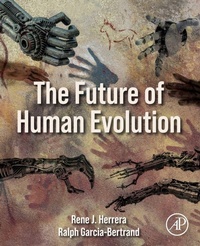
The Future of Human Evolution
Published on 17. November 2025
Book
Paperback/Softback
584 pages
978-0-443-28919-4 (ISBN)
Description
The Future of Human Evolution provides a discussion of how cultural, biological and microevolutionary (drift, selection, and mutation) pressures might affect our future as a species. The book is split into twelve chapters, beginning with evolutionary forecasting, and gene and culture coevolution. It then discusses life expectancy and population growth, followed by chapters on mutation rates, climate change and diet. This book also explores artificial selection and 'designer babies', trans-humanism and artificial intelligence (machine-human symbiosis), inequality and the colonization of space. The Future of Human Evolution serves as a valuable resource for both researchers and students studying human evolution and human population genetics, as well as non-academics with an interest in human evolution.
More details
Language
English
Place of publication
San Diego
United States
Publishing group
Elsevier Science Publishing Co Inc
Target group
Professional and scholarly
College/higher education
Product notice
Paperback (trade)
Dimensions
Height: 235 mm
Width: 193 mm
Thickness: 35 mm
Weight
1170 gr
ISBN-13
978-0-443-28919-4 (9780443289194)
Copyright in bibliographic data and cover images is held by Nielsen Book Services Limited or by the publishers or by their respective licensors: all rights reserved.
Schweitzer Classification
Other editions
Additional editions
Rene J. Herrera | Ralph Garcia-Bertrand
The Future of Human Evolution
E-Book
11/2025
Elsevier
€162.99
Available for download
Persons
Dr. Rene Herrera holds degrees from The City College of the City University of New York (BS), New York University (MS) and Fordham University (Ph.D). He continued his studies in molecular biology/genetic engineering as a postdoctoral associate at The Rockefeller University and New York Medical College. His areas of research include mechanisms underlying control of gene expression at the pre-mRNA splicing level, human evolution and human forensic DNA fingerprinting. He is a frequent contributor to journals in the field of human genetics. Dr. Herrera has established collaborative efforts with several leading scientists worldwide attesting to his philosophy of expanding the reaches of his research. His commitment to creating a professional foundation for future scientific generations has led him to contribute to the education of numerous students as a mentor. A total of 15 Ph.D. and 41 M.S. students obtained their degree under his supervision and hundreds of undergraduate students have benefited from his guidance in conducting research. He has been a member of numerous NIH, NSF and international research evaluation panels and grant evaluator for educational, and underrepresented student programs for decades. He teaches general courses in biology and genetics as well as advanced courses in human genetics, genetics, molecular biology, human evolution, microbiology, forensic DNA fingerprinting and anatomy/physiology. He routinely acts as consultant to the legal profession in issues involving forensic DNA fingerprinting. Ralph Garcia-Bertrand holds degrees from the University of Nevada (BS, MS), and The University of California, Riverside (PhD). He continued his studies as a University of California, Presidents Post-Doctoral Fellow in the Department of Genetics, at the University of California, Berkeley. His research focuses on human population genetics and evolution. Dr. Garcia-Bertrand was a former Chair of the Department of Molecular Biology, and the Verner Reed Professor of Genetics, at Colorado College. Dr. Garcia- Bertrand has won several teaching awards and has been the Director of undergraduate education programs funded by IBM, the Howard Hughes Medical Institute, and the Freeman Foundation. He was a subcommittee member for various NIH research, educational, and underrepresented student programs for over 22 years. He is a lifetime member of the Society for the Advancement of Chicanos and Native Americans in Science, and the National Association of Biology Teachers. He teaches general and advanced genetics, human evolution, and a course on the ethics of genetics
Content
1. Evolutionary Forecasting
2. Gene and culture coevolution
3. Life expectancy and population growth past, present, and future
4. Mutation rates, the Evolution of new genes and the role of epigenetics in evolution
5. Climate change and ecological collapse
6. Diet
7. Sex selection
8. Artificial selection and designer babies
9. Trans-humanism and artificial intelligence
10. Artificial intelligence
11. Political unrest and inequality
12. Space Colonization
2. Gene and culture coevolution
3. Life expectancy and population growth past, present, and future
4. Mutation rates, the Evolution of new genes and the role of epigenetics in evolution
5. Climate change and ecological collapse
6. Diet
7. Sex selection
8. Artificial selection and designer babies
9. Trans-humanism and artificial intelligence
10. Artificial intelligence
11. Political unrest and inequality
12. Space Colonization