

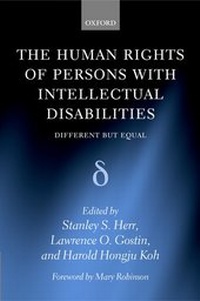
The Human Rights of Persons with Intellectual Disabilities
Different but Equal
Published on 5. June 2003
Book
Hardback
572 pages
978-0-19-826779-9 (ISBN)
Description
This volume brings together two important contemporary social movements: human rights and disability rights. It analyses the global struggle to realize equality, dignity, and comprehensive human and civil rights for persons with intellectual disabilities. In twenty original chapters, distinguished contributors from a range of disciplines address the latest international developments in the field. These include international human rights standards and other sources of legal protection, nondiscrimination laws and the economics of equality, preventative technology, remediation and habilitation, and lifestyle chices and autonomy.
The volume is unique in specifically considering the human rights of persons with intellectual disabilities from an international perspective. It identifies recent internatinal advances in their human rights and public policy positions, in addition to making recommendations for further advances at both the national and international levels.
Although human rights are universal and persons with intellectual disabilities are entitled to protection under general human rights law, the authors argue that there are differences that must be taken into account in order that the intellectually disabled can enjoy even the most basic of rights. This volume explores the implications of altering the status quo, and offers policy-makers and professionals ways to learn from each other's innovations in protecting rights, implementing quality assurance measures, and applying the concepts of inclusion and the 'least restrictive environment'.
The volume is unique in specifically considering the human rights of persons with intellectual disabilities from an international perspective. It identifies recent internatinal advances in their human rights and public policy positions, in addition to making recommendations for further advances at both the national and international levels.
Although human rights are universal and persons with intellectual disabilities are entitled to protection under general human rights law, the authors argue that there are differences that must be taken into account in order that the intellectually disabled can enjoy even the most basic of rights. This volume explores the implications of altering the status quo, and offers policy-makers and professionals ways to learn from each other's innovations in protecting rights, implementing quality assurance measures, and applying the concepts of inclusion and the 'least restrictive environment'.
Reviews / Votes
For generations, persons with intellectual disabilities have too often been the invisible minority: scorned, ignored , hidden from the world. This landmark volume demonstrates that a new era of respect, support, and opportunity has begun. These essays by acknowledged world leaders on human rights and intellectual disabilities emphasize the importance of effective action by all nations to protect these basic rights by implementing fair and sensible social policies. * Edward M. Kennedy, United States Senator from Massachusetts *More details
Language
English
Place of publication
Oxford
United Kingdom
Target group
Professional and scholarly
Illustrations
1 halftone frontispiece, 5 tables and 6 figures
Dimensions
Height: 213 mm
Width: 136 mm
Thickness: 45 mm
Weight
938 gr
ISBN-13
978-0-19-826779-9 (9780198267799)
Copyright in bibliographic data and cover images is held by Nielsen Book Services Limited or by the publishers or by their respective licensors: all rights reserved.
Schweitzer Classification
Other editions
Additional editions
Stanley S. Herr | Lawrence O. Gostin | Harold Hongju Koh
The Human Rights of Persons with Intellectual Disabilities
Different but Equal
Book
06/2003
Oxford University Press
€99.40
Shipment within 15-20 days
Persons
Professor Stanley S. Herr taught at the University of Maryland School of Law from 1983 until his death in September 2001. In addition to his work in public policy, he was a Switzer Distinguished Research Fellow of the National Insitiute of Disability and Rehabilitation Research, Schell Senior Research Fellow at the Yale Law School Schell Center for International Human Rights, and President of the American Association on Mental Retardation.
Lawrence O. Gostin is Professor of Law at Georgetown University, Professor of Public Health at the Johns Hopkins University, and Director of the Center for Law and the Public's Health at Georgetown and Johns Hopkins Univerities. He has contributed to U.S. government advisory boards in several areas of public health.
Harold Hongju Koh is the Gerard C. and Bernice Latrobe Smith Professor of International Law at Yale Law School, where he has taught since 1985. From 1998 to 2001, he served in the U.S. as Assistant Secretary of State for Democracy, Human Rights, and Labor. He has been a fellow of the American Academy of Arts and Sciences, and the Guggenheim and Century Foundations.
Lawrence O. Gostin is Professor of Law at Georgetown University, Professor of Public Health at the Johns Hopkins University, and Director of the Center for Law and the Public's Health at Georgetown and Johns Hopkins Univerities. He has contributed to U.S. government advisory boards in several areas of public health.
Harold Hongju Koh is the Gerard C. and Bernice Latrobe Smith Professor of International Law at Yale Law School, where he has taught since 1985. From 1998 to 2001, he served in the U.S. as Assistant Secretary of State for Democracy, Human Rights, and Labor. He has been a fellow of the American Academy of Arts and Sciences, and the Guggenheim and Century Foundations.
Editor
, Formerly of the University of Maryland School of Law
, Professor of Law, Georgetown University, Professor of Public Health, the Johns Hopkins University, and Director, Center for Law and the Public's Health
, Gerard C. and Bernice Latrobe Smith Professor of International Law, Yale Law School
Content
Dedication ; Foreword ; Introduction ; I. CONCEPTUALIZING INTELLECTUAL DISABILITIES: HISTORY AND TERMINOLOGY ; 1. Meeting the Needs of People with Intellectual Disabilities: International Perspectives ; 2. Terminology and Power ; 3. Definitions and Classifications in Cross-cultural Perspectives ; 4. Social Policy Toward Intellectual Disablilities in the Nineteenth and Twentieth Centuries ; II. THE HUMAN RIGHTS MOVEMENT: INTERNATIONAL NORMS AND STANDARDS ; 5. From Wrongs to Rights: International Human Rights and Legal Protection ; 6. Disability as a Subject of International Human Rights Law and Comparative Discrimination Law ; 7. Human Rights Standards and Legal Reforms ; 8. Liberty, Due Process, and the Pursuit of Happiness ; III. THE DISABILITY RIGHTS MOVEMENT: ANTI-DISCRIMINATION LEGISLATION ; 9. The Potential of Disability Nondiscrimination Laws ; 10. When Legislation Should Take Intellectual Disabilities into Account ; 11. Statutory Changes in Disability Policy: Types of Legislation, Policies, and Goals ; IV. EQUALITY AND DIFFERENCE: SOCIAL POLICY PERSPECTIVES ; 12. On Second Thoughts: Constructing knowledge, Law, Disability, and Inequality ; 13. Prevention of Disability: Is There a Conflict between Public health Prevention and Respect for Persons with Disabilities ; 14. Studying the Emerging Workforce ; 15. The Economics of Equality: An Exploration of Country Differences ; 16. Out-of-home Placement of Children with Intellectual Disabilities: the Need for a Family Support Policy ; 17. Self Determination, Autonomy, and Alternatives for Guardianship ; V. FUTURE GOALS AND ASPIRATIONS ; 18. Voices of Self-advocates ; 19. Recommendations for Developing Nations ; 20. Recommendations for the United Nations and International NGOs ; Conclusion