

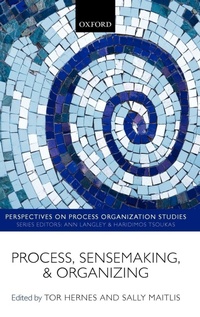
Process, Sensemaking, and Organizing
Published on 25. November 2010
Book
Hardback
344 pages
978-0-19-959456-6 (ISBN)
Description
Process, Sensemaking, and Organizing is the first in a series of volumes which explore perspectives on process theories, an emerging approach to the study of organizations that focuses on (understanding) activities, interactions, and change as essential properties of organizations rather than structures and state - an approach which prioritizes activity over product, change over persistence, novelty over continuity, and expression over determination.
Process and sensemaking may be seen as mutually interlocking phenomena and, as such, are cornerstones in process thinking, This volume brings together contributions from an international group of scholars energized by process organization studies. The collection offers perspectives from different disciplines, insights from diverse theoretical traditions and contexts, and parallels made with a range of cultural forms, including art, poetry, and cookery. At the same time, the chapters exhibit a clear emphasis on a process ontology, process theorizing, and narrative thinking. Across this rich and varied collection recurrent themes emerge that distinguish process theorizing from the more logico-scientific, variance-oriented research that dominates organization studies today. This book will appeal to academics, researchers, and graduate students in management, organization studies, and sociology who wish to better understand the emergent, changing, and flow-like character of organizational life and expand their understanding of the nature of sensemaking as a basis for organizing.
Process and sensemaking may be seen as mutually interlocking phenomena and, as such, are cornerstones in process thinking, This volume brings together contributions from an international group of scholars energized by process organization studies. The collection offers perspectives from different disciplines, insights from diverse theoretical traditions and contexts, and parallels made with a range of cultural forms, including art, poetry, and cookery. At the same time, the chapters exhibit a clear emphasis on a process ontology, process theorizing, and narrative thinking. Across this rich and varied collection recurrent themes emerge that distinguish process theorizing from the more logico-scientific, variance-oriented research that dominates organization studies today. This book will appeal to academics, researchers, and graduate students in management, organization studies, and sociology who wish to better understand the emergent, changing, and flow-like character of organizational life and expand their understanding of the nature of sensemaking as a basis for organizing.
More details
Series
Language
English
Place of publication
Oxford
United Kingdom
Target group
College/higher education
Professional and scholarly
Dimensions
Height: 240 mm
Width: 161 mm
Thickness: 23 mm
Weight
681 gr
ISBN-13
978-0-19-959456-6 (9780199594566)
Copyright in bibliographic data and cover images is held by Nielsen Book Services Limited or by the publishers or by their respective licensors: all rights reserved.
Schweitzer Classification
Other editions
Additional editions
Tor Hernes | Sally Maitlis
Process, Sensemaking, and Organizing
Book
05/2012
1st Edition
Oxford University Press
€80.90
Shipment within 15-20 days
Edited By Tor Hernes And Sally Maitlis
Process, Sensemaking, and Organizing
E-Book
05/2012
1st Edition
Oxford University Press
€170.83
Available for download
Persons
Tor Hernes is Professor of Organization Theory at Copenhagen Business School. Among his books are Understanding Organization as Process: Theory for a Tangled World (London: Routledge, 2007) and Actor-network Theory and Organizing (edited with Barbara Czarniawska, 2005, Copenhagen Business School). Tor Hernes works from a combination of process philosophy, systems theory and Actor-Network Theory.
Sally Maitlis is an Associate Professor of Organizational Behavior in the Sauder School of Business, University of British Columbia. Her work has been published in the Academy of Management Journal, Journal of Management Studies, MIT Sloan Management Review, Organization Science, and Organization Studies. She is a member of the Editorial Boards of the Academy of Management Journal, Academy of Management Review, and Organization Studies. She is currently serving as the International Representative-at-Large for the Management and Organizational Cognition Division of the Academy of Management.
Sally Maitlis is an Associate Professor of Organizational Behavior in the Sauder School of Business, University of British Columbia. Her work has been published in the Academy of Management Journal, Journal of Management Studies, MIT Sloan Management Review, Organization Science, and Organization Studies. She is a member of the Editorial Boards of the Academy of Management Journal, Academy of Management Review, and Organization Studies. She is currently serving as the International Representative-at-Large for the Management and Organizational Cognition Division of the Academy of Management.
Content
Introducing Perspectives on Process Organization Studies ; Process, Sensemaking, and Organizaing: an Introduction ; Stop Making (Philosophical) Sense: Notes towards a Process Organizational-thinking beyond 'Philosophy' ; Co-Constitution, Causality, and Confluence: Organizing in a World without Entities ; Adopting a Process Orientation...in Practice: Chiasmic Relations, Language, and Embodiment in a Living World ; The Poetics of Process: Theorizing the Ineffable in Organization Studies ; Rediscovering Becoming: Insights from an Oriental Perspective on Process Organization Studies ; Going Back to Go Forward: On Studying Organzing in Action Nets ; Actor-Network Theory, Callon's Scallops, and Process-based Organization Studies ; Organizational Learning through Problem Absorption: a Processual View ; Temporal Sensemaking: Managers' Use of Time to Frame Organizational Change ; Studying Metaphors-in-use in their Social and Institutional Context - Sensemaking and Discourse Theory ; Future-oriented Sensemaking: Temporalities and Institutional Legitimation