

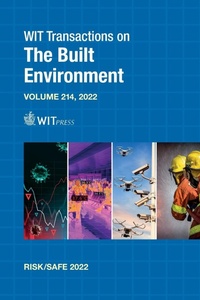
Risk Analysis, Hazard Mitigation and Safety and Security Engineering XIII
Published on 12. December 2022
Book
Hardback
202 pages
978-1-78466-483-1 (ISBN)
Description
Research and industrial developments in the theoretical and practical aspects of safety and security engineering are the focus of this volume. This field, due to its special nature, is an interdisciplinary area of research and application that brings together, in a systematic way, many disciplines of engineering from the traditional to the most technologically advanced. The included papers, which were originally presented at the 13th Conference on Risk Analysis, Hazard Mitigation and Safety and Security Engineering, cover areas such as crisis management, security engineering, natural disasters and emergencies, terrorism, IT security, man-made hazards, pandemics, transportation security, protection and mitigation issues, among others.
Also covered are various aspects of risk management and hazard mitigation, associated with both natural and anthropogenic hazards. Current events help to emphasise the importance of the analysis and management of risk to planners and researchers around the world. Natural hazards such as floods, earthquakes, landslides, fires, epidemics, transportation, climate change, fake news and others have always affected human societies. The more recent emergence of the importance of man-made hazards is a consequence of the rapid technological advances made in the last few centuries. The interaction of natural and anthropogenic risks adds to the complexity of the problems.
Research and industrial developments in the theoretical and practical aspects of safety and security engineering are the focus of this volume. This field, due to its special nature, is an interdisciplinary area of research and application that brings together, in a systematic way, many disciplines of engineering from the traditional to the most technologically advanced. The included papers, which were originally presented at the 13th Conference on Risk Analysis, Hazard Mitigation and Safety and Security Engineering, cover areas such as crisis management, security engineering, natural disasters and emergencies, terrorism, IT security, man-made hazards, pandemics, transportation security, protection and mitigation issues, among others.
Also covered are various aspects of risk management and hazard mitigation, associated with both natural and anthropogenic hazards. Current events help to emphasise the importance of the analysis and management of risk to planners and researchers around the world. Natural hazards such as floods, earthquakes, landslides, fires, epidemics, transportation, climate change, fake news and others have always affected human societies. The more recent emergence of the importance of man-made hazards is a consequence of the rapid technological advances made in the last few centuries. The interaction of natural and anthropogenic risks adds to the complexity of the problems.
Also covered are various aspects of risk management and hazard mitigation, associated with both natural and anthropogenic hazards. Current events help to emphasise the importance of the analysis and management of risk to planners and researchers around the world. Natural hazards such as floods, earthquakes, landslides, fires, epidemics, transportation, climate change, fake news and others have always affected human societies. The more recent emergence of the importance of man-made hazards is a consequence of the rapid technological advances made in the last few centuries. The interaction of natural and anthropogenic risks adds to the complexity of the problems.
Research and industrial developments in the theoretical and practical aspects of safety and security engineering are the focus of this volume. This field, due to its special nature, is an interdisciplinary area of research and application that brings together, in a systematic way, many disciplines of engineering from the traditional to the most technologically advanced. The included papers, which were originally presented at the 13th Conference on Risk Analysis, Hazard Mitigation and Safety and Security Engineering, cover areas such as crisis management, security engineering, natural disasters and emergencies, terrorism, IT security, man-made hazards, pandemics, transportation security, protection and mitigation issues, among others.
Also covered are various aspects of risk management and hazard mitigation, associated with both natural and anthropogenic hazards. Current events help to emphasise the importance of the analysis and management of risk to planners and researchers around the world. Natural hazards such as floods, earthquakes, landslides, fires, epidemics, transportation, climate change, fake news and others have always affected human societies. The more recent emergence of the importance of man-made hazards is a consequence of the rapid technological advances made in the last few centuries. The interaction of natural and anthropogenic risks adds to the complexity of the problems.
More details
Series
Language
English
Place of publication
Southampton
United Kingdom
Target group
Professional and scholarly
College/higher education
Dimensions
Height: 260 mm
Width: 183 mm
Thickness: 16 mm
Weight
585 gr
ISBN-13
978-1-78466-483-1 (9781784664831)
Copyright in bibliographic data and cover images is held by Nielsen Book Services Limited or by the publishers or by their respective licensors: all rights reserved.
Schweitzer Classification
Content
Section 1: Risk analysis, assessment and management
Can we assess landslide hazards in the volcanic crater of Lake Albano, Rome, Italy?;
Geostatistical modeling of seismic actions on the structural components of the San Benedetto Road Tunnel, Italy; Road tunnel risk-based safety design methodology by GU@LARP quantum risk model; Managing homeless patient risk in a U.S. healthcare system
Section 2: Risk in construction and management
Pedestrian mobility in the proximity of construction sites: An approach to analyse and improve the pedestrian experience; Risk-based tunnel design for consequences of road accidents: The role of tunnel length; Analytical model for assessing the resilience of cross-border critical transportation infrastructure
Section 3: Cybersecurity/e-security
Building vulnerability assessment for explosive and CBR terrorist attacks; Strengthening of disaster risk management strategies in the Peruvian rainforest in the face of debris flow through a vulnerability approach; Best practices for vulnerability management in large enterprises: A critical view on the common vulnerability scoring system
Section 4: Safety and security engineering
Emotional analysis of safeness and risk perception of different payment systems in Italy and the UK during the COVID-19 pandemic; Promoting system safety and reliability through risk quantification/visualisation methodology; Effect of different nanomaterial additions in clay-based composites; Safety challenges when managing shift work in the Swedish forest industry: Solutions based on more than 700 years of work experience; Safety aspects related to implanted breast prostheses
Can we assess landslide hazards in the volcanic crater of Lake Albano, Rome, Italy?;
Geostatistical modeling of seismic actions on the structural components of the San Benedetto Road Tunnel, Italy; Road tunnel risk-based safety design methodology by GU@LARP quantum risk model; Managing homeless patient risk in a U.S. healthcare system
Section 2: Risk in construction and management
Pedestrian mobility in the proximity of construction sites: An approach to analyse and improve the pedestrian experience; Risk-based tunnel design for consequences of road accidents: The role of tunnel length; Analytical model for assessing the resilience of cross-border critical transportation infrastructure
Section 3: Cybersecurity/e-security
Building vulnerability assessment for explosive and CBR terrorist attacks; Strengthening of disaster risk management strategies in the Peruvian rainforest in the face of debris flow through a vulnerability approach; Best practices for vulnerability management in large enterprises: A critical view on the common vulnerability scoring system
Section 4: Safety and security engineering
Emotional analysis of safeness and risk perception of different payment systems in Italy and the UK during the COVID-19 pandemic; Promoting system safety and reliability through risk quantification/visualisation methodology; Effect of different nanomaterial additions in clay-based composites; Safety challenges when managing shift work in the Swedish forest industry: Solutions based on more than 700 years of work experience; Safety aspects related to implanted breast prostheses