

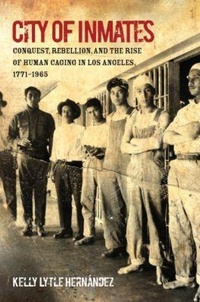
City of Inmates
Conquest, Rebellion, and the Rise of Human Caging in Los Angeles, 1771-1965
Published on 1. February 2020
Book
Paperback/Softback
312 pages
978-1-4696-5919-0 (ISBN)
Description
Los Angeles incarcerates more people than any other city in the United States, which imprisons more people than any other nation on Earth. This book explains how the City of Angels became the capital city of the world's leading incarcerator. Marshaling more than two centuries of evidence, historian Kelly Lytle Hernandez unmasks how histories of native elimination, immigrant exclusion, and black disappearance drove the rise of incarceration in Los Angeles. In this telling, which spans from the Spanish colonial era to the outbreak of the 1965 Watts Rebellion, Hernandez documents the persistent historical bond between the racial fantasies of conquest, namely its settler colonial form, and the eliminatory capacities of incarceration.
But City of Inmates is also a chronicle of resilience and rebellion, documenting how targeted peoples and communities have always fought back. They busted out of jail, forced Supreme Court rulings, advanced revolution across bars and borders, and, as in the summer of 1965, set fire to the belly of the city. With these acts those who fought the rise of incarceration in Los Angeles altered the course of history in the city, the borderlands, and beyond. This book recounts how the dynamics of conquest met deep reservoirs of rebellion as Los Angeles became the City of Inmates, the nation's carceral core. It is a story that is far from over.
But City of Inmates is also a chronicle of resilience and rebellion, documenting how targeted peoples and communities have always fought back. They busted out of jail, forced Supreme Court rulings, advanced revolution across bars and borders, and, as in the summer of 1965, set fire to the belly of the city. With these acts those who fought the rise of incarceration in Los Angeles altered the course of history in the city, the borderlands, and beyond. This book recounts how the dynamics of conquest met deep reservoirs of rebellion as Los Angeles became the City of Inmates, the nation's carceral core. It is a story that is far from over.
Reviews / Votes
Offers a radically new perspective . . . . City of Inmates demonstrates incontrovertibly that the systems of immigrant exclusion and mass incarceration emerged together and fed each other." - The Metropole"By widening the historical frame, [Hernandez] offers the reader a deeper, more complex, and more historically nuanced view of incarceration. An essential contribution to critical prison studies (CPS)." - H-Net Reviews
"Details how successive authoritarian powers in present-day Los Angeles have targeted and captured people using cages to create what is now one of the world's largest prison societies, and ends with a call for it to be destroyed." - The New Inquiry
"City of Inmates is a story of removal and dispossession. It is a story of environmental transformation with the use of a subjugated work force (chain gangs). And it is the story of the rise of the human cage--an object that has been both a tool of removal from the land and a racialized environment itself." - Environmental History
"A beautifully narrated, deeply insightful historical assessment of the dynamics of American settler colonialism. . . . Remarkable for the depth and breadth of the research that undergirds each of its narratives." - Journal of American History
"An astoundingly original evaluation of the central place of incarceration in the history of Los Angeles. . . . City of Inmates is a book that should be read by every person seriously concerned with the question of how we got to where we are, and where we might go from here." - Pacific Historical Review
"Marshaling more than two centuries of historical data, Hernandez finds that native elimination, immigrant exclusion, and black disappearance drove the rise of mass incarceration in Los Angeles from the Spanish colonial era to the outbreak of the 1965 Watts Rebellion." - Law & Social Inquiry
"Convincingly demonstrates that the history of American prisons indexes major social and political battles of the country's history." - Western Historical Quarterly
"An incisive and meticulously researched study of the transformation of Los Angeles from a small group of Native American communities in the 18th century into an Aryan city of the sun in the 20th." - Los Angeles Review of Books
"Hernandez puts in perspective the arrests, convictions, and incarceration for one city that contributes to the US being the carceral capital of the world. Recommended."- Choice
More details
Series
Language
English
Place of publication
Chapel Hill
United States
Target group
Children/juvenile
Product notice
Paperback (trade)
Illustrations
26 halftones, 2 maps, 4 tables
Dimensions
Height: 234 mm
Width: 158 mm
Thickness: 22 mm
Weight
469 gr
ISBN-13
978-1-4696-5919-0 (9781469659190)
Copyright in bibliographic data and cover images is held by Nielsen Book Services Limited or by the publishers or by their respective licensors: all rights reserved.
Schweitzer Classification
Other editions
Additional editions

Kelly Lytle Hernández
City of Inmates
Conquest, Rebellion, and the Rise of Human Caging in Los Angeles, 1771-1965
E-Book
02/2017
The University of North Carolina Press
€19.49
Available for download
Person
Kelly Lytle Hernandez is professor of history and African American studies at UCLA. She is also interim director of the Ralph J. Bunche Center for African American Studies at UCLA. One of the nation's leading experts on race, immigration, and mass incarceration, she is author of the award-winning book Migra! A History of the U.S. Border Patrol (University of California Press, 2010) and City of Inmates: Conquest, Rebellion, and the Rise of Human Caging in Los Angeles (University of North Carolina Press, 2017). Currently, Professor Lytle Hernandez is the research lead for the Million Dollar Hoods project, which maps how much is spent on incarceration per neighborhood in Los Angeles County.