

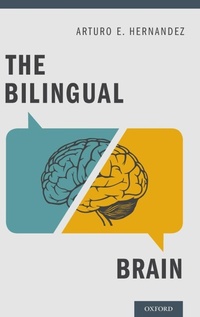
The Bilingual Brain
Published on 10. October 2013
Book
Hardback
206 pages
978-0-19-982811-1 (ISBN)
Description
Cases of language loss and recovery bring up an intriguing paradox. If two languages are stored in the brain, how can it be that a person can lose one of them, but not the other, and then gain one back without relearning it? The traditional models of how a language is represented in the brain suggest that languages can become inaccessible, even though they are not entirely lost. As the author demonstrates through fascinating cases, stress--whether due to foreign language immersion, sleep deprivation, or brain damage--can lead to the apparent loss of one language, but not the other. Arturo Hernandez presents the results of 25 years of research into the factors that might help us to understand how two (or more) languages are stored in one brain. It is clear that the brain is not egalitarian--some languages are privileged and others are not, but why?
Hernandez will extend recent work that has begun to take a biological or natural systems approach. He proposes that, in bilinguals, two languages live inside a brain almost like two species live in an ecosystem. For the most part they peacefully co-exist and often share resources. But they also compete for resources, particularly when under stress. Although there are still many questions to answer and many puzzles to solve, Hernandez argues that the nonlinear dynamical models, which have been used to uncover the underlying mechanisms seen in natural systems and more recently in language and cognition, can be used to shed considerable light on the neural bases of bilingualism.
Hernandez will extend recent work that has begun to take a biological or natural systems approach. He proposes that, in bilinguals, two languages live inside a brain almost like two species live in an ecosystem. For the most part they peacefully co-exist and often share resources. But they also compete for resources, particularly when under stress. Although there are still many questions to answer and many puzzles to solve, Hernandez argues that the nonlinear dynamical models, which have been used to uncover the underlying mechanisms seen in natural systems and more recently in language and cognition, can be used to shed considerable light on the neural bases of bilingualism.
More details
Language
English
Place of publication
New York
United States
Target group
Professional and scholarly
Academics and educated students with a basic understanding of psychology and neuroscience or a curiosity for case studies about bilingualism and the brain.
Dimensions
Height: 240 mm
Width: 161 mm
Thickness: 16 mm
Weight
479 gr
ISBN-13
978-0-19-982811-1 (9780199828111)
Copyright in bibliographic data and cover images is held by Nielsen Book Services Limited or by the publishers or by their respective licensors: all rights reserved.
Schweitzer Classification
Other editions
Additional editions
Arturo E. Hernandez
The Bilingual Brain
E-Book
08/2013
1st Edition
OUP eBook
€53.99
Available for download
Person
Arturo Hernandez is currently Professor of Psychology and Director of the Developmental Cognitive Neuroscience graduate program at the University of Houston. His major research interest is in the neural underpinnings of bilingual language processing and second language acquisition in children and adults. He has used a variety of neuroimaging methods as well as behavioral techniques to investigate these phenomena which have been published in a number of peer reviewed journal articles. His research is currently funded by a grant from the National Institutes of Child Health and Human Development. Hernandez's interest in language learning has also been informed by having learned four languages at various points during his life.
Content
Table of Contents ; Chapter 1: Antagonists, parasites, and symbiotes ; Chapter 2. The sensorimotor nature of early learning ; Chapter 4: Proficiency, efficiency and expertise ; Chapter 5: Practice what you speak ; Chapter 6: Controlled adjustments ; Chapter 7: Control, flexibility and the two language dilemma ; Chapter 8: The final frontier ; Bibliography