

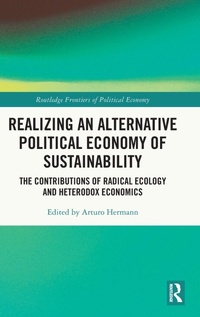
Realizing an Alternative Political Economy of Sustainability
The Contributions of Radical Ecology and Heterodox Economics
1st Edition
Published on 25. July 2025
Book
Hardback
294 pages
978-1-032-46927-0 (ISBN)
Description
Engagement with and between a plurality of progressive, non-neoclassical traditions is an important step in fostering a more capacious understanding of sustainability - both as a concept and as a political objective. To that end, this book provides a critical overview of the development of alternative perspectives on the economics of sustainability, highlighting the presence of various strands of heterodox economics and radical ecology, and arguing that greater engagement between these schools of thought is required to help formulate viable alternatives to the prevailing neoliberal ideology.
The chapters in Part I of this volume, "Ecofeminism, Social Ecological Economics, Bioeconomics, Steady State", present a series of concrete policy proposals for building socially just, sustainable socio-economic processes. Each chapter utilizes the acumen of a given heterodox tradition to formulate policy reforms to secure this objective. In Part II, "Heterodox Macroeconomics and Sustainability", the contributors make the case for more radical forms of socio-economic transformation, particularly emphasizing community, local and regional level initiatives for change. The final part, "Circular Economy, Civil Economy and Other Heterodox Contributions", reflects on the potential strategic political-economic contribution of heterodox economics to building more sustainable and just socio-economic practices in a broader sense. These chapters demonstrate that heterodox economics and radical ecology can productively contribute to realizing sustainability in areas such as economic pedagogy, through working in conjunction with other social justice movements, and by challenging extant neoliberal ideologies of sustainability. They also deliberate on some of the institutional and epistemological challenges that confront heterodox practitioners seeking to make such an impact.
This volume is essential reading for anyone concerned with a viable alternative conception of the economy and sustainability, including readers from all schools of heterodox economics and radical ecology, and people and organizations involved in various ways in building an alternative political economy of sustainability.
The chapters in Part I of this volume, "Ecofeminism, Social Ecological Economics, Bioeconomics, Steady State", present a series of concrete policy proposals for building socially just, sustainable socio-economic processes. Each chapter utilizes the acumen of a given heterodox tradition to formulate policy reforms to secure this objective. In Part II, "Heterodox Macroeconomics and Sustainability", the contributors make the case for more radical forms of socio-economic transformation, particularly emphasizing community, local and regional level initiatives for change. The final part, "Circular Economy, Civil Economy and Other Heterodox Contributions", reflects on the potential strategic political-economic contribution of heterodox economics to building more sustainable and just socio-economic practices in a broader sense. These chapters demonstrate that heterodox economics and radical ecology can productively contribute to realizing sustainability in areas such as economic pedagogy, through working in conjunction with other social justice movements, and by challenging extant neoliberal ideologies of sustainability. They also deliberate on some of the institutional and epistemological challenges that confront heterodox practitioners seeking to make such an impact.
This volume is essential reading for anyone concerned with a viable alternative conception of the economy and sustainability, including readers from all schools of heterodox economics and radical ecology, and people and organizations involved in various ways in building an alternative political economy of sustainability.
Reviews / Votes
"Revisiting the main contributions of heterodox economics and radical ecology is particularly stimulating because it is rapidly becoming clear that we are at a historical juncture where the nature of capitalism is radically changing along with the characteristics of democracy and the problems of environmental sustainability.The neoliberal order that emerged in America in the 1970s after the collapse of the Soviet Union promoted deregulation and globalization with the promise of greater prosperity for all. An indirect consequence of the expansion of this order was the rise of so-called neoclassical economic theories and the corresponding marginalization of alternative approaches, especially institutionalism.
In the aftermath of the global financial crisis, it is no longer possible to believe that neoliberal promises have been kept. There are clearly losers as well as winners in the struggle for globalization; the growth of income inequality and the resulting increase in popular discontent have led to the disruption of traditional democratic balances, the growth of political polarization and the worsening of the environmental problems. Neoclassical views do not seem to be able to fully respond to the new challenges that are emerging. Therefore, an approach from different perspectives and different schools of economic thought may be helpful in addressing the current critical juncture.
The contributions in this volume provide a critical reflection on the ongoing social and economic transformations, offering the reader stimulating and alternative perspectives on capitalism, democracy and sustainability."
Massimo Egidi, Professor of Economics at Libera Universita Internazionale degli Studi Sociali Guido Carli in Rome and former rector of the university.
"Climate emergency and ecological breakdown pose existential threats, and the inadequacy of mainstream economics (largely based on the unrealistic neoclassical notion of "weak sustainability") has been a contributing factor to this ominous state of affairs. This collection, built on constructive pluralism and dialogue, provides an opportunity to think and act differently."
Jamie Morgan, Professor of Economics at Leeds Beckett University
"Contemporary capitalism faces sustainability challenges on a number of fronts. The events of 2007-09 and the more recent descent into illiberalism question its financial and social sustainability, while the unfolding climate crisis questions its environmental sustainability. These challenges are easy to identify, but the pressing need is to formulate responses. By bringing together contributions from radical ecology and heterodox economics, this book takes important steps towards addressing the urgent need to reconcile economic activity with a finite planet."
Mark Setterfield, New School For Social Research
More details
Series
Language
English
Place of publication
London
United Kingdom
Publishing group
Taylor & Francis Ltd
Target group
College/higher education
Postgraduate
Illustrations
14 s/w Abbildungen, 14 s/w Photographien bzw. Rasterbilder, 13 s/w Tabellen
13 Tables, black and white; 14 Halftones, black and white; 14 Illustrations, black and white
Dimensions
Height: 240 mm
Width: 161 mm
Thickness: 21 mm
Weight
631 gr
ISBN-13
978-1-032-46927-0 (9781032469270)
Copyright in bibliographic data and cover images is held by Nielsen Book Services Limited or by the publishers or by their respective licensors: all rights reserved.
Schweitzer Classification
Other editions
Additional editions
Arturo Hermann
Realizing an Alternative Political Economy of Sustainability
The Contributions of Radical Ecology and Heterodox Economics
E-Book
07/2025
Routledge
€60.99
Available for download
Arturo Hermann
Realizing an Alternative Political Economy of Sustainability
The Contributions of Radical Ecology and Heterodox Economics
E-Book
07/2025
Routledge
€60.99
Available for download
Person
Arturo Hermann is a "Senior researcher" ("Primo ricercatore") in economics at the Italian National Institute of Statistics (Istat), Rome, Italy.
Content
Introduction Part I : Ecofeminism, Social Ecological Economics, Bioeconomics, Steady State 1. Toward Ecofeminist Radical Political Economy in Action: Strategies for Sustainable Societal Transformations 2. Challenging the Economic Mainstreaming of Sustainability and Social-Ecological Crises 3. Hermans Daly's Political Economy for Sustainability: The Steady-State and Other Policies for Ending Uneconomic Growth 4. The Bioeconomics of Nicholas Georgescu-Roegen: a new epistemological foundation for economic science 5. Bioeconomics and the approach to environmental sustainability. The ecological transition:a new "economic myth"? Part II: Heterodox Macroeconomics and Sustainability 6. Principles of post-Keynesian Ecological Economics 7. Green Finance 8. A Kaleckian-Schumpeterian Synthesis to Secure Sustainability 9. Economic Policy and Sustainability in a Monetary Economy: A Monetary Theory of Production Approach 10. The social role of central banking in promoting an equitable and sustainable society 11. Step by radical step: the macroeconomics of a degrowth transition Part III : Circular Economy, Civil Economy and Other Heterodox Contributions 12. Shifting to circular economy principles that could counter environmental changes and reduce inequalities 13. Circular Economy and Philosophy of Economics 14. From linear to circular model ESG criteria, EU policies and the new paradigm of civil economy 15. Radical Ecology and Original Institutional Economics