

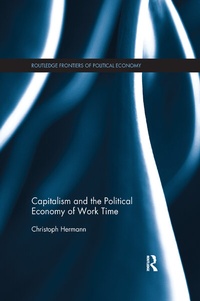
Capitalism and the Political Economy of Work Time
1st Edition
Published on 23. August 2018
Book
Paperback/Softback
236 pages
978-1-138-37765-3 (ISBN)
Description
John Maynard Keynes expected that around the year 2030 people would only work 15 hours a week. In the mid-1960s, Jean Fourastie still anticipated the introduction of the 30-hour week in the year 2000, when productivity would continue to grow at an established pace. Productivity growth slowed down somewhat in the 1970s and 1980s, but rebounded in the 1990s with the spread of new information and communication technologies. The knowledge economy, however, did not bring about a jobless future or a world without work, as some scholars had predicted. With few exceptions, work hours of full-time employees have hardly fallen in the advanced capitalist countries in the last three decades, while in a number of countries they have actually increased since the 1980s.
This book takes the persistence of long work hours as starting point to investigate the relationship between capitalism and work time. It does so by discussing major theoretical schools and their explanations for the length and distribution of work hours, as well as tracing major changes in production and reproduction systems, and analyzing their consequences for work hours.
Furthermore, this volume explores the struggle for shorter work hours, starting from the introduction of the ten-hour work day in the nineteenth century to the introduction of the 35-hour week in France and Germany at the end of the twentieth century. However, the book also shows how neoliberalism has eroded collective work time regulations and resulted in an increase and polarization of work hours since the 1980s. Finally, the book argues that shorter work hours not only means more free time for workers, but also reduces inequality and improves human and ecological sustainability.
This book takes the persistence of long work hours as starting point to investigate the relationship between capitalism and work time. It does so by discussing major theoretical schools and their explanations for the length and distribution of work hours, as well as tracing major changes in production and reproduction systems, and analyzing their consequences for work hours.
Furthermore, this volume explores the struggle for shorter work hours, starting from the introduction of the ten-hour work day in the nineteenth century to the introduction of the 35-hour week in France and Germany at the end of the twentieth century. However, the book also shows how neoliberalism has eroded collective work time regulations and resulted in an increase and polarization of work hours since the 1980s. Finally, the book argues that shorter work hours not only means more free time for workers, but also reduces inequality and improves human and ecological sustainability.
More details
Series
Language
English
Place of publication
London
United Kingdom
Publishing group
Taylor & Francis Ltd
Target group
College/higher education
Illustrations
3 s/w Abbildungen, 3 s/w Zeichnungen, 7 s/w Tabellen
7 Tables, black and white; 3 Line drawings, black and white; 3 Illustrations, black and white
Dimensions
Height: 234 mm
Width: 156 mm
Weight
480 gr
ISBN-13
978-1-138-37765-3 (9781138377653)
Copyright in bibliographic data and cover images is held by Nielsen Book Services Limited or by the publishers or by their respective licensors: all rights reserved.
Schweitzer Classification
Other editions
Additional editions
Christoph Hermann
Capitalism and the Political Economy of Work Time
E-Book
10/2014
1st Edition
Routledge
€72.49
Available for download
Christoph Hermann
Capitalism and the Political Economy of Work Time
E-Book
10/2014
1st Edition
Routledge
€72.49
Available for download
Christoph Hermann
Capitalism and the Political Economy of Work Time
Book
10/2014
1st Edition
Routledge
€217.50
Shipment within 15-20 days
Person
Christoph Hermann is a senior researcher at the Working Life Research Centre in Vienna and a lecturer at the University of Vienna, Austria.
Content
1. Introduction PART I: Work Time Theories 2. Neoclassical, Weberian, and Institutionalist Perspectives 3. Marxist, Post-Marxist, and Feminist Perspectives 4. Causes and Consequences: Debating Work Time Theories PART II: Work Time, Production, and Reproduction 5. From Fordism to Lean Production 6. The Fragmented World of Service Work 7. Gender Persistence in Domestic Work PART III: Work Time Struggles 8. The Establishment of a Normal Workday and Week 9. Work Time Reduction and Flexibilization PART IV: Conclusions 10. Neoliberalism and the Surge in Work Hours 11. Capitalism and Work Time