

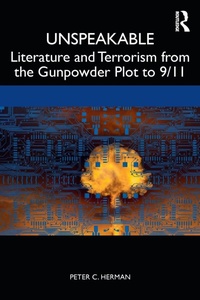
Unspeakable
Literature and Terrorism from the Gunpowder Plot to 9/11
1st Edition
Published on 25. September 2019
Book
Paperback/Softback
212 pages
978-0-367-24900-7 (ISBN)
Description
Unspeakable: Literature and Terrorism from the Gunpowder Plot to 9/11 explores the representation of terrorism in plays, novels, and films across the centuries. Time and time again, writers and filmmakers including William Shakespeare, Joseph Conrad, Henry James, Gillo Pontecorvo, Don DeLillo, John Updike, and Steven Spielberg refer to terrorist acts as beyond comprehension, "a deed without a name," but they do not stop there. Instead of creating works that respond to terrorism by providing comforting narratives reassuring audiences and readers of their moral superiority and the perfidy of the terrorists, these writers and filmmakers confront the unspeakable by attempting to see the world from the terrorist's perspective and by examining the roots of terrorist violence.
Reviews / Votes
Peter Herman's expansive study causes us to question and reconsider what we think we know about terrorism and about those who engage in such acts. The range of the text ? from the Gunpowder Plot to 9/11 - highlights the paradoxical impulses (to speak and not to speak) at the heart of any narrative about terrorism. -- Tim Gauthier, University of Nevada, Las VegasThis is a must-read book for anybody interested in the cultural interpretation of terrorism. By zooming in on the speakability/unspeakability paradox, characteristic of acts of terrorism, Peter Herman succeeds in revealing how literature and film create a counter-narrative that undoes simplistic ideological interpretations of political violence. His readings demonstrate how the possible worlds of fiction and film create a triangulating discourse that runs counter to the reductive us-versus-them rhetoric, current in journalistic and political interpretations of terrorist events. -- Kristiaan Versluys, Ghent University, Belgium
Peter Herman's book is a fine demonstration of what the humanities might provide to the study of terrorism, usually left to social sciences...Historians and literary and film scholars, in particular, will find the book a welcome addition, but one might hope that terror experts in the social sciences will read it for a new perspective from the humanities for understanding terrorist events in their human complexity. --Ann Larabee, Modern Philology
For Herman writers of fiction 'have always offered us the tools for a better understanding of terrorism. We just need to pay attention.' This scholarly, insightful, and illuminating book gives these writers their due attention, and it also shows how the one-dimensional representations it critiques have too often obscured our historical understanding of terrorism, and too often left us dangerously blind in one eye. -- Matthew Carr, Infernal Machine
More details
Language
English
Place of publication
London
United Kingdom
Publishing group
Taylor & Francis Ltd
Target group
College/higher education
Illustrations
35 s/w Abbildungen, 32 s/w Photographien bzw. Rasterbilder, 3 s/w Zeichnungen
3 Line drawings, black and white; 32 Halftones, black and white; 35 Illustrations, black and white
Dimensions
Height: 229 mm
Width: 152 mm
Thickness: 12 mm
Weight
335 gr
ISBN-13
978-0-367-24900-7 (9780367249007)
Copyright in bibliographic data and cover images is held by Nielsen Book Services Limited or by the publishers or by their respective licensors: all rights reserved.
Schweitzer Classification
Other editions
Additional editions
Book
09/2019
1st Edition
Routledge
€206.30
Shipment within 15-20 days
E-Book
09/2019
1st Edition
Routledge
€63.49
Available for download
E-Book
09/2019
1st Edition
Routledge
€63.49
Available for download
Person
Peter C. Herman is Professor of English and Comparative Literature at San Diego State University.
Content
Introduction: Speakable/Unspeakable: The Rhetoric of Terrorism 1. "A Deed without a Name": Macbeth, the Gunpowder Plot, and Terrorism 2. Terrorism and the Nineteenth Century: From the French Revolution to the Stevensons, Greer, James, Conrad, and the Rosetti Sisters 3. When Terrorism Becomes Speakable: Pontecorvo's The Battle of Algiers and the Literature of the Troubles 4. Israel/Palestine: Unspeakability in John le Carre, The Little Drummer Girl, Steven Spielberg, Munich, and Mohammed Moulessehoul [Yasmina Khadra], The Attack 5. "Why do they hate us?": Updike, Hamid, DeLillo 6. Epilogue: Where Do We Go From Here? Nadeem Aslam, Amy Waldman, and Jodi Picoult