

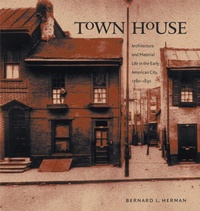
Town House
Architecture and Material Life in the Early American City, 1780-1830
Published on 28. February 2017
Book
Paperback/Softback
320 pages
978-1-4696-3352-7 (ISBN)
Description
In this abundantly illustrated volume, Bernard Herman provides a history of urban dwellings and the people who built and lived in them in early America. In the eighteenth century, cities were constant objects of idealization, often viewed as the outward manifestations of an organized, civil society. As the physical objects that composed the largest portion of urban settings, town houses contained and signified different aspects of city life, argues Herman.
Taking a material culture approach, Herman examines urban domestic buildings from Charleston, South Carolina, to Portsmouth, New Hampshire, as well as those in English cities and towns, to better understand why people built the houses they did and how their homes informed everyday city life. Working with buildings and documentary sources as diverse as court cases and recipes, Herman interprets town houses as lived experience. Chapters consider an array of domestic spaces, including the merchant family's house, the servant's quarter, and the widow's dower. Herman demonstrates that city houses served as sites of power as well as complex and often conflicted artifacts mapping the everyday negotiations of social identity and the display of sociability.
Taking a material culture approach, Herman examines urban domestic buildings from Charleston, South Carolina, to Portsmouth, New Hampshire, as well as those in English cities and towns, to better understand why people built the houses they did and how their homes informed everyday city life. Working with buildings and documentary sources as diverse as court cases and recipes, Herman interprets town houses as lived experience. Chapters consider an array of domestic spaces, including the merchant family's house, the servant's quarter, and the widow's dower. Herman demonstrates that city houses served as sites of power as well as complex and often conflicted artifacts mapping the everyday negotiations of social identity and the display of sociability.
More details
Series
Language
English
Place of publication
Chapel Hill
United States
Target group
Professional and scholarly
Dimensions
Height: 229 mm
Width: 216 mm
Thickness: 17 mm
Weight
653 gr
ISBN-13
978-1-4696-3352-7 (9781469633527)
Copyright in bibliographic data and cover images is held by Nielsen Book Services Limited or by the publishers or by their respective licensors: all rights reserved.
Schweitzer Classification
Other editions
Additional editions

E-Book
12/2012
1st Edition
Omohundro Institute and UNC Press
from
€48.99
Available for download
Person
Bernard L. Herman is Edward F. and Elizabeth Goodman Rosenberg Professor of Art History at the University of Delaware. He is author of three previous books, including Architecture and Rural Life in Central Delaware, 1700-1900; The Stolen House; and, with Gabrielle M. Lanier, Everyday Architecture of the Mid-Atlantic: Looking at Buildings and Landscapes.