

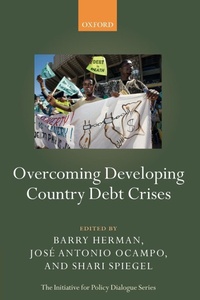
Overcoming Developing Country Debt Crises
Published on 1. April 2010
Book
Paperback/Softback
532 pages
978-0-19-957879-5 (ISBN)
Description
Developing country debt crises have been a recurrent phenomenon over the past two centuries. In recent times sovereign debt insolvency crises in developing and emerging economies peaked in the 1980s and, again, from the middle 1990s to the start of the new millennium. Despite the fact that several developing countries now have stronger economic fundamentals than they did in the 1990s, sovereign debt crises will reoccur again. The reasons for this are numerous, but the central one is that economic fluctuations are inherent features of financial markets, the boom and bust nature of which intensify under liberalized financial environments that developing countries have increasingly adopted since the 1970s. Indeed, today we are in the midst of an almost unprecedented global "bust."
The timing of the book is important. The conventional wisdom is that the international economic and financial system is broken. Policymakers in both the poorest and the richest countries are likely to seriously consider how to restructure the international trade and financial system, including how to resolve sovereign debt crises in a more effective and fair manner.
This book calls for the international reform of sovereign debt workouts which derives from both economic theory and real-world experiences. Country case studies underline the point that we need to do better. This book recognizes that the politics of the international treatment of sovereign debt have not supported systemic reform efforts thus far; however, failure in the past does not preclude success in the future in an evolving international political environment, and the book thus puts forth alternative reform ideas for consideration.
The timing of the book is important. The conventional wisdom is that the international economic and financial system is broken. Policymakers in both the poorest and the richest countries are likely to seriously consider how to restructure the international trade and financial system, including how to resolve sovereign debt crises in a more effective and fair manner.
This book calls for the international reform of sovereign debt workouts which derives from both economic theory and real-world experiences. Country case studies underline the point that we need to do better. This book recognizes that the politics of the international treatment of sovereign debt have not supported systemic reform efforts thus far; however, failure in the past does not preclude success in the future in an evolving international political environment, and the book thus puts forth alternative reform ideas for consideration.
More details
Series
Language
English
Place of publication
Oxford
United Kingdom
Target group
College/higher education
Professional and scholarly
Illustrations
17 figures and 23 tables
Dimensions
Height: 234 mm
Width: 156 mm
Thickness: 28 mm
Weight
799 gr
ISBN-13
978-0-19-957879-5 (9780199578795)
Copyright in bibliographic data and cover images is held by Nielsen Book Services Limited or by the publishers or by their respective licensors: all rights reserved.
Schweitzer Classification
Other editions
Additional editions
Edited By Barry Herman | Jose Antonio Ocampo | And Shari Spiegel
Overcoming Developing Country Debt Crises
E-Book
04/2010
1st Edition
Oxford University Press
€86.48
Available for download
Barry Herman | Jose Antonio Ocampo | Shari Spiegel
Overcoming Developing Country Debt Crises
Book
04/2010
Oxford University Press
€83.10
Shipment within 15-20 days
Persons
Barry Herman is Visiting Senior Fellow at the Graduate Program in International Affairs of The New School in New York. He is also a member of the Board of Directors of Global Integrity, a research NGO based in Washington that works with independent scholars and investigative reporters on assessing laws, institutions and practices to improve governance and limit corruption in developed and developing countries. He completed almost 30 years in the United Nations Secretariat in 2005, the last two years of which were as Senior Advisor in the Financing for Development Office in the Department of Economic and Social Affairs (DESA). Prior to his UN service, he taught international economics and development at the City University of New York and Dickinson College (Carlisle, Pa). He holds a PhD in economics from the University of Michigan and an MBA from the University of Chicago.
Jose Antonio Ocampo is Professor in the School of International and Public Affairs and Fellow of the Committee on Global Thought at Columbia University. Prioir to this, Professor Ocampo served as the United Nations Under-Secretary-General for Economic and Social Affairs, and head of UN Department of Economic and Social Affairs (DESA), as Executive Secretary of the UN Economic Commission for Latin America and the Caribbean (ECLAC), and has held a number of high-level posts in the Government of Colombia, including Minister of Finance and Public Credit and Director of the National Planning Department. He has also served as Executive Director of FEDESARROLLO, the main think tank on economic issues in Colombia, Director of the Centro de Estudios sobre Desarrollo Economico of Universidad de los Andes, Professor of Economics at Universidad de los Andes, and Professor of Economic History at Universidad Nacional de Colombia. He has also been Visiting Professor at Cambridge, Oxford and Yale Universities.
Shari Spiegel is a Principal at New Holland Capital, PLC (an advisor to APG, the Dutch Civil Servant's Pension Fund). From 2002 to 2007 she was the Executive Director at IPD and an adjunct professor and Lecturer at the School of International Affairs, Columbia University. Ms. Spiegel joined IPD from Lazard Asset Management where she was a Director of Lazard LLC and the Senior Fixed Income Portfolio Manager in charge of emerging markets. Prior to this, she spent several years working in Budapest where she was an advisor to the Hungarian Central Bank and an instructor at the International Training Centre for Bankers. Later, she served as CEO of Budapest Investment Management Company. She has also held positions at Drexel Burnham Lambert and Citibank NA in New York. She has an MA in economics from Princeton Univesity and a BA in applied mathematics and economics from Northwestern University. She is a member of the Board of Directors of New Rules for Global Finance, an NGO based in Washington.
Jose Antonio Ocampo is Professor in the School of International and Public Affairs and Fellow of the Committee on Global Thought at Columbia University. Prioir to this, Professor Ocampo served as the United Nations Under-Secretary-General for Economic and Social Affairs, and head of UN Department of Economic and Social Affairs (DESA), as Executive Secretary of the UN Economic Commission for Latin America and the Caribbean (ECLAC), and has held a number of high-level posts in the Government of Colombia, including Minister of Finance and Public Credit and Director of the National Planning Department. He has also served as Executive Director of FEDESARROLLO, the main think tank on economic issues in Colombia, Director of the Centro de Estudios sobre Desarrollo Economico of Universidad de los Andes, Professor of Economics at Universidad de los Andes, and Professor of Economic History at Universidad Nacional de Colombia. He has also been Visiting Professor at Cambridge, Oxford and Yale Universities.
Shari Spiegel is a Principal at New Holland Capital, PLC (an advisor to APG, the Dutch Civil Servant's Pension Fund). From 2002 to 2007 she was the Executive Director at IPD and an adjunct professor and Lecturer at the School of International Affairs, Columbia University. Ms. Spiegel joined IPD from Lazard Asset Management where she was a Director of Lazard LLC and the Senior Fixed Income Portfolio Manager in charge of emerging markets. Prior to this, she spent several years working in Budapest where she was an advisor to the Hungarian Central Bank and an instructor at the International Training Centre for Bankers. Later, she served as CEO of Budapest Investment Management Company. She has also held positions at Drexel Burnham Lambert and Citibank NA in New York. She has an MA in economics from Princeton Univesity and a BA in applied mathematics and economics from Northwestern University. She is a member of the Board of Directors of New Rules for Global Finance, an NGO based in Washington.
Content
INTRODUCTION; PART I: THE ANALYTICAL FRAMEWORK FOR DEBT POLICY; PART II: CRISIS EXPERIENCES WHEN MOST CREDITS WERE PRIVATE; PART III: CRISIS EXPERIENCES WHEN MOST CREDITS WERE OFFICIAL; PART IV: POLITICAL ECONOMY AND INSTITUTIONAL REFORM; CONCLUSION