

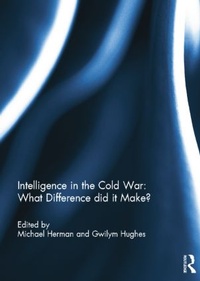
Intelligence in the Cold War: What Difference did it Make?
1st Edition
Published on 27. April 2015
Book
Paperback/Softback
150 pages
978-1-138-81448-6 (ISBN)
Description
Intelligence was a major part of the Cold War, waged by both sides with an almost warlike intensity. Yet the question 'What difference did it all make?' remains unanswered. Did it help to contain the Cold War, or fuel it and keep it going? Did it make it hotter or colder? Did these large intelligence bureaucracies tell truth to power, or give their governments what they expected to hear?
These questions have not previously been addressed systematically, and seven writers tackle them here on Cold War aspects that include intelligence as warning, threat assessment, assessing military balances, Third World activities, and providing reassurance. Their conclusions are as relevant to understanding what governments can expect from their big, secret organizations today as they are to those of historians analysing the Cold War motivations of East and West. This book is valuable not only for intelligence, international relations and Cold War specialists but also for all those concerned with intelligence's modern cost-effectiveness and accountability.
This book was published as a special issue of Intelligence and National Security.
These questions have not previously been addressed systematically, and seven writers tackle them here on Cold War aspects that include intelligence as warning, threat assessment, assessing military balances, Third World activities, and providing reassurance. Their conclusions are as relevant to understanding what governments can expect from their big, secret organizations today as they are to those of historians analysing the Cold War motivations of East and West. This book is valuable not only for intelligence, international relations and Cold War specialists but also for all those concerned with intelligence's modern cost-effectiveness and accountability.
This book was published as a special issue of Intelligence and National Security.
Reviews / Votes
"...[I]n my view these excellent papers make significant contributions to our understanding of that turbulent era." - J. Kenneth McDonald, H-Diplo Article Reviews, no, 394More details
Language
English
Place of publication
London
United Kingdom
Publishing group
Taylor & Francis Ltd
Target group
College/higher education
Dimensions
Height: 246 mm
Width: 174 mm
Weight
294 gr
ISBN-13
978-1-138-81448-6 (9781138814486)
Copyright in bibliographic data and cover images is held by Nielsen Book Services Limited or by the publishers or by their respective licensors: all rights reserved.
Schweitzer Classification
Other editions
Additional editions
Michael Herman | Gwilym Hughes
Intelligence in the Cold War: What Difference did it Make?
E-Book
09/2013
1st Edition
Routledge
€64.49
Available for download
Michael Herman | Gwilym Hughes
Intelligence in the Cold War: What Difference did it Make?
E-Book
09/2013
1st Edition
Routledge
€64.49
Available for download
Michael Herman | Gwilym Hughes
Intelligence in the Cold War: What Difference did it Make?
What Difference did it Make?
Book
12/2012
1st Edition
Routledge
€207.10
Shipment within 15-20 days
Persons
Michael Herman is a former intelligence practitioner. His publications since his retirement in 1987 have included Intelligence Power in Peace and War published in 1996 and regularly reprinted. His principal academic association has been with Nuffield College, where he is still active as the Founder Director of the Oxford Intelligence Group. He is an Honorary D.Litt of Nottingham University.
Gwilym Hughes is Director of the Oxford Intelligence Group and a Fellow of Nuffield College Oxford. Formerly a member of the British Defence Staffs in Paris and Canberra, he is a graduate of the Royal Military College of Science, Shrivenham and the Australian Joint Services Staff College.
Gwilym Hughes is Director of the Oxford Intelligence Group and a Fellow of Nuffield College Oxford. Formerly a member of the British Defence Staffs in Paris and Canberra, he is a graduate of the Royal Military College of Science, Shrivenham and the Australian Joint Services Staff College.
Content
1. Introduction: Intelligence in the Cold War 2. Intelligence and the Risk of Nuclear War: Able Archer-83 Revisited 3. Certainties, Doubts, and Imponderables: Levels of Analysis In the Military Balance 4. Intelligence as Threats and Reassurance 5. Estimating Soviet Power: the creation of Britain's Defence Intelligence Staff 1960-65 6. Chekists Look Back on the Cold War: the polemical literature 7. KGB Human Intelligence Operations in Israel 1948-1973 8. What Difference Did It Make?