

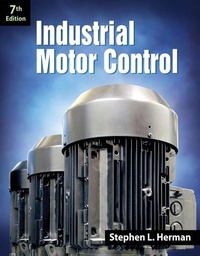
Industrial Motor Control
7th Edition
Published on 29. August 2020
Book
Paperback/Softback
576 pages
978-0-357-67059-0 (ISBN)
Description
INDUSTRIAL MOTOR CONTROL 7E is an integral part of any electrician training. Comprehensive and up to date, this book provides crucial information on basic relay control systems, programmable logic controllers, and solid state devices commonly found in an industrial setting. Written by a highly qualified and respected author, you will find easy-to-follow instructions and essential information on controlling industrial motors and commonly used devices in contemporary industry. INDUSTRIAL MOTOR CONTROL 7E successfully bridges the gap between industrial maintenance and instrumentation, giving you a fundamental understanding of the operation of variable frequency drives, solid state relays, and other applications that employ electronic devices.
More details
Edition
7th edition
Language
English
Place of publication
Mason, OH
United States
Publishing group
Cengage Learning, Inc
Target group
College/higher education
Product notice
Paperback (trade)
Unsewn / adhesive bound
Dimensions
Height: 274 mm
Width: 214 mm
Thickness: 24 mm
Weight
1179 gr
ISBN-13
978-0-357-67059-0 (9780357670590)
Copyright in bibliographic data and cover images is held by Nielsen Book Services Limited or by the publishers or by their respective licensors: all rights reserved.
Schweitzer Classification
Person
Stephen L. Herman was an electrician and proficient instructor with over 30 years of practical experience, and was known for his reader-friendly approach. A seasoned author, Mr. Herman wrote leading books on electricity and mathematics that are popular with students and instructors alike. For two decades, Mr. Herman served as lead instructor for the Electrical Technology Curriculum at Lee College in Baytown, Texas, where he received an Excellence in Education Award from the Halliburton Education Foundation. He also taught at Randolph Community College in Asheboro, North Carolina, for nine years and helped pioneer an electrical curriculum for Northeast Texas Community College in Mount Pleasant, Texas. His additional publications include "Electric Motor Control," "Electricity and Controls for HVAC/R," "Industrial Motor Controls," "Understanding Motor Controls," "Electronics for Electricians," "Alternating Current Fundamentals," "Direct Current Fundamentals," "Electrical Studies for Trades," "Electrical Principles," "Experiments in Electricity For Use with Lab Volt Equipment," "The Complete Laboratory Manual for Electricity" and "Practical Problems in Mathematics for Electricians."
Content
1. General Principles of Motor Control. 2. Symbols and Schematic Diagrams. 3. Manual Starters. 4. Overload Relays. 5. Relays, Contactors, and Motor Starters. 6. The Control Transformer. 7. Timing Relays. 8. Pressure Switches and Sensors. 9. Float Switches. 10. Flow Switches and Sensors. 11. Limit Switches. 12. Phase Failure Relays. 13. Solenoid and Motor Operated Valves. 14. Temperature Sensing Devices. 15. Hall Effect Sensors. 16. Proximity Detectors. 17. Photodetectors. 18. Basic Control Circuits. 19. Schematics and Wiring Diagrams. 20. Timed Starting for Three Motors (Circuit #2). 21. Float Switch Control of a Pump and Pilot Lights (Circuit #3). 22. Developing a Wiring Diagram (Circuit #1). 23. Developing a Wiring Diagram (Circuit #2). 24. Developing a Wiring Diagram (Circuit #3). 25. Reading Large Schematic Diagrams. 26. Installing Control Systems. 27. Hand-Off Automatic Controls. 28. Multiple Pushbutton Stations. 29. Forward-Reverse Control. 30. Jogging and Inching. 31. Sequence Control. 32. DC Motors. 33. Starting methods for DC Motors. 34. Solid-State DC Drives. 35. Stepping Motors. 36. The Motor and Starting Methods. 37. Resistor and Reactor Starting for AC Motors. 38. Autotransformer Starting. 39. Wye-Delta Starting. 40. Part Winding Starters. 41. Consequent Pole Motors. 42. Variable Voltage and Magnetic Clutches. 43. Braking. 44. Wound Rotor Induction Motors. 45. Synchronous Motors. 46. Variable Frequency Control. 47. Motor Installation. 48. Developing Control Circuits. 49. Troubleshooting. 50. Digital Logic. 51. The Bounceless Switch. 52. Start-Stop Pushbutton Control. 53. Programmable Logic Controllers. 54. Programming a PLC. 55. Analog Sensing for Programmable Controllers. 56. Semiconductors. 57. The PN Junction. 58. The Zener Diode. 59. The Transistor. 60. The Unijunction Transistor. 61. The SCR. 62. The Diac. 63. The Triac. 64. The 555 Timer. 65. The Operational Amplifier. Appendix. Glossary.