

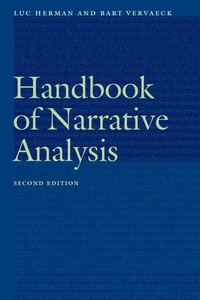
Handbook of Narrative Analysis
2nd Edition
Will be published approx. on 1. December 2019
Book
Paperback/Softback
438 pages
978-1-4962-1714-1 (ISBN)
Description
Stories are everywhere, from fiction across media to politics and personal identity. Handbook of Narrative Analysis sorts out both traditional and recent narrative theories, providing the necessary skills to interpret any story. In addition to discussing classical theorists, such as GErard Genette, Mieke Bal, and Seymour Chatman, Handbook of Narrative Analysis presents precursors (such as E. M. Forster), related theorists (Franz Stanzel, Dorrit Cohn), and a large variety of postclassical critics. Among the latter particular attention is paid to rhetorical, cognitive, and cultural approaches; intermediality; storyworlds; gender theory; and natural and unnatural narratology.
Not content to consider theory as an end in itself, Luc Herman and Bart Vervaeck use two short stories and a graphic narrative by contemporary authors as touchstones to illustrate each approach to narrative. In doing so they illuminate the practical implications of theoretical preferences and the ideological leanings underlying them. Marginal glosses guide the reader through discussions of theoretical issues, and an extensive bibliography points readers to the most current publications in the field. Written in an accessible style, this handbook combines a comprehensive treatment of its subject with a user-friendly format appropriate for specialists and nonspecialists alike.
Handbook of Narrative Analysis is the go-to book for understanding and interpreting narrative. This new edition revises and extends the first edition to describe and apply the last fifteen years of cutting-edge scholarship in the field of narrative theory.
Not content to consider theory as an end in itself, Luc Herman and Bart Vervaeck use two short stories and a graphic narrative by contemporary authors as touchstones to illustrate each approach to narrative. In doing so they illuminate the practical implications of theoretical preferences and the ideological leanings underlying them. Marginal glosses guide the reader through discussions of theoretical issues, and an extensive bibliography points readers to the most current publications in the field. Written in an accessible style, this handbook combines a comprehensive treatment of its subject with a user-friendly format appropriate for specialists and nonspecialists alike.
Handbook of Narrative Analysis is the go-to book for understanding and interpreting narrative. This new edition revises and extends the first edition to describe and apply the last fifteen years of cutting-edge scholarship in the field of narrative theory.
Reviews / Votes
"A comprehensive and coherent account of narratology, [Handbook of Narrative Analysis] is engaging and readable and explicitly oriented toward the reader's experience."-Sabine Gross, MonatshefteMore details
Series
Edition
Second Edition
Language
English
Place of publication
Lincoln
United States
Target group
Professional and scholarly
Edition type
New edition
Product notice
Paperback (trade)
Illustrations
13 illustrations, 3 appendixes, index
Dimensions
Height: 225 mm
Width: 152 mm
Thickness: 29 mm
Weight
668 gr
ISBN-13
978-1-4962-1714-1 (9781496217141)
Copyright in bibliographic data and cover images is held by Nielsen Book Services Limited or by the publishers or by their respective licensors: all rights reserved.
Schweitzer Classification
Other editions
Additional editions
Luc Herman | Bart Vervaeck
Handbook of Narrative Analysis
E-Book
12/2019
2nd Edition
University of Nebraska Press
€44.49
Available for download
Luc Herman | Bart Vervaeck
Handbook of Narrative Analysis
E-Book
12/2019
2nd Edition
University of Nebraska Press
€49.49
Available for download
Previous edition

Luc Herman | Bart Vervaeck
Handbook of Narrative Analysis
Book
05/2005
University of Nebraska Press
€71.38
Article exhausted; check for reprint
Persons
Luc Herman is a professor of American literature and narrative theory at the University of Antwerp. He is the coauthor and coeditor of books on Thomas Pynchon and is the coeditor with Bart Vervaeck, Lars Bernaerts, and Dirk De Geest of Stories and Minds: Cognitive Approaches to Literary Narrative (Nebraska, 2013). Bart Vervaeck is a professor of Dutch literature and narrative theory at the University of Leuven. He is the author of monographs on postmodern fiction and on literary descents into hell.
Content
Acknowledgments
Introduction
1. Traditional Questions
2. New Questions
Chapter 1Before and Surrounding Structuralism
1. Story and Plot
2. Telling and Showing
3. Author and Narrator
4. Narrator and Reader
5. Consciousness and Speech
6. Perception and Speech
Chapter 2Structuralism
1. Story
1.1. Events
1.2. Actants
1.3. Setting
2. Narrative
2.1. Time
2.2. Character
2.3. Focalization
3. Narration
3.1. Narrating
3.2. Consciousness Representation
Chapter 3Postclassical Narratology
1. Broadening Conceptions of the Narrative Text
1.1. Broadening the Medium: Intermediality
1.2. Broadening in Time: Diachronic Narratology
1.3. Broadening the Fictional World
2. Communicative Approaches
2.1. Rhetorical Narratology
2.2. Cognitive Narratology
3. Narratology and Ideology
3.1. Narrative Ethics
3.2. Feminist and Queer Narratology
3.3. Postcolonial Narratology
3.4. Cultural Narratology and Socio-narratology
4. Everyday Life as a Narrative Process
4.1. Postmodern Narratology
4.2. Natural Narratology
4.3. Unnatural Narratology
Appendix A: ""Pegasian"" by Charlotte Mutsaers
Appendix B: ""The Map"" by Gerrit Krol
Appendix C: ""City"" by Wasco
Notes
Bibliography
Index
Introduction
1. Traditional Questions
2. New Questions
Chapter 1Before and Surrounding Structuralism
1. Story and Plot
2. Telling and Showing
3. Author and Narrator
4. Narrator and Reader
5. Consciousness and Speech
6. Perception and Speech
Chapter 2Structuralism
1. Story
1.1. Events
1.2. Actants
1.3. Setting
2. Narrative
2.1. Time
2.2. Character
2.3. Focalization
3. Narration
3.1. Narrating
3.2. Consciousness Representation
Chapter 3Postclassical Narratology
1. Broadening Conceptions of the Narrative Text
1.1. Broadening the Medium: Intermediality
1.2. Broadening in Time: Diachronic Narratology
1.3. Broadening the Fictional World
2. Communicative Approaches
2.1. Rhetorical Narratology
2.2. Cognitive Narratology
3. Narratology and Ideology
3.1. Narrative Ethics
3.2. Feminist and Queer Narratology
3.3. Postcolonial Narratology
3.4. Cultural Narratology and Socio-narratology
4. Everyday Life as a Narrative Process
4.1. Postmodern Narratology
4.2. Natural Narratology
4.3. Unnatural Narratology
Appendix A: ""Pegasian"" by Charlotte Mutsaers
Appendix B: ""The Map"" by Gerrit Krol
Appendix C: ""City"" by Wasco
Notes
Bibliography
Index