

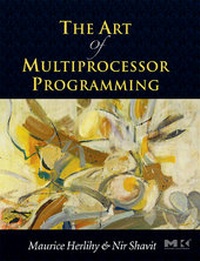
The Art of Multiprocessor Programming
Published on 29. April 2008
Book
Paperback/Softback
528 pages
978-0-12-370591-4 (ISBN)
Description
The Art of Multiprocessor Programming promises to be the first comprehensive presentation of the principles and tools available for programming multiprocessor machines.
As the computer industry changes from single-processor to multiprocessor architectures, this revolution requires a fundamental change in how programs are written. To leverage the performance and power of multiprocessor programming, also known as multicore programming, programmers need to learn the new principles, algorithms, and tools.
The book will be of immediate use to programmers working with the new architectures. For example, the next generation of computer game consoles will all be multiprocessor-based, and the game industry is currently struggling to understand how to address the programming challenges presented by these machines. This change in the industry is so fundamental that it is certain to require a significant response by universities, and courses on multicore programming will become a staple of computer science curriculums.
This book includes fully-developed Java examples detailing data structures, synchronization techniques, transactional memory, and more.
Students in multiprocessor and multicore programming courses and engineers working with multiprocessor and multicore systems will find this book quite useful.
As the computer industry changes from single-processor to multiprocessor architectures, this revolution requires a fundamental change in how programs are written. To leverage the performance and power of multiprocessor programming, also known as multicore programming, programmers need to learn the new principles, algorithms, and tools.
The book will be of immediate use to programmers working with the new architectures. For example, the next generation of computer game consoles will all be multiprocessor-based, and the game industry is currently struggling to understand how to address the programming challenges presented by these machines. This change in the industry is so fundamental that it is certain to require a significant response by universities, and courses on multicore programming will become a staple of computer science curriculums.
This book includes fully-developed Java examples detailing data structures, synchronization techniques, transactional memory, and more.
Students in multiprocessor and multicore programming courses and engineers working with multiprocessor and multicore systems will find this book quite useful.
More details
Language
English
Place of publication
San Francisco
United States
Publishing group
Elsevier Science & Technology
Target group
Professional and scholarly
Computer engineers working with multiprocessor systems, students in courses on multiprocessing
Illustrations
Approx. 100 illustrations
Dimensions
Height: 235 mm
Width: 191 mm
Weight
890 gr
ISBN-13
978-0-12-370591-4 (9780123705914)
Copyright in bibliographic data and cover images is held by Nielsen Book Services Limited or by the publishers or by their respective licensors: all rights reserved.
Schweitzer Classification
Other editions
New editions
Maurice Herlihy | Nir Shavit | Victor Luchangco
The Art of Multiprocessor Programming
Book
12/2020
2nd Edition
Morgan Kaufmann
€73.50
Available immediately
Additional editions
E-Book
05/2014
1st Edition
Morgan Kaufmann
€59.95
Available for download
Persons
Maurice Herlihy received an A.B. in Mathematics from Harvard University, and a Ph.D. in Computer Science from M.I.T. He has served on the faculty of Carnegie Mellon University, on the staff of DEC Cambridge Research Lab, and is currently a Professor in the Computer Science Department at Brown University. Dr. Herlihy is an ACM Fellow, and is the recipient of the 2003 Dijkstra Prize in Distributed Computing. He shared the 2004 Goedel Prize with Nir Shavit, with whom he also shared the 2012 Edsger W. Dijkstra Prize In Distributed Computing. Nir Shavit received a B.A. and M.Sc. from the Technion and a Ph.D. from the Hebrew University, all in Computer Science. From 1999 to 2011 he served as a member of technical staff at Sun Labs and Oracle Labs. He shared the 2004 Goedel Prize with Maurice Herlihy, with whom he also shared the 2012 Edsger W. Dijkstra Prize in Distributed Computing. He is a Professor in the Electrical Engineering and Computer Science Department at M.I.T. and the Computer Science Department at Tel-Aviv University.
Content
1 Introduction; 2 Mutual Exclusion; 3 Concurrent Objects and Linearization; 4 Foundations of Shared Memory; 5 The Relative Power of Synchronization Methods; 6 The Universality of Consensus; 7 Spin Locks and Contention; 8 Monitors and Blocking Sychronization; 9 Linked Lists: the Role of Locking; 10 Concurrent Queues and the ABA Problem; 11 Concurrent Stakcs and Elimination; 12 Counting, Sorting and Distributed Coordinatino; 13 Concurrent Hashing and Natural Parallelism; 14 Skiplists and Balanced Search; 15 Priority Queues; 16 Futures, Scheduling and Work Distribution; 17 Barriers; 18 Transactional Memory; Appendices