

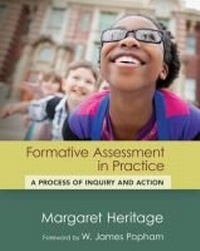
Formative Assessment in Practice
A Process of Inquiry and Action
Will be published approx. on 30. March 2013
Book
Paperback/Softback
176 pages
978-1-61250-551-0 (ISBN)
Description
Margaret Heritage presents a practical guide to formative assessment as a process of ""inquiry and action"" essential to twenty-first century learning.
In the wake of the development of the Common Core standards and the effort to develop the appropriate assessments to accompany them, formative assessment has attracted increasing attention from policy makers and practitioners alike. Yet this powerful and promising approach is often applied in ways that fail to capture its potential for improving student learning.
In her book, Margaret Heritage presents a practical guide to formative assessment as a process of ""inquiry and action"" essential to twenty-first century learning. Heritage's approach is distinctive in that it is grounded in a ""children's rights"" framework--that is, the belief that assessment should be in the best interest of all students, that students should be involved in the decisions that ensue from assessment use, and that opportunities to learn, progress, and succeed will be available to all children equally. Accordingly, she addresses the students' own role in learning about themselves as learners and examines the classroom as a community of practice. The book also includes chapters on learning progressions and the policy contexts that support formative assessment.
Skilfully interweaving theory and practice, this book promises to be an invaluable resource for teachers, teacher educators, and those interested in the academic and policy aspects of assessment.
In the wake of the development of the Common Core standards and the effort to develop the appropriate assessments to accompany them, formative assessment has attracted increasing attention from policy makers and practitioners alike. Yet this powerful and promising approach is often applied in ways that fail to capture its potential for improving student learning.
In her book, Margaret Heritage presents a practical guide to formative assessment as a process of ""inquiry and action"" essential to twenty-first century learning. Heritage's approach is distinctive in that it is grounded in a ""children's rights"" framework--that is, the belief that assessment should be in the best interest of all students, that students should be involved in the decisions that ensue from assessment use, and that opportunities to learn, progress, and succeed will be available to all children equally. Accordingly, she addresses the students' own role in learning about themselves as learners and examines the classroom as a community of practice. The book also includes chapters on learning progressions and the policy contexts that support formative assessment.
Skilfully interweaving theory and practice, this book promises to be an invaluable resource for teachers, teacher educators, and those interested in the academic and policy aspects of assessment.
More details
Series
Language
English
Place of publication
Cambridge
United States
Target group
Professional and scholarly
Dimensions
Height: 231 mm
Width: 187 mm
Thickness: 10 mm
Weight
310 gr
ISBN-13
978-1-61250-551-0 (9781612505510)
Copyright in bibliographic data and cover images is held by Nielsen Book Services Limited or by the publishers or by their respective licensors: all rights reserved.
Schweitzer Classification
Other editions
Additional editions
E-Book
03/2013
Harvard Education Press
€26.49
Available for download
Person
Margaret Heritage is a senior scientist at WestEd andan assistant director at the National Center for Research onEvaluation, Standards, and Student Testing at UCLA. W. James Popham began his career in education as a high school teacher in Oregon. He is professor emeritus at the University of California, Los Angeles Graduate School of Education and Information Studies. He is the author of twenty-five books and a former president of the American Educational Research Association. In 2002 the National Council on Measurement in Education presented him with its Award for Career Contributions to Educational Measurement. In 2006 he was awarded a Certificate of Recognition by the National Association of Test Directors.