

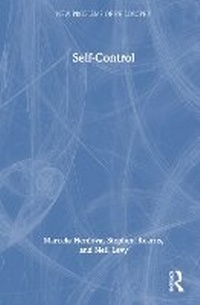
Self-Control
1st Edition
Published on 30. December 2022
Book
Hardback
234 pages
978-0-8153-5731-5 (ISBN)
Description
Self-control is a fundamental part of what it is to be a human being. It poses important philosophical and psychological questions about the nature of belief, motivation, judgment, and decision making. More immediately, failures of self-control can have high costs, resulting in ill-health, loss of relationships, and even violence and death, whereas strong self-control is also often associated with having a virtuous character. What exactly is self-control? If we lose control can we still be free? Can we be held responsible for loss of self-control?
In this thorough and clearly written introduction to the philosophy of self-control the authors examine and assess the following topics and questions:
The importance of self-control
What is self-control?
Self-control and the law of desire
Mechanisms of self-control
How is it possible to lose self-control?
Blameworthiness and (the loss of) self-control
Externalist self-control
Pathologies of self-control.
Combining philosophical analysis with surveys of the latest psychological research, and including chapter summaries, suggestions for further reading, and a glossary of key terms, Self-Control is essential reading for students of philosophy of mind and psychology, moral psychology, free will, and ethics. It will also be of interest to those in related fields such as psychology and cognitive science.
In this thorough and clearly written introduction to the philosophy of self-control the authors examine and assess the following topics and questions:
The importance of self-control
What is self-control?
Self-control and the law of desire
Mechanisms of self-control
How is it possible to lose self-control?
Blameworthiness and (the loss of) self-control
Externalist self-control
Pathologies of self-control.
Combining philosophical analysis with surveys of the latest psychological research, and including chapter summaries, suggestions for further reading, and a glossary of key terms, Self-Control is essential reading for students of philosophy of mind and psychology, moral psychology, free will, and ethics. It will also be of interest to those in related fields such as psychology and cognitive science.
Reviews / Votes
'Self-Control weaves together philosophical analysis and scientific evidence to provide a balanced tour of this important topic. The chapters are concise yet comprehensive and punctuated with concrete examples of self-control - and its failures - from real life and fiction. The authors expertly guide readers through traditional philosophical debates as well as cutting-edge issues, such as pathologies of self-control.' - Josh May, University of Alabama at Birmingham, USAMore details
Series
Language
English
Place of publication
New York
United States
Publishing group
Taylor & Francis Inc
Target group
College/higher education
Dimensions
Height: 234 mm
Width: 156 mm
Weight
400 gr
ISBN-13
978-0-8153-5731-5 (9780815357315)
Copyright in bibliographic data and cover images is held by Nielsen Book Services Limited or by the publishers or by their respective licensors: all rights reserved.
Schweitzer Classification
Other editions
Additional editions
Marcela Herdova | Stephen Kearns | Neil Levy
Self-Control
Book
12/2022
1st Edition
Routledge
€60.30
Shipment within 15-20 days
Marcela Herdova | Stephen Kearns | Neil Levy
Self-Control
E-Book
12/2022
1st Edition
Routledge
€52.49
Available for download
Marcela Herdova | Stephen Kearns | Neil Levy
Self-Control
E-Book
12/2022
1st Edition
Routledge
€52.49
Available for download
Persons
Marcela Herdova is an Assistant Professor in the Department of Philosophy at Florida State University, USA.
Stephen Kearns is an Associate Professor in the Department of Philosophy at Florida State University, USA.
Neil Levy is a Professor of Philosophy at Macquarie University, Australia, and a Senior Research Fellow at the Oxford Uehiro Centre for Practical Ethics, UK.
Stephen Kearns is an Associate Professor in the Department of Philosophy at Florida State University, USA.
Neil Levy is a Professor of Philosophy at Macquarie University, Australia, and a Senior Research Fellow at the Oxford Uehiro Centre for Practical Ethics, UK.
Content
Preface 1. The Importance of Self-Control 2. What Is Self-Control? 3. Self-Control and the Law of Desire 4. Mechanisms of Self-Control 5. How Is It Possible to Lose Self-Control? 6. Blameworthiness and (the Loss of) Self-Control 7. Externalist Self-Control 8. Pathologies of Self-Control Conclusion. Glossary Index