

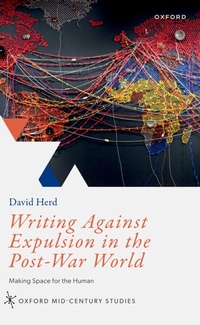
Writing Against Expulsion in the Post-War World
Making Space for the Human
Published on 4. June 2025
Book
Paperback/Softback
296 pages
978-0-19-897377-5 (ISBN)
Description
Writing Against Expulsion in the Post-War World: Making Space for the Human tells a pre-history of the Hostile Environment. The book's starting point is the rapidly escalating use of detention as a response to human movement and the global production of geopolitical non-personhood in which detention results. As a matter of urgency, the book argues, we need to understand what is at stake in such policies and to resist the world we are making when we detain and expel. Writing Against Expulsion returns to a post-war period when the brutal consequences of the politics of expulsion were visible and when it was clear to writers of all kinds that space for the human had to be made.
Drawing on contemporary histories of forced displacement, eye witness accounts, international legal documents, and on a range of emblematic cross-disciplinary texts and authors - the Universal Declaration of Human Rights, the political philosophy of Hannah Arendt, the poetry of Charles Olson, the revolutionary theory of Frantz Fanon - the book shows how mid-century writers both documented the lived experience of expulsion and asserted ways of thinking and acting by which expulsion could be prevented. What emerged were new languages of rights and recognition - new accounts of Moving, Making and Speaking - through which the exclusions of nation and border could be countered.
Drawing on contemporary histories of forced displacement, eye witness accounts, international legal documents, and on a range of emblematic cross-disciplinary texts and authors - the Universal Declaration of Human Rights, the political philosophy of Hannah Arendt, the poetry of Charles Olson, the revolutionary theory of Frantz Fanon - the book shows how mid-century writers both documented the lived experience of expulsion and asserted ways of thinking and acting by which expulsion could be prevented. What emerged were new languages of rights and recognition - new accounts of Moving, Making and Speaking - through which the exclusions of nation and border could be countered.
Reviews / Votes
Writing Against Expulsion in the Post-War World is a lucid and compelling report on the individual at the mercy of the bureaucracy of immigration control, `the geo-political non-person`, and how the condition of this figure relates to the aftermath of the 1939-45 War and the subsequent moment of decolonisation. It takes us through the political, philosophical and literary contexts with fluency, passion and rigour. Its engagement with the texts through which the argument progresses is extensive and thoroughly persuasive, and allows the reader to witness the personal journey Herd himself travelled in understanding the issues that are the subject of this wonderful and important book. * Abdulrazak Gurnah, Winner of the Nobel Prize in Literature 2021 * Writing Against Expulsion is one of those books that arrives in the world and immediately feels necessary. David Herd asks and brilliantly answers two questions about the condition of unwelcome migrants and the UK government: 'how did we get here' and 'how do we move away from where we are?' Drawing on and building from the works of writers such as Hannah Arendt, Frantz Fanon, the poet Charles Olson, as well as his own work with Refugee Tales, Herd re-casts conversations around 'political non-persons' to allow space for imagination, humanity and truth. A profound and inspiring book. * Kamila Shamsie, author of Home Fire * David Herd is a poet and a philosopher, and his book is born of unquiet rage and a blazing concern about the most salient issue of the times: migration...Writing against Expulsion is deeply researched and argued, an original, indispensable investigation into a topic clouded by misunderstanding and sheer ignorance; in 2023, when it first came out, it was a prophetic warning; it is even more necessary now. * Marina Warner, Birkbeck, University of London, author of Sanctuary: Ways of Telling, Ways of Dwelling * Writing against Expulsion in the Post-War World is a timely and politically urgent study that connects postwar experiences of forced displacement and mass migration with our contemporary moment. Herd traces an important history of the "geopolitical non-person"-a dehumanized individual whose essential rights have been suspended. Reading poetic and philosophical works by Charles Olson, Hannah Arendt, and Frantz Fanon alongside first-hand accounts, government policies, and the Universal Declaration of Human Rights, Herd makes a powerful case for the relevance of literary analysis to real-life legal and political dilemmas. Blurring the boundaries between literary scholarship and activism, Herd delivers nothing less than a manifesto against the current political climate where detention, expulsion, and deportation have come to define the very conditions of civic life. * 2024 MSA (Modernist Studies Association) Book Award panel *More details
Series
Language
English
Place of publication
Oxford
United Kingdom
Target group
Professional and scholarly
Product notice
Paperback (trade)
Unsewn / adhesive bound
Dimensions
Height: 213 mm
Width: 137 mm
Thickness: 18 mm
Weight
372 gr
ISBN-13
978-0-19-897377-5 (9780198973775)
Copyright in bibliographic data and cover images is held by Nielsen Book Services Limited or by the publishers or by their respective licensors: all rights reserved.
Schweitzer Classification
Person
David Herd is the author of numerous books of poetry and prose, including All Just, described by the Los Angeles Review of Books as 'one of the few truly necessary works of poetry written on either side of the Atlantic in the past decade', and Walk Song, a Book of the Year in the Australian Book Review. He has given readings and lectures in Europe, North America, India, and Australia and held visiting fellowships at George Mason University, Simon Fraser University, and the Gloucester Writers Center. He is Professor of Literature & Human Rights at the University of St Andrews and co-organiser of the project Refugee Tales.
Content
Introduction
1: The Non-Place
2: Writing Against Expulsion
3: Moving
4: Making
5: Speaking
Conclusion
Acknowledgements
Bibliography
1: The Non-Place
2: Writing Against Expulsion
3: Moving
4: Making
5: Speaking
Conclusion
Acknowledgements
Bibliography