

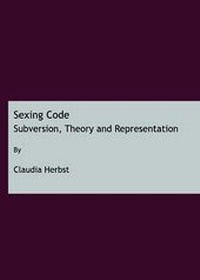
Sexing Code
Subversion, Theory and Representation
Published on 28. February 2008
Book
Hardback
160 pages
978-1-84718-479-5 (ISBN)
Description
Critically investigating the gender of programming in popular culture, Sexing Code proposes that the de facto representation of technical ability serves to perpetuate the age-old association of the male with intellect and reason, while identifying the female with the body. Challenging this division, in which code is situated within the male sphere, the discussion highlights women (1)s contributions in the writing and theorizing of code, particularly in the digital arts, hacking, and hacktivism. Presenting an accessible and lively discussion, Sexing Code demonstrates that the gendering of programming selectively confers the privilege of authorship and is therefore a salient factor in the production of culture in the twenty-first century.
Reviews / Votes
'Sexing Code is a highly instructive and profound discussion on the contemporary and historic situation of women in the traditionally male dominated world of computer programming as well as on the representation of female programmers in the media . . . Herbst vividly shows that the act of programming is not randomly associated with men and that it is in fact the substantial political and economical meaning and agency of codes that guarantees and stabilizes this close association.' - Andreas Jahn-Sudmann, Ph.D. Co-editor of Computer Games as a Sociocultural Phenomenon: Games Without Frontiers - War Without Tears.'Claudia Herbst's new book is an important contribution to the discussions concerned with women's participation in code cultures. Sexing Codes incorporates both critique of media representations and the views and experiences of women in programming in order to unravel "the historical and visual milieu within which code culture is embedded." Herbst guides her readers through an impressive range of examples, stories and contexts, from the marginalization of women in histories of computing to the gender dynamics of software culture, from the representations of female hackers in journalism and Hollywood film, to the works and views of female media artists.' - Susanna Paasonen, Ph.D. Author of Figures of Fantasies.More details
Edition
Unabridged edition
Language
English
Place of publication
Newcastle upon Tyne
United Kingdom
Target group
College/higher education
Professional and scholarly
Edition type
Unabridged edition
Product notice
With dust jacket
Dimensions
Height: 212 mm
Width: 148 mm
ISBN-13
978-1-84718-479-5 (9781847184795)
Copyright in bibliographic data and cover images is held by Nielsen Book Services Limited or by the publishers or by their respective licensors: all rights reserved.
Schweitzer Classification
Other editions
Additional editions
E-Book
05/2009
1st Edition
Cambridge Scholars Publishing
€80.99
Available for download
Person
Claudia Herbst is a digital artist and media theorist whose works explore the meaning of technology in the construction of gender. Her critical inquiries focus on the social, political, and economic role of computer programming and contextualize technology's languages as a form of writing and literacy.