

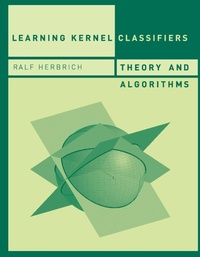
Learning Kernel Classifiers
Theory and Algorithms
Published on 1. November 2022
Book
Paperback/Softback
384 pages
978-0-262-54659-1 (ISBN)
Description
An overview of the theory and application of kernel classification methods.
Linear classifiers in kernel spaces have emerged as a major topic within the field of machine learning. The kernel technique takes the linear classifier—a limited, but well-established and comprehensively studied model—and extends its applicability to a wide range of nonlinear pattern-recognition tasks such as natural language processing, machine vision, and biological sequence analysis. This book provides the first comprehensive overview of both the theory and algorithms of kernel classifiers, including the most recent developments. It begins by describing the major algorithmic advances: kernel perceptron learning, kernel Fisher discriminants, support vector machines, relevance vector machines, Gaussian processes, and Bayes point machines. Then follows a detailed introduction to learning theory, including VC and PAC-Bayesian theory, data-dependent structural risk minimization, and compression bounds. Throughout, the book emphasizes the interaction between theory and algorithms: how learning algorithms work and why. The book includes many examples, complete pseudo code of the algorithms presented, and an extensive source code library.
Linear classifiers in kernel spaces have emerged as a major topic within the field of machine learning. The kernel technique takes the linear classifier—a limited, but well-established and comprehensively studied model—and extends its applicability to a wide range of nonlinear pattern-recognition tasks such as natural language processing, machine vision, and biological sequence analysis. This book provides the first comprehensive overview of both the theory and algorithms of kernel classifiers, including the most recent developments. It begins by describing the major algorithmic advances: kernel perceptron learning, kernel Fisher discriminants, support vector machines, relevance vector machines, Gaussian processes, and Bayes point machines. Then follows a detailed introduction to learning theory, including VC and PAC-Bayesian theory, data-dependent structural risk minimization, and compression bounds. Throughout, the book emphasizes the interaction between theory and algorithms: how learning algorithms work and why. The book includes many examples, complete pseudo code of the algorithms presented, and an extensive source code library.
More details
Series
Language
English
Place of publication
Cambridge (Massachusetts)
United States
Publishing group
MIT Press Ltd
Target group
Professional and scholarly
Interest Age: From 18 years
Product notice
Paperback (trade)
Dimensions
Height: 229 mm
Width: 178 mm
Thickness: 22 mm
Weight
663 gr
ISBN-13
978-0-262-54659-1 (9780262546591)
Copyright in bibliographic data and cover images is held by Nielsen Book Services Limited or by the publishers or by their respective licensors: all rights reserved.
Schweitzer Classification
Person
Ralf Herbrich