

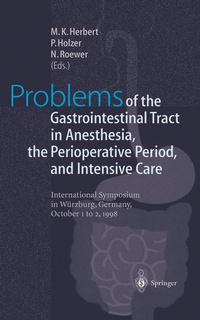
Problems of the Gastrointestinal Tract in Anesthesia, the Perioperative Period, and Intensive Care
International Symposium in Würzburg, Germany, 1-3 October 1998
Published on 18. September 2011
Book
Paperback/Softback
XII, 371 pages
978-3-642-64301-9 (ISBN)
Description
After a long period of neglect, the gastrointestinal tract is increasingly being recog nized as an important target of anesthetics and anesthesia-related processes, as well as of conditions and treatments related to peri- and postoperative period and inten sive care. Drugs used in anesthesia and intensive care and physiological or pathologi cal changes in the perioperative period affect the digestive system in its function from the pharynx to the colon. Prolonged postoperative ileus or stasis of propulsive peri stalsis in the critically ill or multiply injured patient may impair enteral nutrition and give rise to complications such as sepsis or multiple organ failure. In view of this new understanding of the clinical relevance of gut function, we felt that a book on problems of the gastrointestinal tract in anesthesia, the perioperative period, and intensive care was badly needed. The present volume is the product of an international symposium which brought together physiologists, pharmacologists, experimental and clinical anesthetists, gastroenterologists, surgeons, and intensive care physicians to discuss all major contemporary aspects of bowel function in health and under the influence of anesthesia, surgery, and intensive care.
More details
Edition
Softcover reprint of the original 1st ed. 1999
Language
English
Place of publication
Berlin
Germany
Publishing group
Springer Berlin
Target group
Professional and scholarly
Professional/practitioner
Illustrations
XII, 371 p.
Dimensions
Height: 235 mm
Width: 155 mm
Thickness: 21 mm
Weight
587 gr
ISBN-13
978-3-642-64301-9 (9783642643019)
DOI
10.1007/978-3-642-60200-9
Schweitzer Classification
Other editions
Additional editions
M.K. Herbert | P. Holzer | N. Roewer
Problems of the Gastrointestinal Tract in Anesthesia, the Perioperative Period, and Intensive Care
International Symposium in Würzburg, Germany, 1-3 October 1998
Book
10/1999
Springer
€85.55
Article exhausted; check different version
Content
I Gastrointestinal Motility.- Properties and Functional Aspects of the Enteric Nervous System.- Pharmacotherapy of Gastrointestinal Motor Disorders.- Effect of Interleukin-lß on Cholinergic Contractions in the Gastrointestinal Tract of the Rat.- Impairment of Intestinal Motility in the Critically Ill Patient.Clinical Implications and Contribution of Drugs and Mediators.- Potential of Motilides in the Treatment of Hypomotility Syndromes.- The Pathogenesis of Postoperative Ileus in the Rat: Role of Nitric Oxide, Vasoactive Intestinal Polypeptide and ?-Opioid Receptors.- What Dose of Neostigmine is Effective for the Treatment of Postoperative Colonic Ileus? Lessons from Colonic Motility Studies.- Small Bowel Transit Time in Intensive Care Unit Patients: Effect of Cisapride and Erythromycin.- Guided Placement of Nasojejunal Feeding Tubes Using Erythromycin and Fluoroscopy in Intensive Care Unit Patients.- High-dose Catecholamines Diminish the Effect of Erythromycin on Antral Motility and Gastric Emptying in Intensive Care Unit Patients.- II Dysfunction of the Gastrointestinal Tract in Shock, Sepsis and Critical Illness.- Gastrointestinal Secretion, Absorption and Barrier Function.- The Human Intestinal Microflora: Physiology and Pathophysiology.- Clinical Strategies for Prevention of Bacterial Translocation.- Reduction of Perioperative Endotoxin Leakage from the Gastrointestinal Tract by Enteral Application of Immunoglobulin-Enriched Colostral Milk Preparation.- Bacterial Translocation and Endotoxemia During Aseptic Surgery.- Antiendotoxin Antibody Production of Mononuclear Cells in Multiply Injured Patients.- Multivariate Analysis of Parameters Predicting Lethal Outcome in a Porcine Model of Abdominal Sepsis.- Gastric Mucosal Tonometry.- Continuous Mucosal PC02Monitoring of the Gastrointestinal Tract.- The Potential of Tissue Lightguide Spectrophotometry for Monitoring Gastric Mucosal Oxygenation During Mechanical Ventilation.- III Nutritional Aspects.- The Colon as a Metabolically Active Organ: Implications for the Composition of Enteral Formula Diets.- Early Enteral Nutrition Influences Immunological Response of Lymphocyte Subsets After Polytrauma.- Glutamine-supplemented Parenteral Nutrition.- IV. Perioperative Dysfunction of the Gastrointestinal Tract.- Perioperative Motility of the Foregut.- Electrogastrography During the Early Postoperative Period.- Therapeutic Interventions for Improvement of Impaired Intestinal Blood Flow.- Influence of Dopexamine on Splanchnic Perfusion During Cardiac Surgery.- Postoperative Intestinal Ischemia in Cardiac Surgical Patients.- Gastrointestinal Complications After Cardiopulmonary Bypass.- The "Laparoscopic Window": A New Laparoscopic Bedside Technique for Second Look Intervention.- V Postoperative Nausea and Vomiting.- Postoperative Nausea and Vomiting.- Prediction of Postoperative Nausea and Vomiting Using Clinical Risk Factors.- Logistical Regression Analysis of Factors Causing Postoperative Nausea or Vomiting During Different Postoperative Time Periods.- Postoperative Nausea and Vomiting After Laparoscopy in Gynecology.- Prophylaxis and Therapy of Postoperative Nausea and Vomiting.- VI Update - Gastric, Duodenal, and Stress Ulcer, Etiology, Pathophysiology, Treatment.- Gastric Acid Backdiffusion and Neuronal Emergency System.- Intensive Care Pharmacotherapy: Stress Ulcer Prophylaxis and Mucosecretolysis.- Pneumonia Prophylaxis Under Ulcer Therapy.