

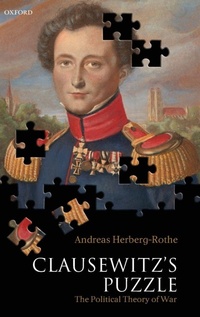
Clausewitz's Puzzle
The Political Theory of War
Published on 15. March 2007
Book
Hardback
202 pages
978-0-19-920269-0 (ISBN)
Description
Blending detailed contextual analysis with issues in modern-day international relations this book provides a major new analysis of the theory of Clausewitz and its relevance to contemporary society.
This book argues that Clausewitz developed a wide-ranging political theory of war by reflecting on the success, the limitations, and the failure of Napoleon's method of waging war, a theory, which is still relevant in light of contemporary conflict. This new interpretation is the result of reflecting on Clausewitz's theory in light of the new developments and lays down the foundation of a general theory of war by concentrating on Clausewitz's historical analyses of war campaigns.
For the first time analysis of three paradigmatic military campaigns is placed at the centre of understanding surrounding Clausewitz's 'On War': The author argues that the limitations of Napoleon's strategy, as revealed in Russia and in his final defeat, enabled Clausewitz to develop a general theory of war.
This book is a project of the Oxford Leverhulme Programme on the Changing Character of War.
This book argues that Clausewitz developed a wide-ranging political theory of war by reflecting on the success, the limitations, and the failure of Napoleon's method of waging war, a theory, which is still relevant in light of contemporary conflict. This new interpretation is the result of reflecting on Clausewitz's theory in light of the new developments and lays down the foundation of a general theory of war by concentrating on Clausewitz's historical analyses of war campaigns.
For the first time analysis of three paradigmatic military campaigns is placed at the centre of understanding surrounding Clausewitz's 'On War': The author argues that the limitations of Napoleon's strategy, as revealed in Russia and in his final defeat, enabled Clausewitz to develop a general theory of war.
This book is a project of the Oxford Leverhulme Programme on the Changing Character of War.
Reviews / Votes
'For those who have a strong interest in and a deep understanding of Clausewitz's theory, this book is stimulating, thought-provoking and valuable.' * Bill Bentley, Canadian Military Journal * 'Clausewitz's Puzzle will undoubtedly generate more healthy debate throughout military and security communities. It would also make an excellent text at War Colleges and post-graduate courses in international relations, security studies, military history, even philosophy.' * Bill Bentley, Canadian Military Journal * Both slender volumes (that of Echevarria and Herberg-Rothe) are weighty and incisive contributions to our understanding of the dead Prussian's work, who like none other continues to form our own thinking of war * RUSI, Dec 2007, Vol. 152, No. 6 *More details
Language
English
Place of publication
Oxford
United Kingdom
Target group
College/higher education
Professional and scholarly
Dimensions
Height: 240 mm
Width: 161 mm
Thickness: 16 mm
Weight
473 gr
ISBN-13
978-0-19-920269-0 (9780199202690)
Copyright in bibliographic data and cover images is held by Nielsen Book Services Limited or by the publishers or by their respective licensors: all rights reserved.
Schweitzer Classification
Other editions
Additional editions
E-Book
03/2007
OUP eBook
€76.49
Available for download
Person
Andreas Herberg-Rothe, Dr. phil. habil., Private Lecturer at the Institute for Social Sciences (since 2001), Humboldt University Berlin; Visiting fellow at London School of Economics and Political Science (2005-2006), Associate of the Oxford Leverhulme Programme 'The changing character of war' (2004-2005); Post doctoral thesis: 'Enigma Clausewitz' (Expert witnesses: Bredow, Muenkler, Paret) at Humboldt University (2000).
Content
PART I PROLOGUE ; PART II ANTI-THESES AND AMBIVALENCES ; 1. Clausewitz and Napoleon: Jena, Moscow, and Waterloo ; 2. Violence, Fear, and Power: The Expansion and Limitation of War ; 3. Concepts of Absolute and real War ; PART III USING CLAUSEWITZ TO GO BEYOND CLAUSEWITZ ; 4. Clausewitz's legacy: the Trinity ; 5. Polarity and Asymmetry Between Attack and Defence ; 6. The Formula: Politics in War